


Common fingerprinting mistakes that lead to rejected international background checks include writing your name in the wrong order on the card choosing the wrong purpose code for why you're being fingerprinted, using a card format the destination country doesn't accept, and not accounting for worn or dry skin ridges before the appointment. Working with a trained provider like Globeia, which uses the correct country-specific cards and runs on-site quality checks, helps avoid most of these issues before the card is even submitted.
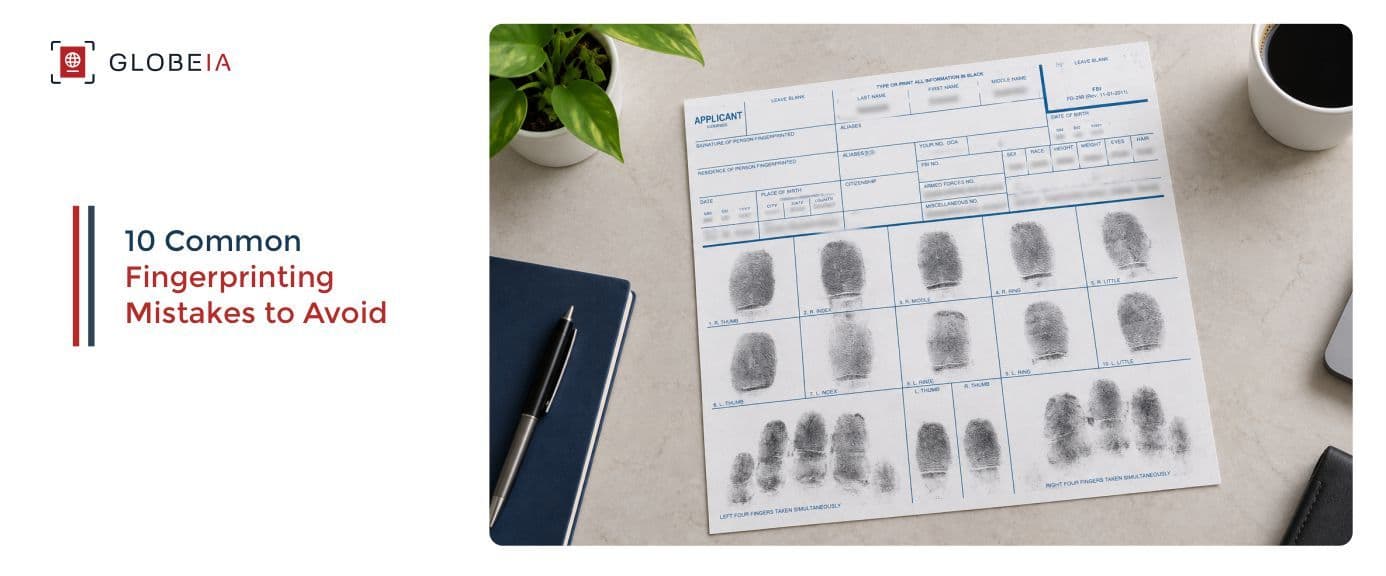
Fingerprinting is a vital step for immigration, police clearance, licensing, employment, FBI background checks, RCMP criminal record checks and other official processes. But even a seemingly “clean” fingerprint card can be rejected by international authorities, due to technical errors or form issues.
Most pieces only cover the obvious mistakes, like using the wrong ink or a smudged print. Those matter, but they are not the ones that cause issues for international applicants the most. Below are ten fingerprinting mistakes we see again and again at Globeia, along with simple ways to avoid each one.
This is one of the most common fingerprinting mistakes for applicants from countries where the family name comes first. On US fingerprint cards, the format is strictly Last Name, First Name, Middle Name. If you write your name the way it appears in daily life back home, it may not match your passport order at all.
The main problem is that this mismatch does not always get caught at the fingerprinting stage. It usually shows up later, when your background check result does not match the name on your passport or visa application, and the receiving country asks questions.
How to avoid this: You should always copy your name exactly as it appears on your passport, in the Last, First, Middle order the card asks for. Do not translate or reorder your name to "make sense" in English. And, if your passport has only one name, ask your fingerprinting provider how to fill that field correctly.
Every fingerprint card has a field asking why you are being printed, sometimes called the "reason fingerprinted" or "purpose" field. This is not a formality. It tells the international authorities, and later the receiving country, what kind of check this is, and it affects which result letter you get back.
Applicants tend to pick "Employment" or "Other" when their actual purpose is a visa, immigration, adoption, or licensing case. The issuing authorities for international background checks, like the FBI, may still process the card. But the resulting report can be the wrong type for what your destination country actually asked for.
How to avoid this: Always confirm the exact purpose your requesting country or agency wants before your appointment and match the wording on the card to that purpose. If you are unsure, ask your provider to confirm the correct reason code before you sign.
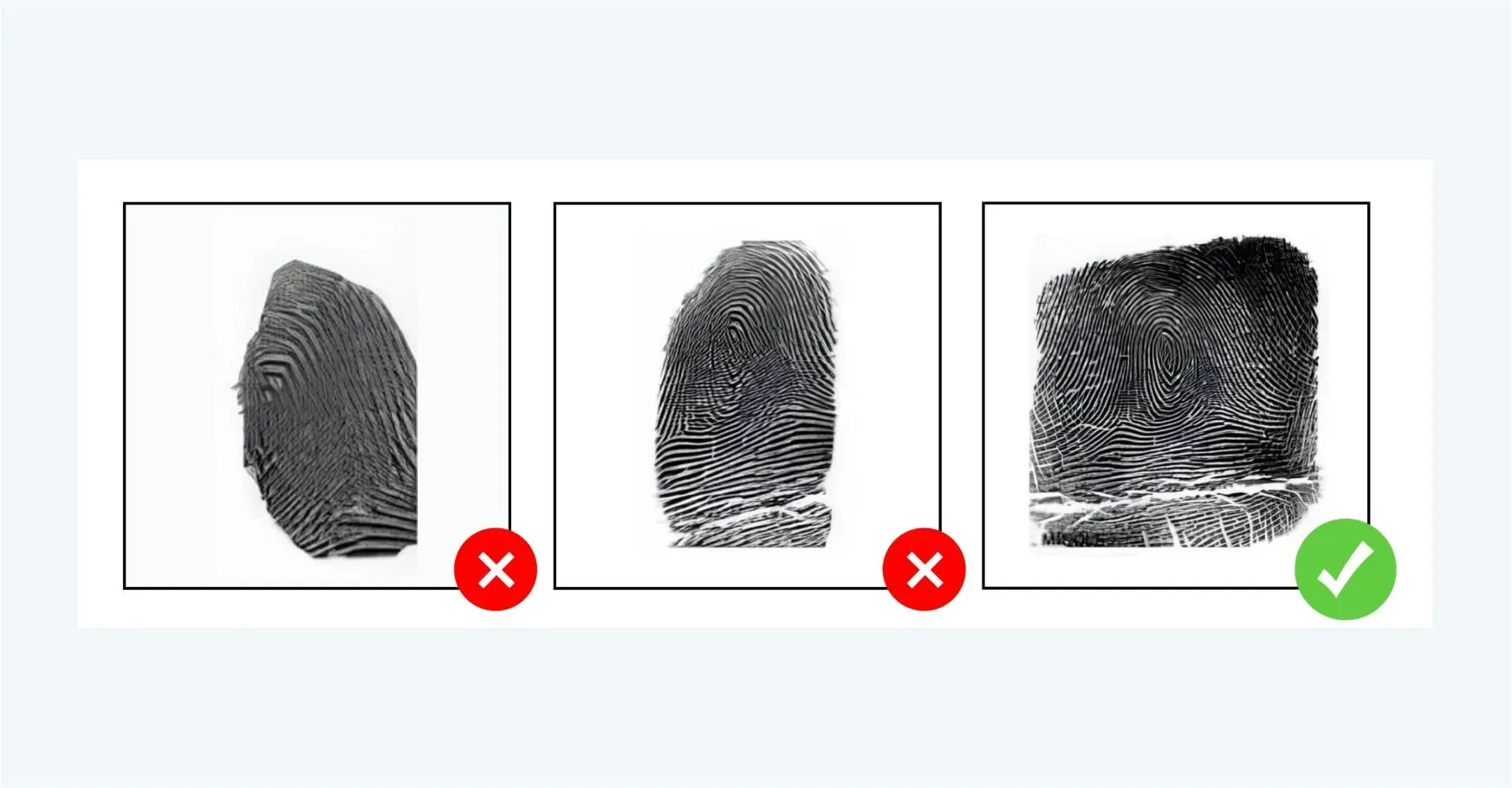
Not every country and agency wants the same thing. Some accept a FD-258 ink card. Others want C-216C or equivalent formats. Sending the wrong format wastes an entire appointment. You only find out once the receiving office rejects it, and by then you have lost days or weeks.
How to avoid this: Check with the embassy, consulate, or agency asking for your background check before you book anything. Either confirm the requirement from them or conduct a thorough independent research. Keep that confirmation in writing so your fingerprinting provider can follow it exactly.
Some of the common formats most international applicants run into:
| Format | Common Requirement By |
| FD-258 or FD-1164 | FBI (Identity History Summary) |
| C-216C | RCMP (Criminal Record Check) |
| COC Fingerprint Form | Singapore (Certificate of Clearance) |
| SAPS 91a | South Africa (Police Clearance Certificate) |
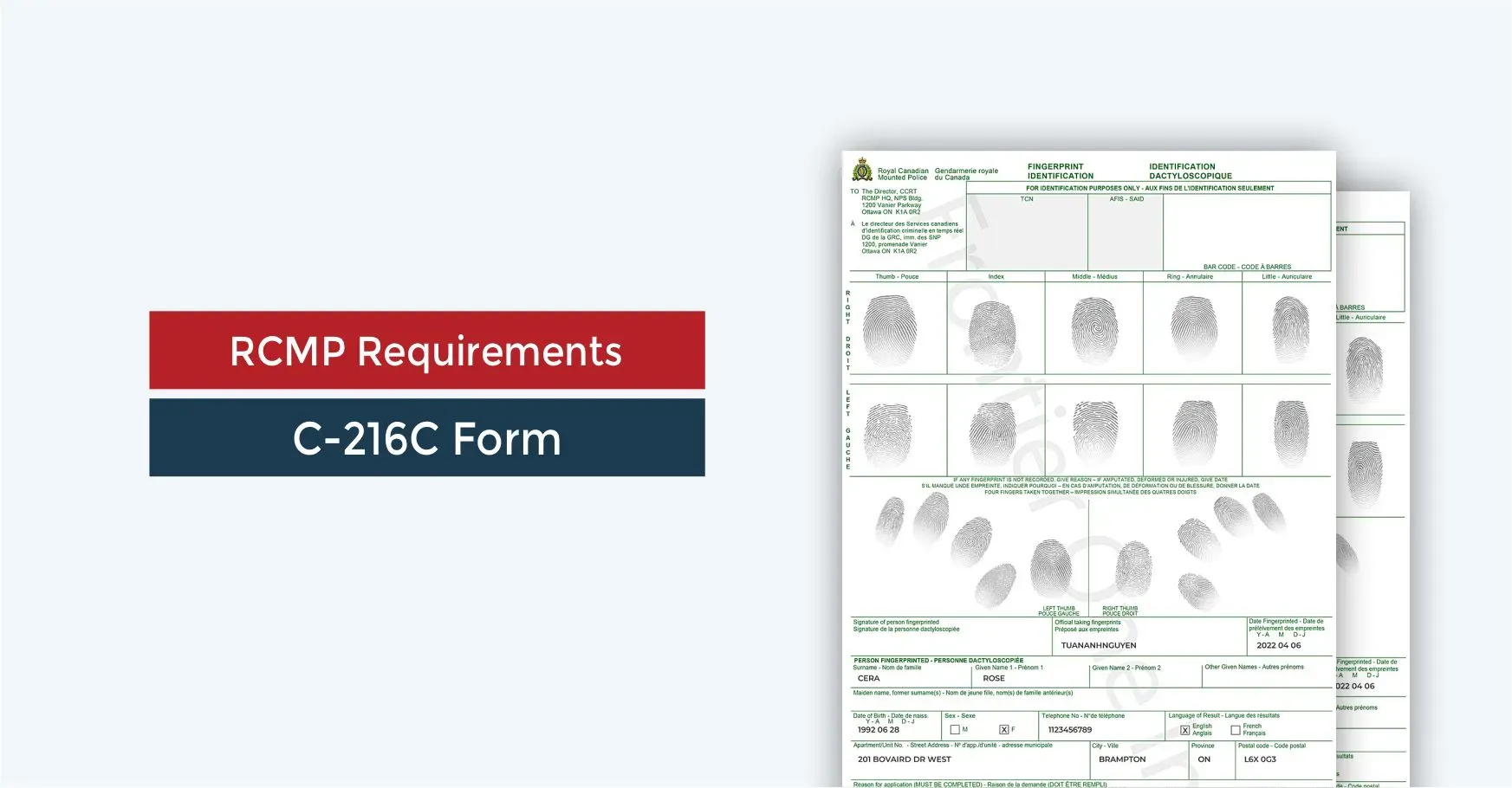
Ridge detail fades with age, manual labor, frequent hand washing, or skin conditions like eczema. If you work with your hands, or you are simply applying later in life, your natural ridges may already be lighter than the fingerprint scanners prefer. This is different from a technician error. It is about your skin on the day of the appointment.
People usually do not think about this until their card comes back rejected for "insufficient ridge detail," a phrase that has nothing to do with how carefully the card was filled out.
How to avoid this:
Each box on the card is meant for a specific finger, rolled a specific way, nail to nail, in one smooth motion. Rolling the wrong finger into the wrong box, or rolling from the wrong side, creates confusion that can cause a rejection even when the print itself looks clear.
This is one area where a simple visual reference helps more than a paragraph of instructions. Below is the standard rolling sequence used on a ten print card:
RIGHT HAND (rolled impressions)
Thumb --> Index --> Middle --> Ring --> Little
LEFT HAND (rolled impressions)
Thumb --> Index --> Middle --> Ring --> Little
FLAT IMPRESSIONS (taken last)
Left four fingers together --> Right four fingers together --> Both thumbs together
How to avoid this: Let a trained technician handle the rolling. This is not a step to do yourself at home. You just need to stay relaxed and let your finger rotate naturally instead of pressing down hard, which is what causes ghosting or doubled lines.
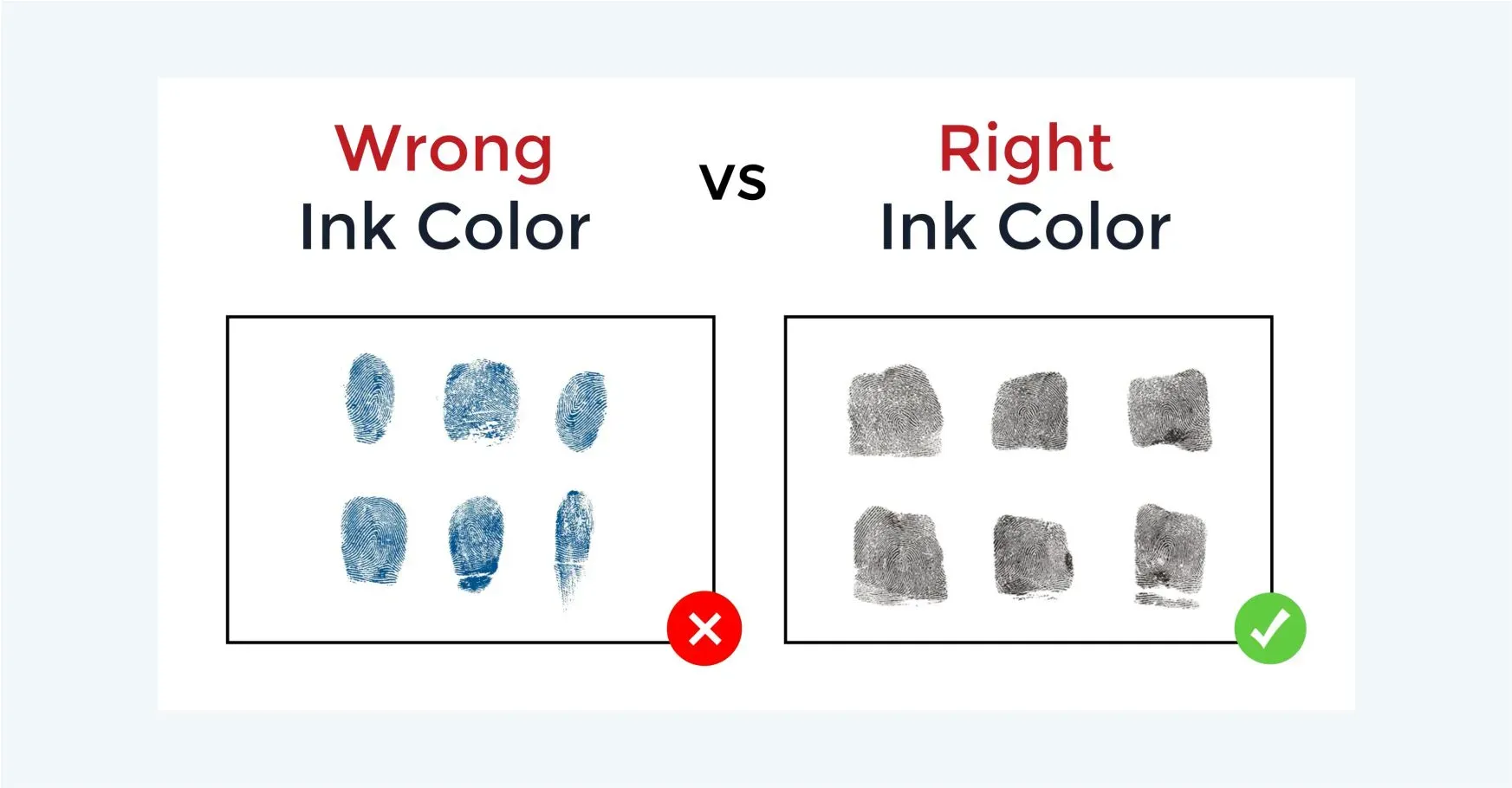
This one is well known, but it is worth mentioning because it is still the single biggest reason cards get rejected. Only professional grade black ink is accepted for the vast majority of checks, including FBI and RCMP submissions. Blue, coloured, or low quality ink can get a card rejected outright, no matter how clean the roll looks.
On top of that, too much ink causes smudging, too little causes faint or unreadable ridges, and movement during the roll causes streaking.
How to avoid this: Work with a trained and experienced technician who uses proper fingerprint ink pads, not a regular office stamp pad. If a print looks off right after rolling, ask to redo that finger immediately rather than waiting to find out later.
Your fingerprint card needs a signature and date. And for international cases, this signature often needs to match the one on your passport, your application form, and sometimes a notarized document later in the process. A casual signature that does not resemble your usual one can raise questions during review.
How to avoid this: Sign the card the same way you sign your passport or official ID. Keep a copy of the signed card for your own records in case a later document needs to match it.
Fingerprinting is only the first step. Once your background check comes back, most countries also need it authenticated, either through an apostille or through embassy legalization, before it means anything abroad. Applicants usually treat fingerprinting and authentication as two separate, unrelated tasks, which leads to wasted time.
A background check sent to the wrong authenticating office, for example a state office instead of the federal one, will simply be sent back.
How to avoid this: Find out early whether your destination country is part of the Hague Apostille Convention or requires embassy legalization instead. Then, plan your fingerprinting appointment and your authentication request as one connected process, not two separate errands.
If your legal name is originally written in a script other than the Latin alphabet, such as Arabic, Chinese, Cyrillic, or Devanagari, the Latin spelling used on your fingerprint card needs to exactly match your passport's official transliteration. Even small spelling differences, an extra letter or a different vowel, can cause problems when the receiving country cross checks your background check against your visa or residency application.
How to avoid this: You need to use the exact spelling printed on your passport's machine readable zone, not a version you are used to writing casually. Just avoid using nicknames or shortened versions of your name anywhere on official paperwork. If your passport has recently been renewed with a different transliteration, use the current version consistently across every document.
A rushed appointment is where most of the mistakes above tend to happen at once. An untrained or hurried technician may roll fingers too quickly, apply uneven ink, skip a quality check, or misread the purpose field. For a domestic background check, a redo is a minor inconvenience. For an international case involving apostille, translation, and courier time, a single rejection can add weeks.
How to avoid this:
Every one of these mistakes is avoidable, and most of them have nothing to do with luck. They come down to preparation, a provider who understands international cases, and double checking the small details before you sign anything.
At Globeia, this is the part of the process we focus on daily. Matching the right card format and authentication path to each country's actual requirements, so applicants do not lose time to an avoidable rejection.This is what you get with Globeia’s doorstep fingerprinting services:
Highly Trained Associates
Our associates are trained and experienced with international submission standards. They know the requirements of international law enforcement agencies like the FBI and RCMP, and they follow them closely on every appointment. They also carry out on site quality checks with diligence, so your fingerprints meet the accuracy level these agencies expect the first time around.
Country-Specific Official Fingerprint Card Availability
We always keep a stock of official, country relevant forms on hand. This includes the FD-258 or FD-1164 for FBI background checks, and the C-216C for RCMP criminal record checks. Our fingerprinting services support background checks not only from the USA and Canada, but also Australia, the UK, Hong Kong, Singapore, the Gulf countries, the UAE, Bahrain, the Philippines, and more. Whatever country you are applying to, we guide you on its specific card and process requirements.
Automated Pre-Verification of Details
When your application is ready to go to international authorities, our automated SmartPortal checks and cross verifies all your details against your submitted documents and information. This is faster and more reliable than a manual review. Your information is checked side by side with your documents, and any errors are caught and resolved before your application reaches the right authority.
Apostille, Legalization, and Translation Add Ons
If your background check needs further authentication, whether that is apostille, legalization, or translation, you can add these services on. You can choose them as standalone services, or bundle them with your fingerprinting appointment. Either way, we coordinate the entire process as a single workflow, so it takes minimum effort on your part.
Read 50 Common Questions About Globeia’s Fingerprinting Services in India
Avoiding fingerprinting mistakes isn’t just about saving time , it’s about ensuring your application moves forward without costly delays or rejections. Whether you’re applying for a visa, immigration, or professional licensing, the smallest error can lead to big setbacks.
At Globeia, we use professional fingerprinting and expert guidance to make sure you don’t fall into the trap of common fingerprinting mistakes. With our mobile service across India, we bring accuracy and complete peace of mind right to your doorstep.