

By Ayushi Trivedi · Updated May 29, 2026
Spain is no longer just a holiday postcard for Indians. It is quietly becoming one of the most liveable, and legally accessible countries in the world for Indian professionals, families, freelancers, and investors looking to build a life in Europe. But moving to Spain from India is not a simple Google search away. Between navigating visa categories, apostilling Indian documents, understanding how your Indian PF and mutual funds are treated under Spanish tax law, finding the right city, and knowing what the Indian community actually looks like on the ground- the process demands a guide that speaks your language, understands your starting point, and gives you updated facts.
That is exactly what this updated 2026 guide does. Whether you are a software engineer exploring the Spain Digital Nomad Visa, a family planning a long-term move, a student considering Spanish universities, or someone on the path to permanent residency and eventually a Spanish passport, this is the most complete, India-specific, legally updated resource available covering every visa option, real costs, taxes, healthcare, schooling, and the full roadmap from your first visa to citizenship.
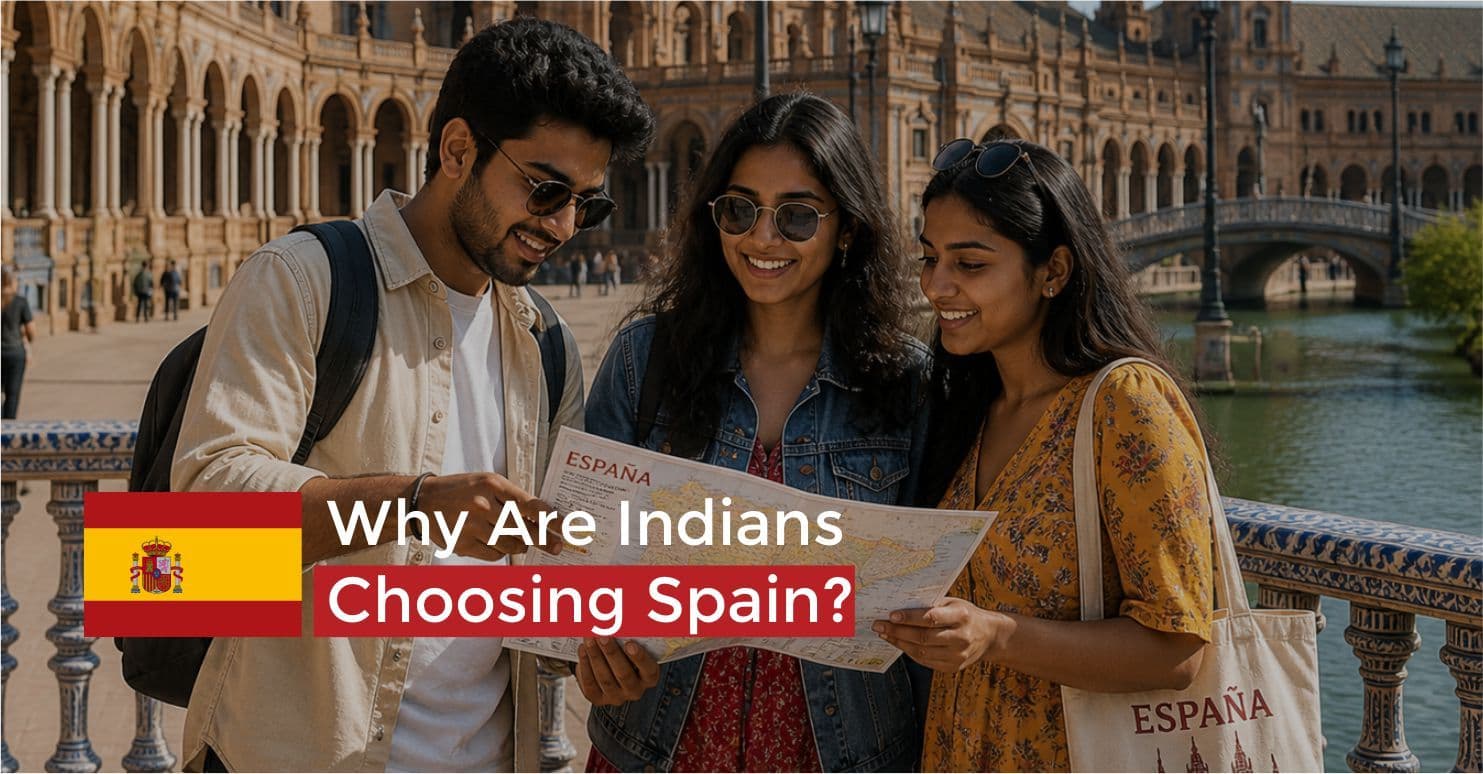
For decades, the default European dream for Indians meant the United Kingdom, Germany, or the Netherlands. Spain barely registered. It was seen as a country with high unemployment, a language barrier, and limited career opportunity for Indian professionals. That perception is now outdated, and the numbers quietly confirm it.
According to Spain's National Statistics Institute (INE), the Indian-origin population in Spain has been growing steadily year-on-year, concentrated in Madrid, Barcelona, Valencia, and increasingly in mid-sized cities like Malaga and Alicante. The profile of Indians arriving has also shifted from primarily traders and restaurateurs to IT professionals, remote workers, MBA graduates, healthcare workers, and entire families making long-term lifestyle decisions.
For Indian professionals and families, the United Kingdom was the automatic first choice for decades- shared language, established Indian community, familiar institutions. Post-Brexit, that equation fractured. The UK's immigration costs rose sharply, the Skilled Worker visa income thresholds were raised, and the path to settlement became longer and more expensive. Meanwhile, Spain being a full EU member, offers something the UK no longer can- once you have Spanish long-term residency or citizenship, you have the legal right to live and work across 29 European countries. That is a fundamentally different level of mobility, and Indians are noticing.
In 2023, Spain passed the Ley de Startups (Startup Act), one of the most progressive pieces of innovation legislation in Europe. This led to the creation of the Spain Digital Nomad Visa- a dedicated legal route for remote workers and digital freelancers to live in Spain while working for clients or employers based outside Spain. As of 2025, this visa is fully operational and has become the single most popular entry route for Indian IT professionals, designers, consultants, and remote-first workers making the move to Spain.
One of the reasons Indians are choosing Spain over Germany, France, or the Netherlands is the ratio of quality of life to cost. Spain consistently ranks among the top countries globally for healthcare quality, life expectancy, food quality, climate, and work-life balance while its cost of living remains lower than London, Amsterdam, or Munich.
For an Indian family relocating from a Tier-1 Indian city, the lifestyle upgrade is substantial without the financial shock of a London or Zurich relocation. A spacious apartment in Valencia or Seville costs a fraction of what an equivalent flat would in Berlin or Paris. Mediterranean food culture, while different from Indian cuisine, is vegetarian-friendly in a way that Northern Europe often is not. Spain's produce markets and strong vegetable culture make dietary adaptation far easier for Indian families than many expect.
Spain's economy is the fourth largest in the Eurozone and the sectors where Indian professionals are finding opportunities include:
One of the most common concerns Indians have about Spain, compared to the UK, Canada, or Australia, is the language. Spanish is essential for long-term life in Spain and this is not a country where English alone carries you through indefinitely.
In Madrid and Barcelona, English is widely spoken in professional and business settings, and you will manage in the short term. But for healthcare, dealing with bureaucracy, making friends outside the expat bubble, understanding your lease, or navigating your child's school - Spanish becomes necessary within the first year. Spanish is considered one of the easiest languages for English speakers to learn, language schools are affordable and excellent in Spain, and the immersive environment means most people become conversational within 12-18 months of consistent effort. For citizenship, a minimum DELE A2 Spanish language certificate is required, which most people achieve comfortably within two years of living in Spain.
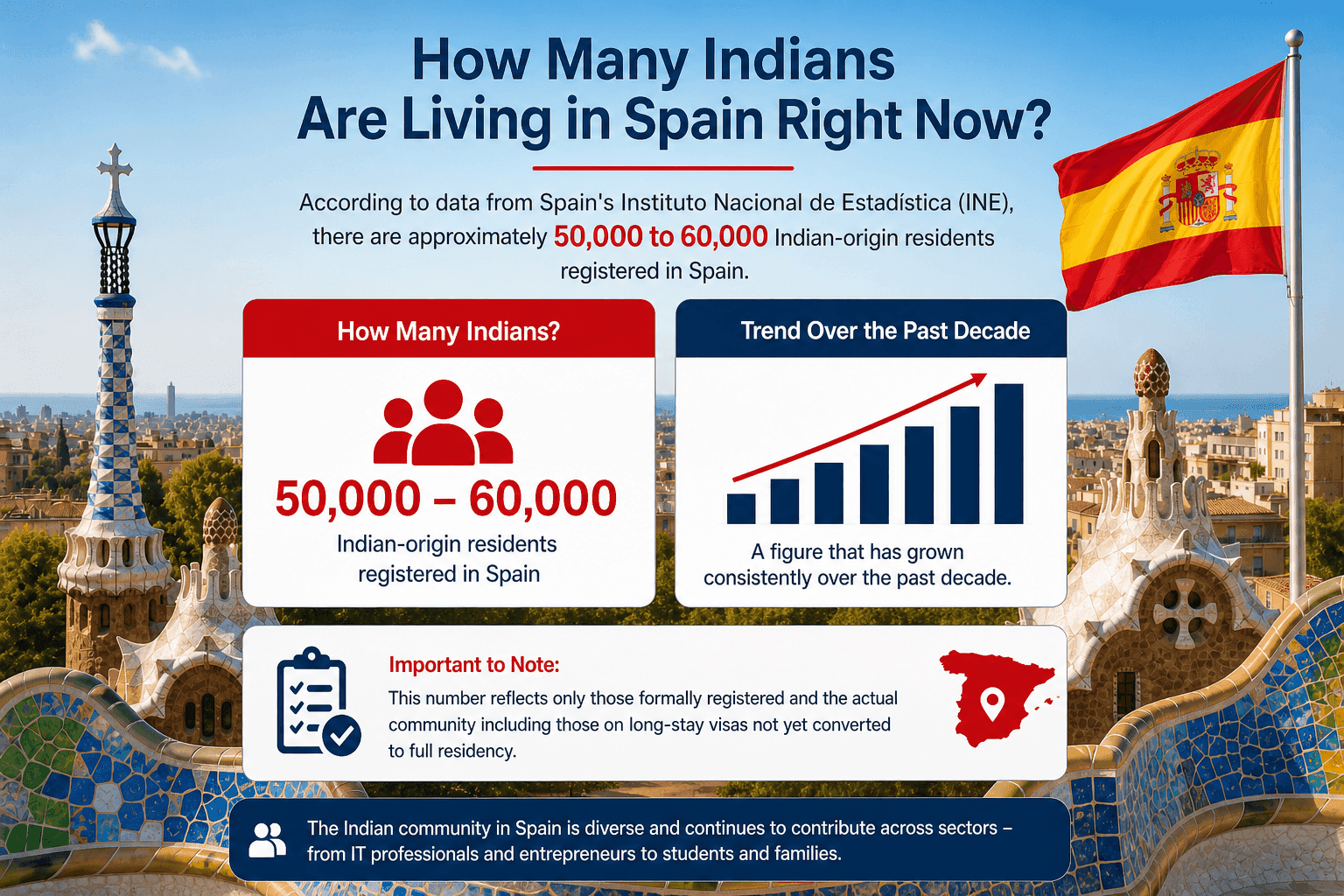
According to data from Spain's Instituto Nacional de Estadística (INE), there are approximately 50,000 to 60,000 Indian-origin residents registered in Spain, a figure that has grown consistently over the past decade. This number reflects only those formally registered and the actual community including those on long-stay visas not yet converted to full residency.
Where are Indians in Spain concentrated?
The profile has shifted meaningfully in the last five years. The earlier wave was dominated by traders, restaurant owners, and textile businesses who were Gujarati and Sindhi communities. The current wave is predominantly IT professionals, MBA graduates, healthcare workers, and remote-first entrepreneurs, with a growing number of entire families making permanent lifestyle relocations rather than temporary work postings. Indian students are also a rising segment, with Spain's affordable and internationally recognised universities attracting applicants who previously defaulted to the UK or Australia.
There are Hindu temples, Gurudwaras, Indian grocery stores, and active community associations in Madrid and Barcelona, with smaller community infrastructure developing in Valencia and Malaga. Diwali and Holi events are publicly celebrated in major cities. The community is young, educated, and still in the process of building the kind of deep institutional roots that Indian communities have in London or Toronto which also means it is a community you can shape and contribute to, not just join.
Before learning about individual visa categories, it's important to understand how Spain's immigration system is actually structured.
A Spanish visa is issued by the Spanish consulate in India and allows you to enter Spain. For stays under 90 days, Indians can enter Spain (and the broader Schengen Area) visa-free for tourism or short business visits. For stays longer than 90 days you need a long-stay visa , which you apply for from India before travelling.
Once you arrive in Spain on a long-stay visa, you then apply within the country for your TIE (Tarjeta de Identidad de Extranjero), your physical residency card. The visa gets you in but the TIE is what makes you a legal resident. This two-step process confuses many first-time applicants.
Your NIE (Numero de Identidad de Extranjero) is simply a tax identification number assigned to all foreigners in Spain. You need it to open a bank account, sign a lease, buy a car, or do almost anything administrative. Your TIE is your residency card. You will need both, and they are obtained through different processes.
Spain's immigration framework broadly has three levels:
Most people moving to Spain are aiming for the long-stay visa that converts into a renewable residency permit.
Each category has different income requirements, work authorisation rules, renewal timelines, and paths to permanent residency. Choosing the wrong one, for example, taking a Non-Lucrative Visa when you plan to work can result in visa violations, fines, and in serious cases, deportation.
What makes this important for Indians is that the application happens before you leave India, at the Spanish consulate. Unlike some countries where you can switch visa categories from within the country, Spain requires you to return to your home country and reapply if you have chosen the wrong route. This means a wrong decision does not just cost you money, it can cost you months of your life and force an unplanned return trip. Beyond that, certain visa categories have a direct impact on how quickly you can access permanent residency, whether your spouse can work, and whether you qualify for tax benefits like the Beckham Law. Two people arriving in Spain in the same month, both Indian nationals, can have different financial and legal outcomes five years later and this is purely based on which visa category they chose at the start.
The actual process of moving to Spain from India involves a sequence of steps that must happen in the right order. If you submit documents in the wrong sequence, miss an apostille, or skip your empadronamiento in the first week then you delay your entire residency timeline by months.
Before you start collecting paperwork, few decisions need to be made that will shape everything that follows.
Decide your visa category with certainty.
Your visa category determines which documents you need, which consulate process you follow, and what your life looks like in Spain for the next several years. Changing your mind after submitting an application is not a minor inconvenience, it means starting over.
Decide which city you are moving to.
This matters more than it sounds at the bureaucratic level. Spain's immigration system is regionally administered. Your work permit (if applicable) is tied to the province where you will work. Your empadronamiento (municipal registration) is done in the specific municipality where you live. Your TIE application is filed at the Foreigners' Office or National Police station in your province. Knowing your destination city lets you research the specific local process and timelines.
Find a reputable Spanish immigration lawyer early.
This is not mandatory but advisory, professional legal support reduces the risk of rejection. Even for the DNV, a lawyer can review your document package before submission. Many Indian expat communities in Spain have recommendations for lawyers who are experienced with Indian applicants specifically.
This is where the process actually begins in India.
An apostille is an internationally recognised certificate that authenticates the origin of a public document. Spain is a signatory to the 1961 Hague Apostille Convention, as is India. What this means is any Indian government-issued document you submit to Spanish authorities must carry an apostille stamp from India's Ministry of External Affairs (MEA) to be considered legally valid in Spain. Without an apostille, your Indian documents are simply pieces of paper as far as Spanish immigration is concerned. This is non-negotiable.
Which Documents Need to Be Apostilled?
The exact list depends on your visa category, but the following are required across most visa applications:
Which documents do not need an apostille?
Documents like Bank statements, employment contracts, and company documents are generally not government-issued documents and do not require apostille, though they may require certified translation.
How to Get an Apostille in India?
The process has two stages for most documents:
Stage 1: State-level Attestation
Before the MEA can apostille a document, most documents must first be attested by the State Home Department or State Education Department in the state where the document was issued. For example, a birth certificate from Maharashtra, must be attested by Maharashtra's authorities before going to the MEA. This state-level step is where timelines vary most, some states process in 1-2 weeks, some take 4-6 weeks.
Stage 2: MEA Apostille
Once state-attested, documents go to the MEA for the apostille stamp. This takes 3 to 7 working days once the document is physically received. The MEA apostille is the final authentication that Spain will accept.
With your apostilled and translated documents ready, you now formally apply for your long-stay visa. For most Indian applicants, this process does not begin at the consulate door, it begins with BLS International.
BLS International- Your First Point of Contact
BLS International is the official outsourced visa application service provider authorised by the Spanish government to collect visa applications across India. This means that instead of submitting your application directly at the Spanish consulate, most applicants book their appointment through BLS, submit their documents at a BLS centre, pay their fees there, and have BLS forward the complete application to the Spanish consulate for processing and decision.
BLS has visa application centres in multiple Indian cities including Delhi, Mumbai, Bangalore, Chennai, Kolkata, Hyderabad, Ahmedabad, and others, making it more accessible than the two consulate locations alone. The appointment booking, document checklist guidance, and submission all happen through BLS. The consulate itself handles only the assessment and decision.
Important: Always use the official BLS Spain visa portal for India to book appointments, check current document requirements, and confirm BLS centre locations and fees before applying. BLS service fees are charged separately from the Spanish consulate visa fee and are non-refundable. Verify current details at the official BLS website before submitting anything.
Which Consulate Covers You?
While BLS handles the intake, your application is processed by one of the two consular offices in India authorised to assess and issue Spanish long-stay visas, determined by your permanent residential address in India.
Embassy of Spain in New Delhi- Consular Section
This covers Delhi NCR, Uttar Pradesh, Rajasthan, Punjab, Haryana, Himachal Pradesh, Uttarakhand, Jammu and Kashmir, Ladakh, Bihar, Jharkhand, Odisha, West Bengal, Assam, Sikkim, Arunachal Pradesh, Nagaland, Manipur, Meghalaya, Mizoram, Tripura, Chandigarh, Lakshadweep, Andaman and Nicobar Islands, and the countries of Bhutan, Maldives, Nepal, and Sri Lanka.
Consulate General of Spain in Mumbai
This covers Maharashtra, Goa, Gujarat, Karnataka, Kerala, Tamil Nadu, Andhra Pradesh, Telangana, Chhattisgarh, Madhya Pradesh, and Union Territories of Dadra and Nagar Haveli, Daman and Diu, and Puducherry.
Note for residents of Bangalore, Chennai, Kolkata, and surrounding states: India also has Honorary Consulates in Bangalore and Chennai, and a currently closed Honorary Consulate in Kolkata. Honorary Consulates cannot process visa applications for Indian nationals. Your application must go through BLS and will be processed by the Consulate General in Mumbai, which covers your jurisdiction.
How to Book Your Appointment?
Appointment slots through BLS for Spanish long-stay visas in Delhi and Mumbai jurisdictions, fill up weeks to months in advance. During peak periods, wait times can stretch to 8 to 14 weeks. Book your appointment through the BLS portal the moment you have decided on your visa category, even if your documents are not yet fully ready. You can continue preparing and apostilling documents while waiting for your appointment date.
What to Expect at the BLS Centre on Your Appointment Day?
On your appointment day, you attend the BLS centre - not the consulate, with your complete document package. BLS staff will check that all required documents are present, correctly apostilled, and translated where required. They will collect your biometric data. Once your submission is accepted, BLS forwards your application to the relevant consulate for assessment.
Common reasons for rejection or delay and how to avoid them:
While waiting for your visa, use the time to handle several practical matters that will make your first weeks in Spain smoother.
Arrange accommodation for arrival.
You need a confirmed address in Spain either a signed lease agreement or a confirmed booking for your visa application.
Inform your Indian bank.
Notify your Indian bank that you will be travelling to and residing in Spain, so international transactions on your debit and credit cards are not flagged and blocked. Also check your card's international transaction fees and withdrawal charges.
Transfer initial funds.
You will need money available in Spain from day one- for rent deposits, initial living costs, and bureaucratic fees. Services like Wise offer better exchange rates than bank wire transfers for sending money from India to Spain. Note that transfers from India are subject to RBI's Liberalised Remittance Scheme (LRS), which allows Indian residents to remit up to USD 250,000 per financial year for permitted purposes including travel, education, and maintenance of close relatives abroad.
Sort your health insurance.
If your visa category requires private health insurance, confirm your policy is active, covers Spain from your date of arrival, and that you have the policy documents accessible- both digitally and in print.
Download essential apps before leaving India.
Idealista or Fotocasa (housing), Google Translate with Spanish downloaded offline, Citymapper for public transport in Madrid or Barcelona, and WhatsApp groups for Indian expats in your destination city.
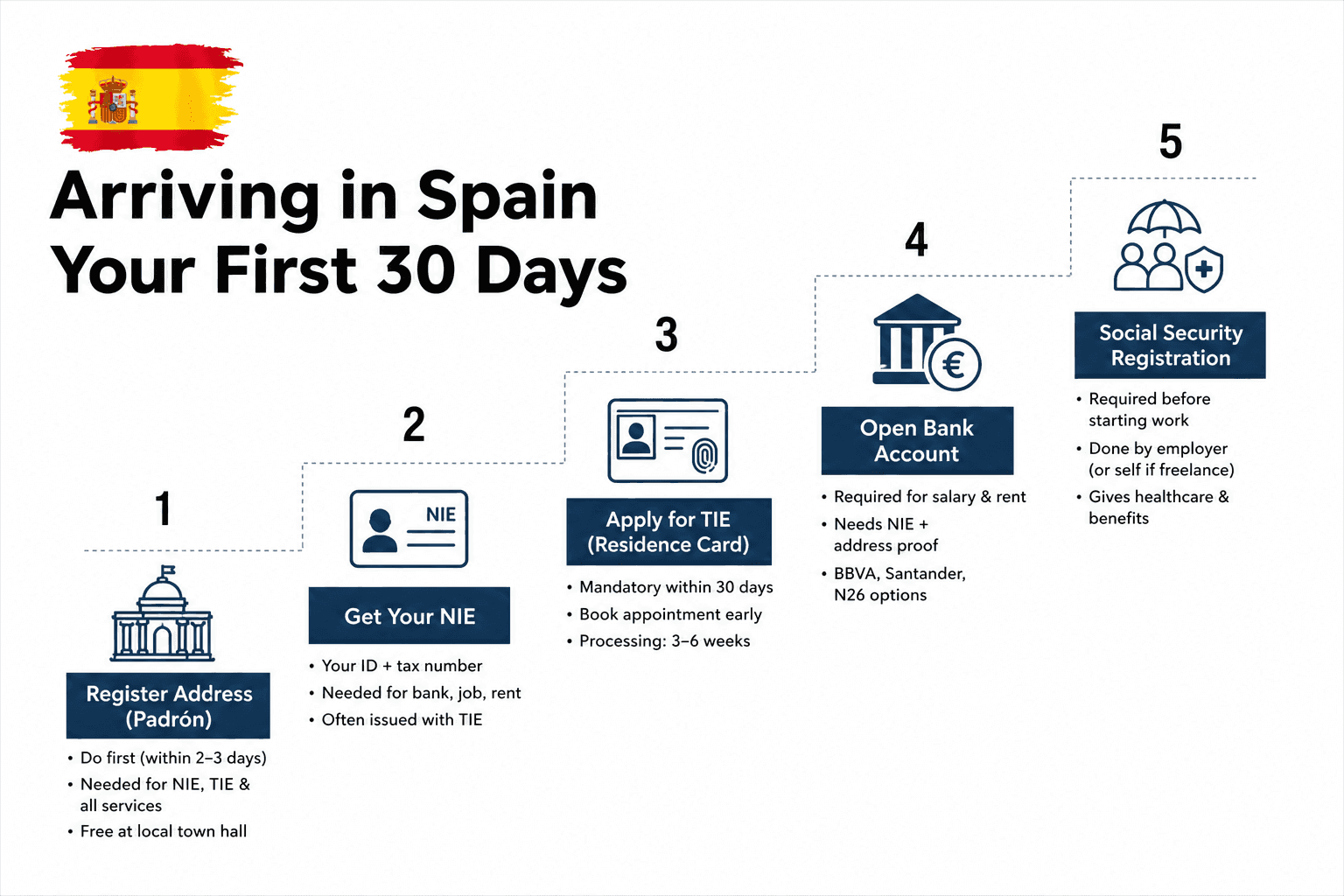
The first month in Spain is the most important of your entire stay. Several registrations must happen within defined legal timeframes, and missing them creates complications that are difficult and time-consuming.
Register Your Address First- Empadronamiento/Padron
The very first thing you must do upon arriving in Spain- before applying for your NIE, before applying for your TIE, and before almost anything else is to register your address at the local town hall (Ayuntamiento) of the municipality where you live. This process is called empadronamiento or padrón, and the certificate it produces is a required supporting document for virtually every subsequent step in your legal settlement in Spain.
Empadronamiento is not optional and it is not a formality. Without it, your NIE and TIE applications are incomplete. Your padrón certificate is required for:
How to register: Visit your local Ayuntamiento with your passport and a signed lease agreement or proof of your address in Spain. Some municipalities allow online appointment booking and some require you to go in person. In Madrid and Barcelona, appointments can be booked through the respective city council websites. There is no fee. You will receive the certificate on the same day or within a few days. You need to keep multiple copies, as you will use it repeatedly. Do this within the first week of arrival, ideally within the first two or three days.
Get Your NIE
Once you have your empadronamiento certificate, your next step is securing your NIE (Número de Identidad de Extranjero). This is your personal tax and identification number in Spain. The NIE is not a card or a document you carry. It is simply a number without which you cannot open a bank account, sign a lease, register with Social Security, buy a car, or handle any formal transaction in Spain.
For long-stay visa holders arriving in Spain, the NIE is automatically assigned as part of the TIE (residency card) application process. It becomes your permanent identification number embedded in your TIE. You do not always need to apply for it separately.
However, if you urgently need the NIE before your TIE is processed. For example, to open a bank account or register with Social Security from day one of employment, you can apply for it independently at a National Police station that handles foreigners' affairs, using Modelo EX-15. You will need:
Apply for Your TIE
The TIE (Tarjeta de Identidad de Extranjero) is your physical residency card. It is what formally makes you a legal resident of Spain. For most long-stay visa categories, you are legally required to apply for your TIE within 30 days of arriving in Spain.
Where to apply: At the Foreigners' Office in your province, or at a National Police station designated for foreign affairs. Appointments must be booked in advance, as TIE appointment slots fill up quickly. Book your appointment online through the Spanish police's sede electrónica immediately upon arrival, even before your 30-day window begins.
Documents required for TIE application:
Processing time: The TIE is ready for collection in 3 to 6 weeks after your appointment, though this varies by province. You will be given a receipt after your appointment, which serves as temporary proof of your legal status while your card is being processed. Keep this receipt you will need for certain administrative processes in the interim.
Open a Spanish Bank Account
A Spanish bank account is essential for receiving salary, paying rent, setting up utilities, and dozens of other daily functions. Opening one as a newly arrived foreigner requires your NIE , proof of address (empadronamiento certificate), and in some cases proof of income or employment.
Banks that are more accessible for newly arrived Indians:
Register with Social Security
If you are employed or self-employed in Spain, registration with Spain's Social Security system is mandatory and must happen before or on your first working day. Your employer handles this registration if you are employed. If you are self-employed, you register yourself through the Tax Agency and with Social Security.
Your Social Security number is separate from your NIE but linked to it. It is what entitles you to Spain's public healthcare system, unemployment benefits (if applicable), and pension contributions.
If you spend more than 183 days in Spain in a calendar year, you are considered a Spanish tax resident for that year. Days do not need to be consecutive. Once you cross this threshold, Spain taxes you on your worldwide income, not just income earned in Spain. This includes your Indian salary, rental income from Indian property, dividends from Indian stocks, interest from fixed deposits, and any other global income source.
If you are arriving as an employee or qualifying professional, you are eligible for Spain's Beckham Law- a flat 24% tax rate for your first six years in Spain. The application window is strictly 6 months from your Social Security registration date. If you miss it and it is gone permanently. Flag this to a tax advisor the moment you register with Social Security.
If you have Indian bank accounts, investments, mutual funds, property, or pension assets above €50,000 in value, you are required to declare them to Spanish tax authorities.
Your Indian driving licence is recognised in Spain for a limited period after you become a legal resident. Once you have your TIE, this means you are formally a resident, not just a visitor- your Indian licence is valid for driving in Spain for 6 months from the date your residency is established. After that 6-month window, you are legally required to hold a Spanish driving licence to drive in Spain.
Can You Exchange Your Indian Licence for a Spanish One?
This is where many Indians are misled by incomplete information online. India and Spain do not have a bilateral driving licence exchange agreement. This means you cannot simply swap your Indian licence for a Spanish one. There is no administrative exchange process available for Indian licence holders, unlike citizens of certain other countries (such as Switzerland or Japan) who can exchange directly.
As an Indian licence holder, you must go through Spain's standard driving licence acquisition process which means:
Theory test: A multiple-choice test covering Spanish traffic rules, road signs, and driving regulations. The test is available in English at most driving schools which is important for Indian applicants who are not yet fluent in Spanish. The theory test consists of 30 questions, and you must answer at least 27 correctly to pass.
Practical test: An on-road driving test conducted by a DGT examiner, in a vehicle provided by the driving school. The test assesses your ability to handle Spanish roads, follow traffic rules, and demonstrate safe driving behaviour.
Your Indian driving licence serves as evidence of your prior driving experience and history, and driving schools take this into account when structuring your training.
Tips for the Licence Process
Enrol in a driving school early- do not wait until the 6-month window is about to close, as test slots can be booked out several weeks in advance. Costs vary by city. Keep your original Indian driving licence safe throughout this process, you will be asked to surrender it to Spanish authorities when your Spanish licence is issued.
Beyond taxes and driving, the first three months in Spain involve a handful of practical setups.
Health Card
Once registered with Spain's Social Security system, you and your registered family members are entitled to access Spain's public healthcare which is one of the best in the world. To actually use it, you need a health card (Tarjeta Sanitaria Individual), which is your personal access card to the public health system.
Apply for it at your local health centre with your TIE, NIE, empadronamiento certificate, and Social Security registration document. The card entitles you to GP consultations, specialist referrals, hospital treatment, and heavily subsidised prescriptions. Apply for this as soon as your TIE and Social Security registration are in place.
Phone and Internet
For a mobile phone contract in Spain, you need your NIE. Until your NIE is confirmed, a prepaid SIM from any Spanish operator works as a bridge. Once your NIE is in hand, you can take out a contract plan.
Spain's main operators are Movistar, Orange, Vodafone, and MásMóvil. Budget operators are Digi and Yoigo, these have become extremely popular among the expat community for their competitive pricing with solid coverage. Digi offers very affordable monthly plans and has become a first choice for many Indians in Spain. For home internet, fibre broadband is widely available across Spanish cities at speeds and prices that will likely exceed what you were used to in India.
Children's School Enrolment
If you have school-age children, enrolment in Spanish public schools is free for compulsory education and is managed by the Consejería de Educación of your autonomous community rather than handled directly by the school. You will need documents such as your child’s birth certificate (often apostilled or officially translated), empadronamiento certificate, proof of legal residence (such as a visa, NIE, or TIE), and previous school records. Requirements and procedures may vary slightly by region.
The main enrolment window runs from March to May for the following academic year. If you arrive outside this window, contact the regional education authority directly as they have provisions for mid-year enrolments for newly arrived families.
Spanish public schools have language support programmes for non-Spanish-speaking children. Most Indian children with an English-medium schooling background adapt to the Spanish system within one academic year.
Spanish Language Learning
If you have not already started learning Spanish, enroll in a course as soon as you are settled. Spain's Escuelas Oficiales de Idiomas (EOI)- official state language schools, offer subsidised Spanish courses for residents at a fraction of private school costs, though fees vary depending on the region. The quality is excellent and the EOI system is widespread across Spanish cities and towns.
Beyond the daily need for Spanish, remember that a DELE A2 certificate is required for the Spanish citizenship application after 10 years. Starting formal language learning in year one rather than year eight makes the entire journey smooth and less stressful. This also opens up your social and professional life in Spain far more quickly than staying within the English-speaking expat bubble.
This is an important section that Indians must be aware of before making their move to Spain. It is important to understand the equation of taxes on both sides.
If you spend more than 183 days in Spain in a calendar year and you are a Spanish tax resident for that year. Days do not need to be consecutive. Once you cross this threshold, Spain taxes you on your worldwide income, your Indian salary, rental income from Indian property, dividends from Indian stocks, interest on fixed deposits, and every other global income source.
Even if you spend fewer than 183 days in Spain, you can still be considered a Spanish tax resident if your main economic interests are based in Spain. For example, if your primary business or investments are there. The 183-day rule is the most common trigger, but it is not the only one.
Spain follows a calendar-year tax system (January to December), unlike India’s financial year (April to March). This difference can create split-year tax complexities in your year of relocation, making professional tax advice especially valuable during your first year.
Spain's Beckham Law is a special tax regime that allows qualifying new residents to pay a flat 24% tax rate on Spanish-sourced income up to €600,000 for their first six years in Spain, instead of the standard progressive rates which rise up to 47%. For income above €600,000, the rate is 47%.
For Indian professionals earning above €30,000 annually in Spain, which covers most IT professionals, consultants, and finance workers. The Beckham Law is a financial advantage. The difference between paying 24% flat versus progressive rates up to 47% compounds meaningfully over six years.
Who Qualifies?
To qualify for the Beckham Law you must:
The 6-month application window is strict and non-negotiable. You lose the benefit for all years if you miss this window. The moment you register with Social Security after arrival, put the Beckham Law application deadline in your calendar immediately.
Does It Apply to DNV Holders?
Yes, Digital Nomad Visa holders can qualify for the Beckham Law provided they meet the conditions above. The 2023 Startup Act that created the DNV extended Beckham Law eligibility to remote workers and digital nomads, which was an important change from the previous rules.
How to Apply
The application is filed with the Spanish Tax Agency using Modelo 149. Given the financial stakes, this is one process where engaging a Spanish tax advisor with expatriate experience is strongly recommended rather than attempting it independently.
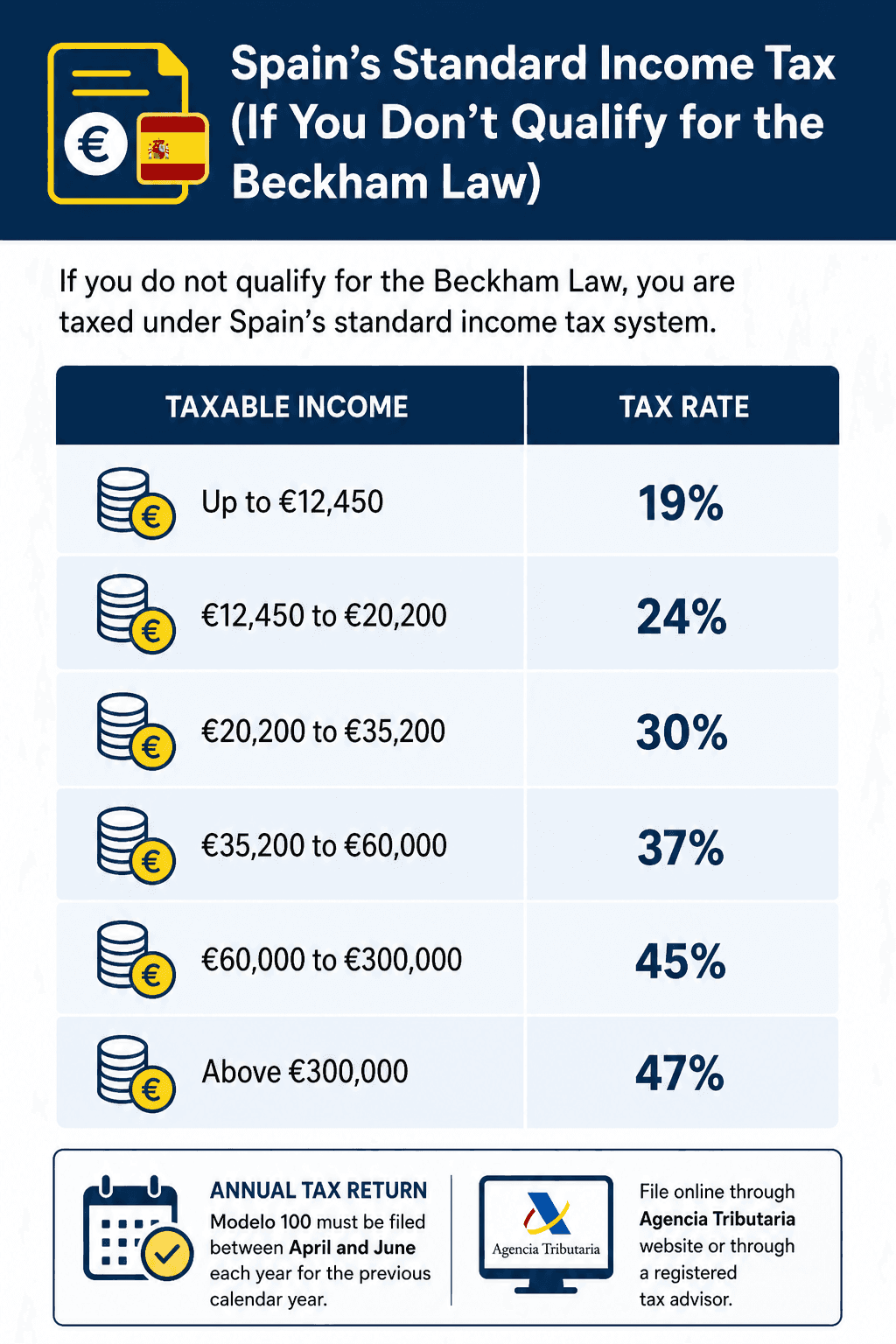
If you do not qualify for the Beckham Law then you are taxed under Spain's standard income tax system.
Your annual tax return- Modelo 100 must be filed between April and June each year for the previous calendar year. Filing is done through the Agencia Tributaria website or through a registered tax advisor.
Modelo 720 is Spain's foreign assets declaration. Any Spanish tax resident who holds assets outside Spain above certain thresholds must declare them to the Agencia Tributaria by 31 March of the year following their first year of Spanish tax residency.
The three categories are:
You only need to file Modelo 720 once for each category and then refile only if the declared value increases by more than €20,000. The declaration is informational, it does not create an additional tax liability on its own but failure to file when required is a serious compliance breach. If you have Indian property, meaningful savings, a mutual fund portfolio, or a PPF or NPS account, Modelo 720 applies to you.
India and Spain have a Double Taxation Avoidance Agreement (DTAA) in force, which ensures that the same income is not taxed twice. Tax paid in India on income can be credited against your Spanish tax liability, and vice versa, depending on the income type and which country has primary taxing rights under the treaty.
The DTAA covers employment income, business profits, dividends, interest, royalties, and capital gains. This means that if you are paying tax in India on rental income from an Indian property, you will not pay the full Spanish rate on that same income, the Indian tax paid is credited. Your Spanish tax advisor applies the relevant DTAA articles when preparing your Modelo 100.
In most cases, if you leave India for employment abroad and spend more than 182 days outside India in a financial year, you will qualify as a Non-Resident Indian (NRI) for tax purposes under the Income Tax Act 1961. This is a legal status change with real financial and compliance implications.
Your existing resident savings accounts should be redesignated as NRO (Non-Resident Ordinary) accounts in accordance with the Foreign Exchange Management Act 1999 (FEMA). You may also open NRE (Non-Resident External) accounts to hold foreign earnings in India in a fully repatriable, tax-free rupee account. It is important to inform your bank of your change in residential status soon after relocating.
Your other Indian financial assets can continue with certain restrictions. Existing PPF accounts can be maintained until maturity but cannot be extended or newly opened once you become an NRI. NPS accounts can continue with contributions, and withdrawals are permitted subject to applicable rules. Mutual funds can also be held as an NRI, although some fund houses impose restrictions depending on your country of residence.
For EPF, you may withdraw your balance after leaving Indian employment. However, if you withdraw before completing five years of continuous service, the amount may be subject to tax, so timing your withdrawal carefully is important.
Money remitted from India to Spain by resident individuals is governed by the Liberalised Remittance Scheme (LRS), which allows outward remittances of up to USD 250,000 per financial year for permitted purposes such as living expenses, education, and investments.
Once you become a Non-Resident Indian (NRI), LRS no longer applies to you. Instead, your remittances are governed by the Foreign Exchange Management Act 1999 (FEMA) provisions applicable to NRO and NRE accounts. Funds held in NRE accounts are freely repatriable, while transfers from NRO accounts are subject to limits and documentation requirements.
However, during your transition year, or if funds are being sent on your behalf by family members who remain resident in India, the LRS limit continues to apply and must be observed.
For transferring money between Spain and India, services like Wise are widely used for their transparency and competitive exchange rates. Regardless of the method used, ensure that all international transfers comply with applicable banking and tax reporting requirements in both India and Spain.
Spain's healthcare system is one of the most respected in the world. The World Health Organization has consistently ranked it among the top ten globally, and for Indians moving from a country where quality healthcare often means expensive private hospitals, the experience of accessing world-class medical care at little to no cost as a Spanish resident is one of the most pleasant surprises of life in Spain.
Spain operates a universal public healthcare system, which is known as Sistema Nacional de Salud- SNS, funded through taxes and Social Security contributions. It covers GP consultations, specialist referrals, hospital treatment, surgery, maternity care, mental health services, and heavily subsidised prescriptions. For most healthcare needs, the cost to the patient is either zero or a small co-payment on medication.
The quality and specific services available vary slightly by region, but the core coverage is consistent nationwide. Madrid, Catalonia, Valencia, and Andalusia all have well-developed health services with major hospitals, specialist centres, and extensive primary care networks.
Access to Spain's public healthcare system as an Indian expat depends on your visa category and whether you are registered with Social Security.
If you are employed or self-employed (autónomo) in Spain, you are automatically enrolled in Social Security and entitled to full public healthcare from your first day of registered work. Your family members registered as dependents on your Social Security also receive full coverage.
If you are on a Digital Nomad Visa, access to public healthcare is linked to your Social Security registration. DNV holders who opt into Spain's voluntary Social Security contribution scheme gain full public healthcare access. Those who do not contribute to Social Security, which is an option for some DNV holders, must maintain private health insurance instead.
If you are on a Non-Lucrative Visa, you are required to have private health insurance as a visa condition and do not automatically access the public system. After becoming a long-term resident (5 years), access to public healthcare becomes available regardless of visa category.
If you are a student, you are required to have health insurance as part of your visa conditions. Some Spanish universities include basic health coverage in their student fees. You need to check with your institution. Students who register with Social Security through part-time work gain public healthcare access through that route.
To activate your public healthcare access, you must obtain your Spanish health card from your local health centre after registering with Social Security and completing your empadronamiento.
Several visa categories such as the Non-Lucrative Visa and Digital Nomad Visa require private health insurance as a condition of approval. Student visa applicants also need private insurance unless they qualify for public healthcare coverage in Spain.
Beyond visa requirements, many Indians in Spain choose to maintain private health insurance alongside public healthcare access for reasons like shorter waiting times for specialists, access to English-speaking doctors, and the ability to choose your own consultant.
Spain's private health insurance market is well-developed and affordable by European standards. The main insurers Indians in Spain most commonly use are:
Monthly premiums for a healthy adult in their 30s start from €50 to €80 per month for basic coverage, rising to €100 to €150 for comprehensive plans. Family coverage for two adults and two children costs around €200 to €350 per month depending on the insurer and plan.
For visa purposes, your policy must explicitly state that it covers Spain, has no excess or deductible and is valid for the full period of your intended stay.
When you arrive in Spain, bring physical copies and digital scans of your complete medical history from India like previous diagnoses, ongoing prescriptions, surgical history, vaccination records, and any chronic condition management records. Spain's public health system does not have access to your Indian medical records, and starting from scratch with a new GP is far smoother when you arrive with organised documentation.
For ongoing prescription medications, be aware that Indian brand names are rarely used in Spain. Bring the generic (INN) name of any medication you take regularly, not just the Indian brand name as your Spanish GP will prescribe using generic names. Most medications available in India are also available in Spain under their generic names, though some Ayurvedic or traditional Indian medicines are not available through Spanish pharmacies.
Spain’s public education system is free, well-structured, and accessible to children of legally residing families. Enrollment is possible once you are registered with your local municipality (empadronamiento), even if your residence card (TIE) is still in process. For Indian families, the key decision comes down to one question: public school, international school, or something in between?
Public schooling in Spain is free for all legal residents regardless of nationality and follows a structured curriculum aligned with European education standards. The language of instruction is Spanish or, in some regions, a combination of Spanish and a regional language such as Catalan, Valencian, or Basque.
Many regions across Spain offer dedicated language integration programmes (aulas de acogida) to help non-Spanish-speaking children adapt. Most Indian children from an English-medium background develop basic conversational Spanish within 6-12 months, with academic fluency typically taking 1-2 years.
The academic year runs from September to June, and enrollment is managed by the regional education authority. School placement is based on catchment areas and availability, meaning families may not always receive their first-choice school.
For Indian families who want English-medium instruction, an internationally recognised curriculum, or continuity with a British or IB education system, international schools are the alternative. Madrid and Barcelona have the widest selection, including British curriculum schools, American curriculum schools, and IB (International Baccalaureate) schools.
Annual fees range from €8,000 to €20,000 per child, though top-tier schools may charge more. Some multinational employers include these costs in relocation packages, but for self-funded families, this is often the largest expense after housing.
Spanish public universities are more affordable than UK, US, or Australian institutions and offer strong academic programmes. Annual tuition fees for non-EU international students range from €1,000 to €3,500 per year for undergraduate programmes which is a fraction of what Indian students pay in the UK or Australia for comparable degrees.
For postgraduate education, Spain has several globally recognised business schools. IE Business School, IESE Business School, and ESADE are all consistently ranked among the top business schools in Europe and actively recruit Indian students for their MBA and master's programmes. These are private institutions with fees comparable to top international programmes , but their European network and placement outcomes are strong.
Spain does not have CBSE or ICSE affiliated schools. Indian families who want to maintain the Indian curriculum if the move is temporary or if children may return to India for further education have two options:
Spain doesn’t yet have the long-established Indian diaspora you might find in countries like the UK or Canada, but it has a young, fast-growing, and supportive Indian community especially in cities like Madrid and Barcelona, with smaller but rising groups in Valencia and Málaga. In these cities, you’ll find Indian neighbourhood pockets, grocery stores, and restaurants that make daily life easier- from sourcing atta and spices to eating familiar food.
Religious and cultural life is also present, with spaces like the Templo Hindu de Madrid, gurudwaras, and mosques supporting different communities, while festivals like Diwali and Holi are celebrated through vibrant, community-led events that often attract both Indians and locals.
While cities like Madrid and Barcelona offer the most developed ecosystem including better access to Indian groceries, temples, and social networks. Smaller cities may have limited infrastructure, requiring occasional travel or online ordering for essentials. That said, what stands out in Spain is the strong sense of community support like active WhatsApp groups and Facebook communities (like “Indians in Madrid” or “Indians in Barcelona”) play a crucial role in helping newcomers with everything from housing and jobs to doctors and daily life. For Indians moving now, this means you’re not just joining a community but you’re becoming part of it in Spain.
Most Indians moving to Spain are focused on the immediate- the visa, the move, the first year. But understanding the long-term pathway from the very beginning changes how you make decisions along the way.
After 5 years of continuous legal residence in Spain, you become eligible to apply for long-term EU residency. Long-term EU residency grants permanent residence rights, although the physical residence card must be periodically renewed. The status can be lost if you are absent from the EU for more than 12 consecutive months or absent from Spain for more than 6 years. It gives you the right to work in Spain in any capacity without restriction, access to social benefits on equal terms with Spanish nationals, and the right to move to and work in most other EU member states under simplified procedures, without going through a full new immigration process from scratch.
For Indian professionals whose career ambitions extend beyond Spain to Germany, the Netherlands, or elsewhere in the EU, this mobility right is a meaningful long-term asset.
What You Need to Apply
The application is filed at the Foreigners' Office (Oficina de Extranjeros) in your province. You must demonstrate:
The 5-year count must be continuous. Extended trips back to India can interrupt the continuity of your residence and affect your eligibility timeline. If you travel to India frequently or for extended periods, track your days carefully and take legal advice on how your travel pattern affects your long-term residency clock.
Spanish citizenship is available to Indian nationals after 10 years of legal residence in Spain. This is longer compared to countries like Portugal (5 years), Germany (5 years, or as little as 3 years in fast-track cases), and Canada (3 years of physical presence). However, the Spanish passport is one of the most powerful in the world, offering visa-free or visa-on-arrival access to over 190 countries along with full European Union citizenship rights.
Requirements for Naturalisation
1. 10 years of legal residence: The 10-year count runs from your first day of legal residence in Spain. As with long-term residency, continuity matters, extended absences can affect your timeline. The 5 years of long-term EU residency you accumulate at the halfway point counts toward the 10 years.
2. Spanish language certificate- DELE A2 minimum: You must hold a minimum DELE A2 certificate, demonstrating basic Spanish language competency. A2 is the minimum legal requirement for naturalisation.
3. CCSE - Civics and culture test: The CCSE is a 25-question multiple choice test covering Spain's constitution, culture, history, geography, and society. It is administered by the Instituto Cervantes and available in English as well as Spanish. Most applicants find it manageable with two to four weeks of focused preparation using the official study materials.
4. Clean criminal record: A criminal record certificate from Spain and from India (apostilled) demonstrating no serious convictions.
5. Renunciation of Indian nationality: Spain does not permit dual citizenship with India. To become a Spanish citizen, you must formally renounce your Indian citizenship. This is a permanent, irreversible act that ends your status as an Indian national.
Application Process
The naturalisation application is filed at the Civil Registry in your province, or through Spain's online judicial portal where available. Processing times have been long- 1 to 3 years in some cases, though Spain has been working to reduce the backlog. You will be interviewed by a Civil Registry official as part of the process to assess your integration and language ability.
What Should Every Indian Understand About Dual Citizenship?
India does not allow dual citizenship. This is not only a Spanish restriction, it is India's own constitutional position. Under the Constitution of India and the Citizenship Act 1955, Indian citizenship is automatically lost upon voluntarily acquiring the citizenship of another country. The moment you take Spanish nationality, you cease to be an Indian citizen by operation of Indian law.
This means the decision to pursue Spanish citizenship is not just an immigration milestone, it is a permanent farewell to your Indian passport. You can never hold both simultaneously. For most Indians, this is a deeply personal decision that involves family ties, property rights in India, emotional identity, and practical considerations that go far beyond immigration paperwork.
What Happens After the OCI Card?
The solution for most Indians who take Spanish citizenship is to apply for an OCI (Overseas Citizen of India) card. OCI is not citizenship, it is a lifelong visa status that gives you:
What OCI does not give you:
For most Indians who have built their professional and financial life in India and maintain deep family ties there, OCI provides access to India after taking foreign citizenship. But the loss of the Indian passport and everything it represents is a decision that deserves unhurried consideration. Many Indians choose to obtain long-term EU residency at the 5-year mark and live indefinitely in Spain without pursuing citizenship at all. That is a legitimate and widely chosen path.
As an NRI, you do not lose your rights over Indian property. You can continue to hold, rent, or sell residential and commercial property in India freely. The only restriction is that NRIs cannot purchase agricultural land, plantation property, or farmhouses in India but existing ownership of any property type is fully protected.
You retain the property, maintain it, and return to it during visits to India. There are no tax implications simply from holding property as an NRI. The challenge is maintenance from a distance, most Indians in this situation arrange for a trusted family member or a property management service to oversee the property in their absence.
Renting out your Indian property as an NRI is a common and financially sensible choice, particularly for those with property in high-demand Indian cities. The income provides a rupee revenue stream while you live in Spain.
The key financial points to understand is rental income paid to an NRI is subject to 30% TDS (Tax Deducted at Source) in India, deducted by the tenant before paying you. The net rental income flows into your NRO account. You must declare this rental income in Spain as well- under the India-Spain DTAA, the tax paid in India is credited against your Spanish liability, so you will not be taxed twice on the same income, but the declaration obligation in Spain exists regardless.
Selling Indian property as an NRI is permitted, though the tax process requires careful handling.
For property held for more than 24 months, the gain is treated as long-term capital gain and is taxed at 20% with indexation, although recent changes have introduced alternative tax treatments in certain cases. For property held under 24 months, gains are treated as short-term and taxed at your applicable income tax slab rate.
The buyer is required to deduct TDS before paying you, usually around 20% for long-term gains, and higher for short-term gains. This TDS is not always your final tax liability, and you can file an income tax return in India to claim refunds if excess tax has been deducted.
Sale proceeds are credited to your NRO account. From there, you can repatriate up to USD 1 million per financial year (across all NRO remittances), subject to submitting a CA certificate along with Forms 15CA and 15CB. These documents confirm tax compliance before funds are transferred abroad. It is advisable to verify current tax rules and repatriation procedures with a CA experienced in NRI taxation before completing the transaction.
We have two main options for housing in Spain. Either you can rent or you can buy a property in Spain.
For the first one to two years in Spain, renting is the sensible choice for the vast majority of Indians. The Spanish property market, the neighbourhoods, the quality of different buildings, and the differences between cities- all of this takes time to understand properly. Buying before you have lived in a city long enough to know it well is a risk.
Finding a rental: Spain's two dominant property portals are Idealista and Fotocasa. Both are well-established and list the vast majority of available rentals across Spain. Idealista tends to have the widest inventory. Most listings include detailed photos, floor plans, and direct landlord or agency contact.
What landlords ask for?
One to two months deposit, first month's rent upfront, and proof of income. For newly arrived Indians without Spanish payslips, this last requirement is where friction arises, some landlords and agencies are reluctant to rent to applicants whose income documentation is foreign. Practical solutions include offering a larger deposit, providing a bank guarantee from a Spanish bank, or showing substantial bank statements demonstrating financial stability. Having your employer provide an official offer letter or salary confirmation in Spanish also helps.
Madrid and Barcelona have the tightest and most competitive rental markets. For well-located apartments under €1,200. Starting your property search 6 to 8 weeks before your intended move date is advisable, and having your NIE and empadronamiento ready speeds up the contract signing process significantly.
Rental contracts in Spain are governed by Spain's Urban Leasing Law called as Ley de Arrendamientos Urbanos(LAU). Standard residential leases run for a minimum term of 5 years or 7 years if the landlord is a legal entity, with annual rent increases capped in line with the CPI or a government-set limit. You have the right to exit after 6 months with 30 days notice. Read your contract carefully, ideally with the help of a lawyer before signing.
There are no restrictions on Indian nationals buying property in Spain. Non-EU foreigners can purchase residential and commercial property freely. The one critical update for 2025 is buying property in Spain no longer grants residency under the Golden Visa real estate route that was closed in April 2025. Property purchase is now purely a lifestyle or investment decision, not an immigration strategy.
How to buy a property?
You need your NIE before any property purchase can be completed, it is required for the notary deed and all financial transactions. Once you identify a property, the standard process involves signing a reservation contract- often with a €3,000 - €10,000 deposit followed by a 10% deposit (Arras contract) to lock in the price. The final purchase deed is signed before a Spanish notary , at which point the balance is paid and ownership transfers.
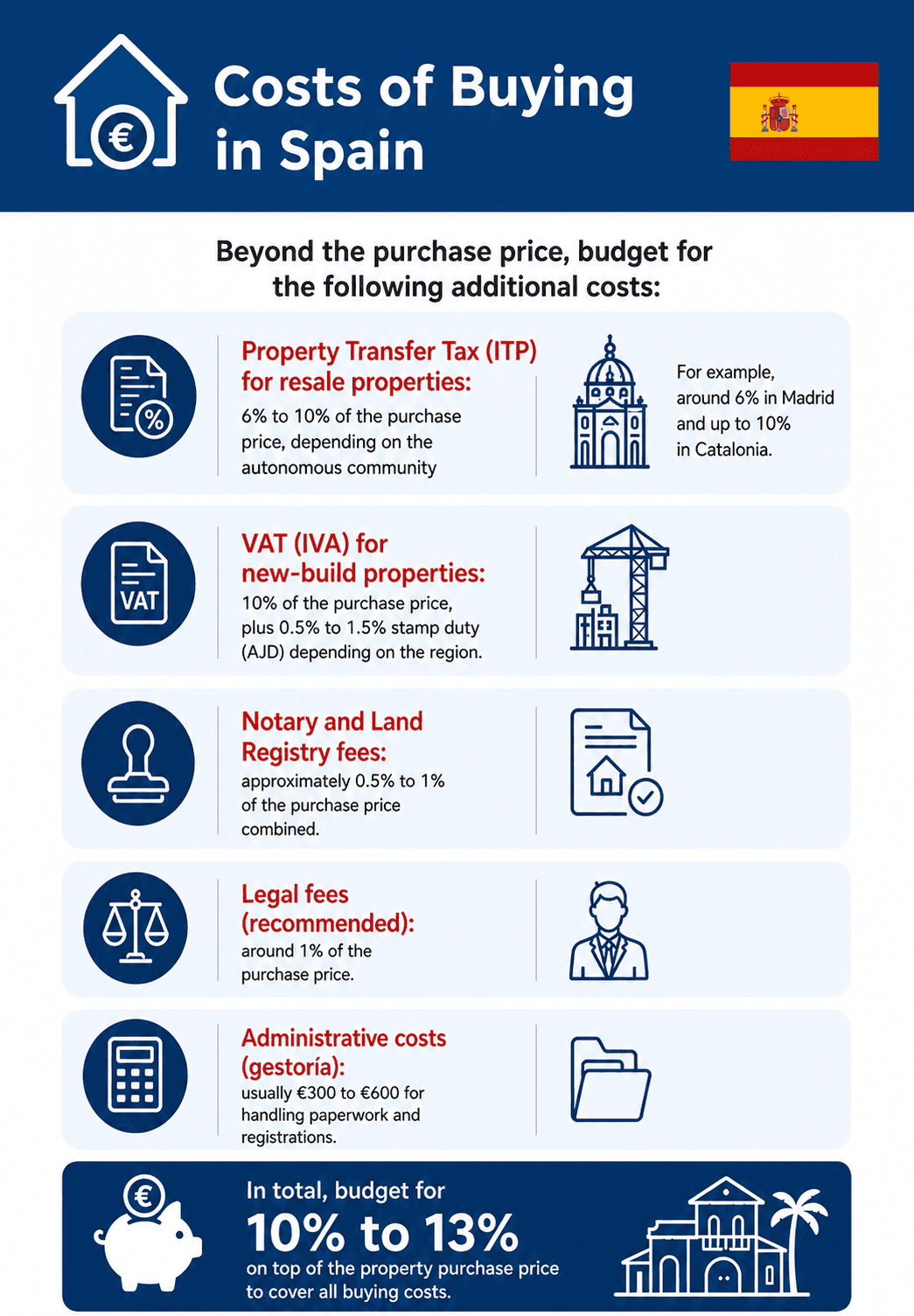
Costs of buying in Spain:
Beyond the purchase price, budget for the following additional costs:
In total, budget for 10% to 13% on top of the property purchase price to cover all buying costs.
Mortgages for Indian nationals in Spain:
Spanish banks do offer mortgages to both resident and non-resident foreign buyers, including Indians. As a non-resident, banks lend around 60% to 70% of the property value, with requirements depending on your income profile and country of residence.
As a Spanish tax resident with a stable income history in Spain, you can access more standard mortgage conditions, usually up to 80% of the property value for a primary residence. Approval is also influenced by affordability rules, with monthly repayments expected to remain within 30–35% of your net income.
Having a Spanish bank account, a stable employment contract, or demonstrable income improves your eligibility and the terms offered.
Best time to buy: Most Indian expats in Spain who have purchased property recommend waiting at least 2 to 3 years after arriving before buying. Long enough to know your city well, establish financial stability in Spain, and make the decision from a position of knowledge rather than urgency.
Moving to Spain from India is not a small decision but it is increasingly a well-considered one, and for good reason. Spain offers world-class healthcare, affordable European living, a legal framework built for modern professionals, and a path to one of the most powerful passports in the world. The process demands patience and preparation of the visas, the apostilles, the bureaucracy but Indians who have made the move consistently say the same thing that the life on the other side is worth it.
Your complete guide to fingerprinting in India, covering Aadhaar, passports, background checks, immigration, property registration, and your legal rights.
Everything Indians need to move to New Zealand in 2026 - visas, Green List occupations, taxes, healthcare, schools, jobs, and a full moving checklist.
The only Spain visa guide Indians need in 2026 - visa types, documents checklist, BLS appointments, financial proof, rejection fixes, and arrival steps, all in one place.

