
By Himani Daryani · Updated June 30, 2026
Spain does not make it hard to visit. If anything, it has spent the last few years doing the opposite.
They keep adding new ways for people to come in, stay longer, and even move there. There is the Digital Nomad Visa, the Non-Lucrative Visa, the Student Visa, and of course the standard Schengen tourist visa. India has consistently been among the top countries applying for short stay Spain visas, and that number keeps growing every year.
Europe has a reputation for being difficult to get into, and some countries do live up to that reputation. Spain is not really one of them. The process is structured, the requirements are clear, and if you put your application together properly, your chances are pretty good.
But "structured and clear" does not mean "simple." There are still documents to gather, appointments to book, cover letters to write, and timelines to plan around. One missing paper or a wrong date can get your application rejected, and that is frustrating when you have flights and plans already in place. Spanish consulates in India are known to be quite rigid and unforgiving when it comes to processing visa applications.
This guide covers everything an Indian applicant needs to apply for a Spanish visa, start to finish. Which visa type you actually need, what documents go into the file, how to book your appointment, how long processing takes, and what to do if something goes wrong. Whether you are going for two weeks or two years, this is the only guide you need to read.
You must have heard that Spain is a Schengen Area member state. What does it mean? The Schengen Agreement was signed in 1985 and includes 29 European countries. Spain is part of those countries that have removed internal border checks between them. Once you enter one Schengen country, you can usually travel freely to the others without needing separate visas or border controls. The Schengen system works like a single travel zone for short stays, usually allowing up to 90 days within a 180-day period.
It simply means that you can travel around all 29 member countries with one Schengen Visa.
However, even though travel is free within the zone, you still enter through the country that issued your visa (for example, Spain if your visa is Spanish-issued). Once you are inside the Schengen Area, you can travel to other member countries like France, Italy, Germany, Portugal, Netherlands, Greece, Switzerland, and many others without needing separate visas or going through immigration checks at every border.
This creates a “border-free” travel experience across most of Europe, which is why the Schengen visa is so popular among Indians for tourism, short business trips, and visits. But there are still rules you need to follow:
One of the most positive developments for Indian travellers is the extension of the Schengen Cascade visa system to Indian nationals in April 2024.
It is a visa progression system that rewards trusted travellers by offering multiple-entry Schengen visas over time. It means: the more responsibly you travel to the Schengen Area, the better your chances of getting long-term visas in the future.
When you apply for your first Schengen visa, you will get a short visa for three months. This is mainly to see how you travel and whether you follow all the visa rules properly. If you use that visa correctly, meaning you travel as planned, do not overstay, and return on time, your next visa can be longer. Many people then start getting multiple-entry visas.
This is not automatic for everyone, but it is a common pattern for frequent and trusted travellers from India. The Schengen countries tend to encourage people who have a consistent and trustworthy travel history. So instead of applying fresh every time, you are gradually trusted with longer validity visas.
This is the eligibility criteria prescribed by the European Commission for Indian nationals to gain multiple-entry visas:
| Type of Visa | Eligibility Requirement |
| 2-Year Multiple Entry | If you have obtained and lawfully used two Schengen visas within the last three years. |
| 5-Year Multiple Entry | If you have previously held and used a 2-year multiple-entry visa and your passport validity allows it. |
The 90/180-day rule is a limit on how long you can stay in countries within the Schengen Area on a short-stay visa, including Spain. It simply means that you can stay up to 90 days (about 3 months), within any 180-day (6-month) period. All countries in the Schengen Area are treated as one single region under this rule. So, if you spend one week in France, one week in Germany, and one week in Italy, it is counted as three weeks in total, not separate time limits for each country.
If you need to stay longer than 90 days in Spain, you must apply for a national long-stay visa, called a D-visa. This visa is issued based on your reasons to stay, be it for residency, employment, or studying at a Spanish university.
How the rule works?
The period of 180 days is not fixed to a calendar year. It is a "moving window". This means that on any given day of your stay, authorities look back at the previous 180 days and count how many days you have already spent in the Schengen Area. If you have been there for 90 days or more, you must leave. You don't have to stay 90 days all at once. You can enter and exit multiple times, as long as the cumulative total in the 180-day window doesn't exceed 90.
What happens if you break the 90/180-Day rule in Spain?
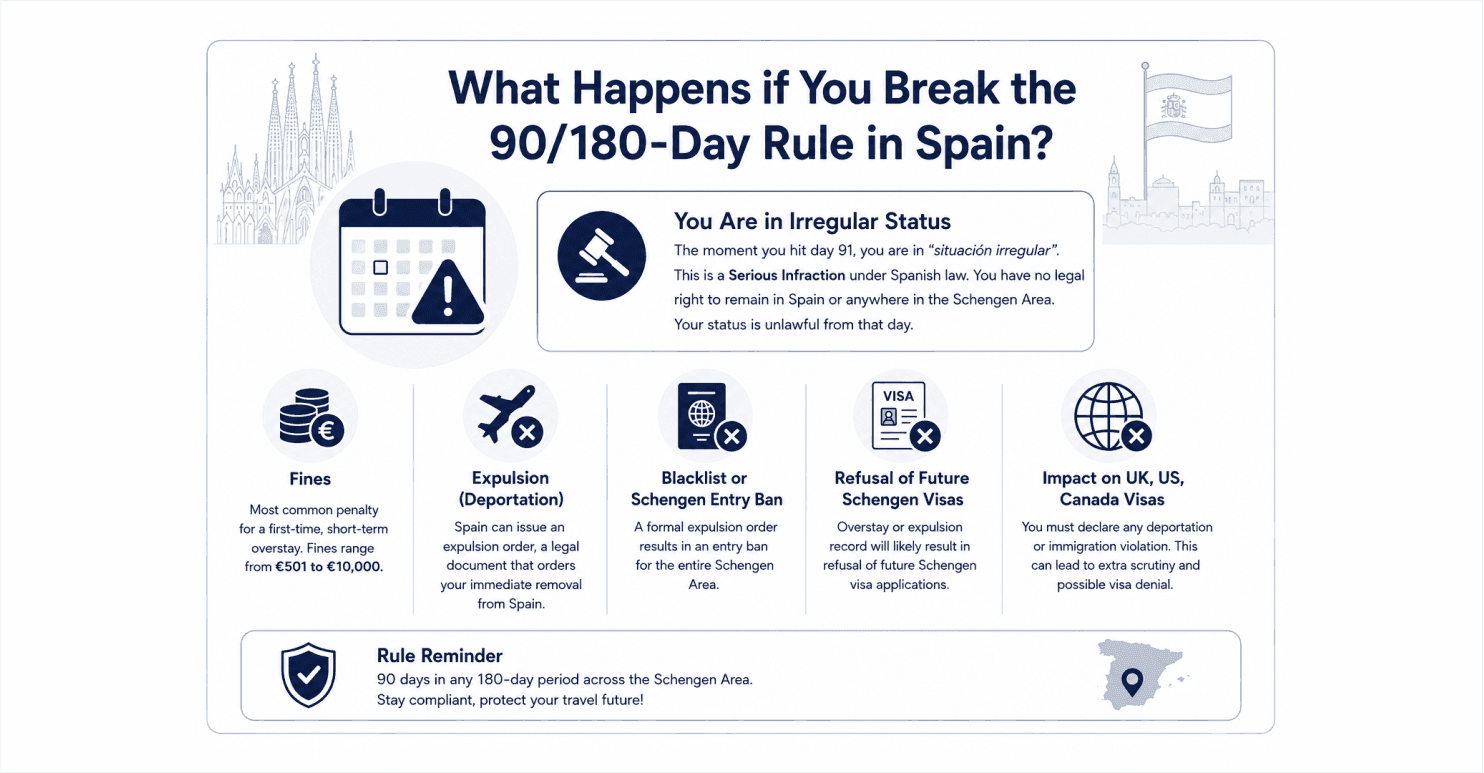
The moment you hit day 91, you are in "situación irregular" (irregular status). This is classified as a Serious Infraction under Spanish law. You have no legal right to remain in Spain or anywhere in the Schengen Area. You might not be arrested immediately, but your status is unlawful from that exact day.
In some cases, if the overstay is short and it's your first time, officers might use discretion and let you leave with a warning. But this is not guaranteed and is becoming less common since EES (Entry/Exit System) has rolled out. It tracks you digitally now, and overstaying by even one day is automatically flagged.
For Indian passport holders, the Schengen application process is already very rigorous. It is best not to break any rules while you’re there! If you are not able to manually track your travel days, do not rely on guesswork. Try a reliable Schengen Calculator to accurately monitor the number of days you have spent in Spain.
The EES has been made fully operational across all Schengen countries, including Spain, from April 10, 2026 onwards. It is a new digital border registration system that replaces the old manual passport stamping process. Every time a non-EU national, including Indian passport holders, enters or exits a Schengen Area country, their details will be digitally recorded. For Indian travellers, this marks the beginning of a highly monitored digital era.
No More Stamps
The most visible change is that your passport will no longer be stamped. Instead of a physical ink mark, you will need to provide your personal data and the EES creates a digital file the moment you cross the border.
Mandatory Biometrics
When you enter Spain for the first time under the new system, you will be asked to provide your fingerprints and have your photo taken at the border. This is a one-time registration - your biometric data is stored in the system and linked to your travel document, so subsequent entries should be quicker.
Real-Time Overstay Detection
This system was specifically designed to identify overstayers. It will calculate your permitted stay and alert border authorities if you overstay. If you try to return to Spain, or anywhere in Europe, after a previous overstay, the system will automatically alert the border officer of your history, leading to an immediate refusal of entry (even if you have a valid visa). There is no room for ambiguity anymore, so make sure you track your travel days carefully before every trip.
What You Should Do
You do not need to register for EES online or fill out extra forms before you fly. The entire process happens digitally at the Spanish border when you land. However, the airlines have warned that this first-time registration can add 5 to 10 minutes per passenger. Thus, we advise travellers to arrive at the airport at least three hours before departure during this initial rollout period.
The rollout of EES didn’t change whether Indian travellers need a visa anymore or not. The country is still a big member of visa-required countries when it comes to Spain. Even if you’re going for the first time, or have visited before, for Indians planning to visit Spain, a visa is mandatory - there are no exceptions. The type of visa depends entirely on the purpose and length of your stay:
To properly understand the Spain visa from India journey, it helps to understand who is travelling. Indian passport holders are an extraordinarily diverse group of travellers - students applying to European universities, IT professionals attending conferences, newly-wed couples on honeymoons, families visiting relatives who have settled abroad, and retirees ticking off a lifetime of travel dreams.
What binds them all together is the navy blue passport, issued by the Republic of India. As of today, the Indian passport grants visa-free or visa-on-arrival access to approximately 56-62 countries. Spain is not among those. Not even close.
India does not currently have a visa-waiver agreement with the European Union, meaning every visit requires prior approval from the Spanish Consulate or Embassy.
Countries like the USA, UK, EU Member States, Australia, Japan, South Korea, and Canada enjoy visa-free entry to Spain. However, from late 2026 onwards, many visa-exempt travellers will also need an ETIAS (European Travel Information and Authorisation System) approval before travelling to Spain and other Schengen countries.
Even with ETIAS, the travel process for visa-free nationals remains much simpler than the standard Schengen visa process followed by Indian passport holders.
| Feature | India | Visa-Free Countries |
| Advance Planning | Must apply weeks or months in advance via an embassy/center. | No embassy visit. Just book a ticket and go. |
| Documentation | Extensive, including Bank statements, ITRs, NOCs, and invites. | Minimal; just a valid passport is required. |
| Interview | Possible in-person interview at the consulate. | None. |
| Risk of Denial | Can be rejected based on financial or intent doubts. | Almost guaranteed entry unless there's a security alert. |
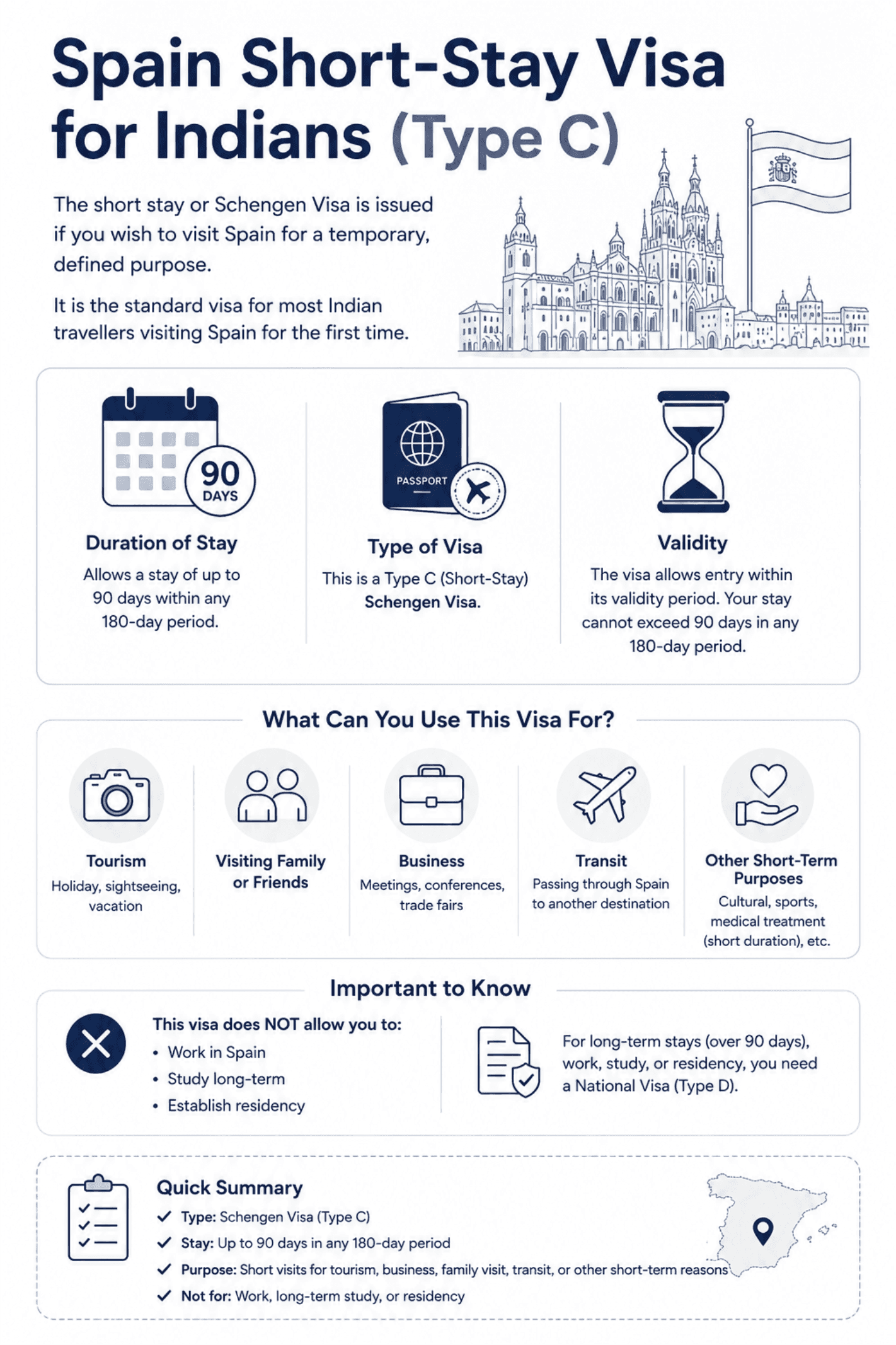
The short stay or Schengen Visa is issued if you wish to visit Spain for a temporary, defined purpose. It allows a stay of up to 90 days within any 180-day period. It is the standard visa for most Indian travellers visiting Spain for the first time. This visa does not allow you to work, study long-term, or establish residency in Spain.
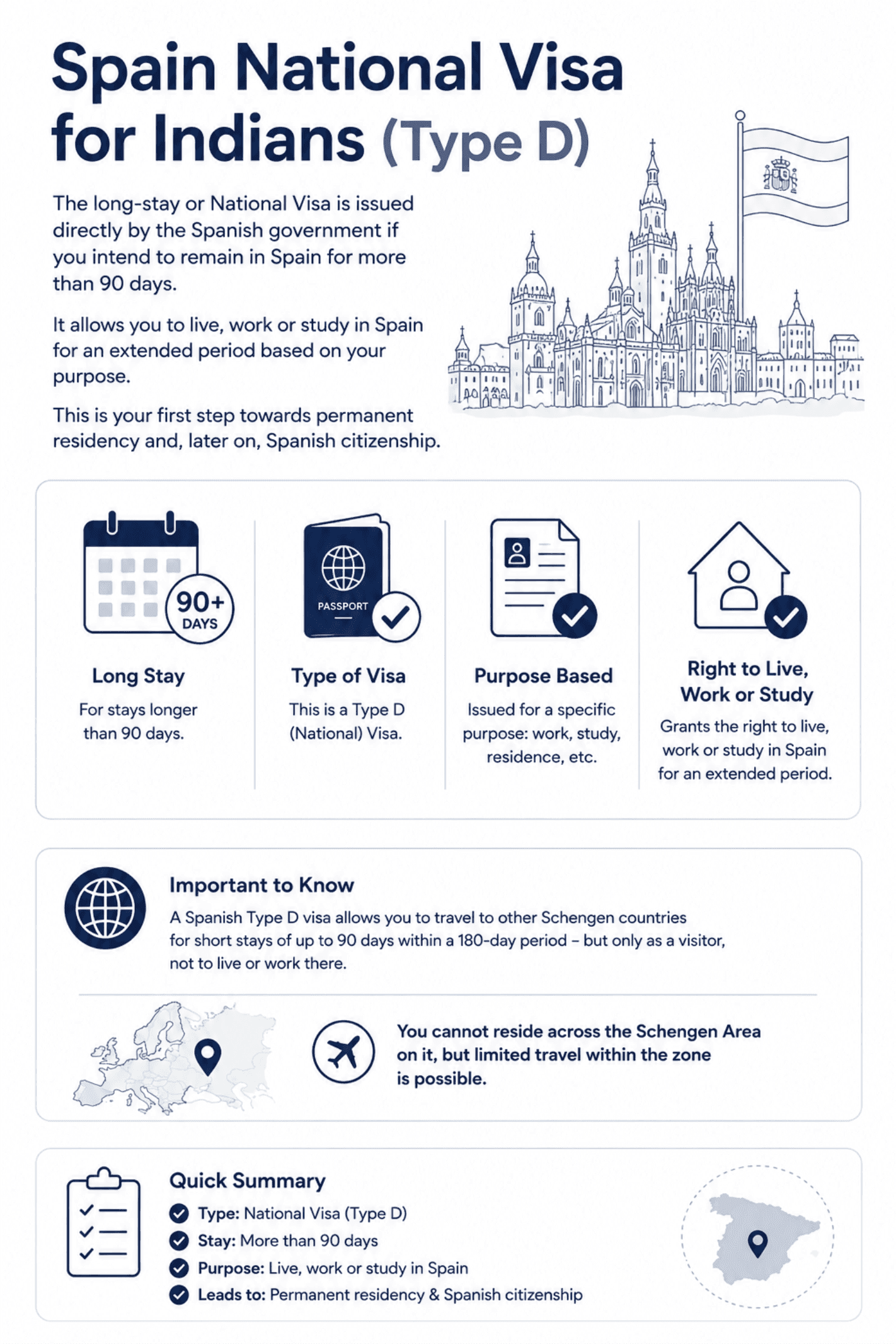
The long-stay or National Visa is issued directly by the Spanish government if you intend to remain in Spain for more than 90 days. It is tailored to a specific life purpose and grants the holder the right to live, work or study in Spain for an extended period, depending on your requirements. This long-stay visa is your first step towards getting permanent residency and, later on, Spanish citizenship.
Important: A Spanish Type D visa allows you to travel to other Schengen countries for short stays of up to 90 days within a 180-day period - but only as a visitor, not to live or work there. So while you cannot reside across the Schengen Area on it, limited travel within the zone is possible.
Before beginning your Spain visa application from India, it is worth pausing and asking yourself a clear set of questions. Your honest answers will point you directly to the right category.
If your stay is under 90 days and your purpose is tourism, business, or a short visit, the Schengen Visa is your route. If you are planning to stay beyond 90 days for any reason, you will need a National Visa, and the specific sub-category will ultimately depend on your purpose and financial circumstances. In 2026, the Spanish consulate is following a strict but fair rule: as long as your "Proof of Intent" matches your visa category, the door to Spain remains wide open.
By now, you probably know that as an Indian travelling to Spain, a visa is non-negotiable. But not all short-stay visas and application processes are created equal. In fact, for some, it’s significantly easier, and even free. If you are a close family member of someone who is a citizen of the EU, EEA, or Switzerland, you fall into a special category of the Spain short term visa that bypasses a lot of the usual hurdles.That alone is reason enough to understand all the categories of short-term Spain visas available before you assume which one applies to you.
There is also a common misconception worth addressing upfront. Many Indians believe that once they have a Schengen visa in hand, entry into Spain is guaranteed. It is not. A visa is permission to travel to the border, not automatic permission to cross it. The border authorities in Spain can and do refuse entry if you cannot clearly demonstrate the purpose of your visit, show proof of accommodation, return tickets, or sufficient funds, or if any other entry requirement is not satisfied on the day you arrive.
So before you apply for a Spanish visa as an Indian resident, it pays to know exactly which visa category fits your situation, and exactly what you need to carry when you land.
A Schengen Visa is your entry pass to not just Spain, but the entire Schengen zone. As an Indian passport holder, you'll need this visa before you travel. It lets you stay for up to 90 days within any 180-day period, and covers a wide range of purposes, including tourism, business trips, visiting family, medical treatment, short courses, training, or volunteering.
Types of Schengen Visas for Indians
| Schengen Visa Type | Purpose |
| Tourist Visa | This is the most common one among Indians. It’s for when you’re going to Spain for a holiday, sightseeing, or just exploring the culture. |
| Business Visa | If you’re going to Spain for meetings, conferences, or to sign a contract. |
| Friends and Family Visit Visa | Specifically for when you have a legal resident or citizen in Spain inviting you to stay with them (you’ll need an official invitation letter for this). |
| Medical Treatment Visa | For Indian patients travelling to Spain to receive specific medical care or surgeries at Spanish healthcare facilities. |
| Short Study / Training / Volunteer Visa | Used for student exchanges, short courses, or unpaid internships/volunteer work that lasts less than 3 months. |
| Airport Transit Visa (TAP) | As per BLS International, from March 4, 2026 onwards, Indian passport holders no longer require an airport transit visa to transit through the international zones of Spanish airports. |
If your spouse, parent, or another close family member is a citizen of an EU country, States of EEA or Switzerland, and you're travelling with them or going to join them in Spain, you may qualify for a special family member visa. Not only is the process faster and easier than a standard Schengen visa, this visa is free of charge. It still requires you to follow the standard Schengen rule: you can stay for up to 90 days within any 180-day period.
Note: This short-stay visa is only valid if you’re visiting as a family member of an EU citizen. If you're planning to relocate permanently to Spain with a Spanish citizen, this isn't the right visa - you'd need to apply for a Residence Visa (long-stay) instead.
Who Qualifies For This Visa?

Only core family members qualify for this specific route:
A Seaman Transit Visa for Spain is another one of the short-stay visas designed specifically for seafarers or crew members working on ships who need to enter Spain temporarily through a seaport. It is one of the most commonly encountered Spanish visa types among Indian merchant navy professionals working in international cargo ships, tankers, and cruise liners. A huge number of these vessels pass through Spanish ports or have crew changes scheduled there.
When is This Visa Needed?
You may need a Seaman Transit Visa if you are an Indian seafarer who is:
It is not a general travel visa; it is strictly for maritime work-related transit through Spain.
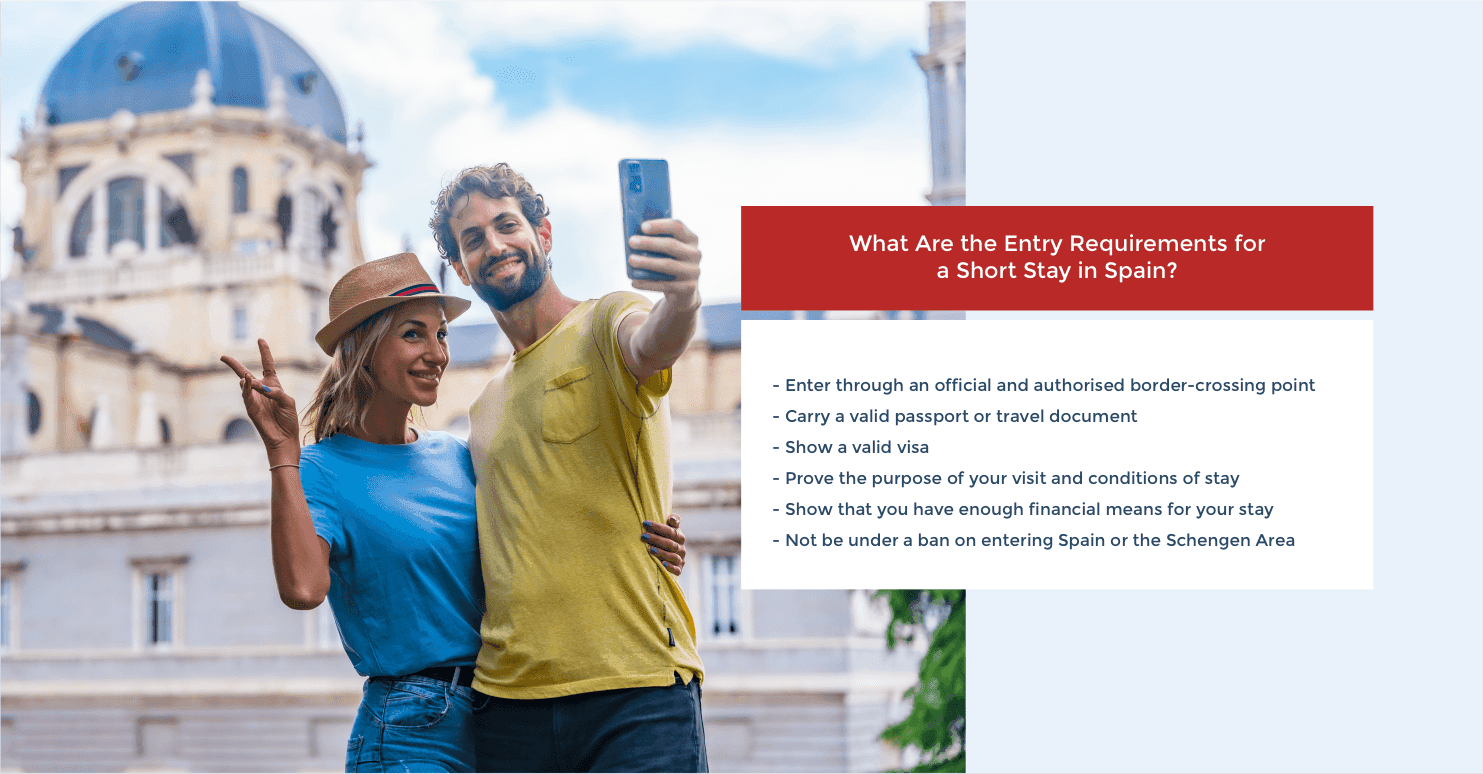
When you arrive in Spain for a short stay you need to meet a set of entry conditions at the border. These aren't just visa formalities; border officers can and do check these on arrival.
To enter Spain legally, you must:
Documents to Show at the Border
Financial Requirements
Spain has a fixed minimum for you to prove that you have enough money for your trip: €122 per person per day is required for the duration of your stay. And you should have at least €1,099 minimum, regardless of how short your trip is. So even if you're visiting for just a weekend, you need to show at least €1,099. This can be shown through bank statements, cash, traveller's cheques, or a credit card with sufficient limit.
Denial of Entry
You may be denied entry into Spain if you don’t meet the entry requirements or if there is already an entry ban against you. This can also happen if you’ve already used up your allowed stay - meaning you’ve spent 90 days in the Schengen Area within the last 180 days.
If this happens, the authorities will give you a written explanation telling you why you were refused entry. They will also inform you about how you can appeal the decision under Spanish rules. But even if you decide to appeal, the denial still applies. The appeal process won’t stop or reverse the decision immediately.
Yes, as an Indian citizen, you can technically extend a Spain Schengen visa, but the reality is quite strict. In the eyes of Spanish authorities, an extension is an exceptional situation, not a standard administrative request.
Conditions Required to Extend the 90-Day Stay
You cannot extend your visa simply because you want more time for sightseeing. An extension is only granted in these four specific scenarios:
If you meet the exceptional criteria, you must visit the Oficina de Extranjería (Foreigners' Office) or a designated National Police Station in the province where you are staying, along with the required documents.
When Should I Apply for Extension?
If you think you might need an extension, do not wait until your final days to act. The Oficina de Extranjería does not offer same-day approvals, and there is no emergency fast-track for tourists. Processing can take anywhere from a few days to several weeks depending on the province and how busy the office is. By the time you realise you need more time, it may already be too late to apply legally.
The practical rule to follow is: if any of the four exceptional circumstances apply to you, apply for extension as soon as the situation arises, ideally with at least 2 weeks remaining on your permitted stay.
The short-stay visa gets most of the attention, but the more interesting story for Indians in 2026 is the long-stay side. Spain has built one of the more accessible long-term residency paths in Europe with a lot of visa options available, each designed for a specific purpose of their move. Thousands of Indians in Spain are already building businesses, raising families, retiring, and working remotely - all legally, all through Spain's long-stay visa system.
A Spain National Visa allows you to stay in the country for up to one year at first, with the option to renew it if you continue to meet the requirements. This visa is issued by the Spanish Consulate in India and is completely different from the short-stay Schengen visa. If you hold an Indian passport, you must apply for this visa from India before you travel. There is no visa-on-arrival option.
But the hard truth is that the Spanish bureaucratic system is thorough, slow, and entirely in Spanish. That's not said to discourage you, it's said because people who go in unprepared end up with rejected applications, delays that cost them months, and frustration that could have been avoided. The system is designed to be thorough. And the only way to navigate a system this demanding and rigorous is to choose the right visa.
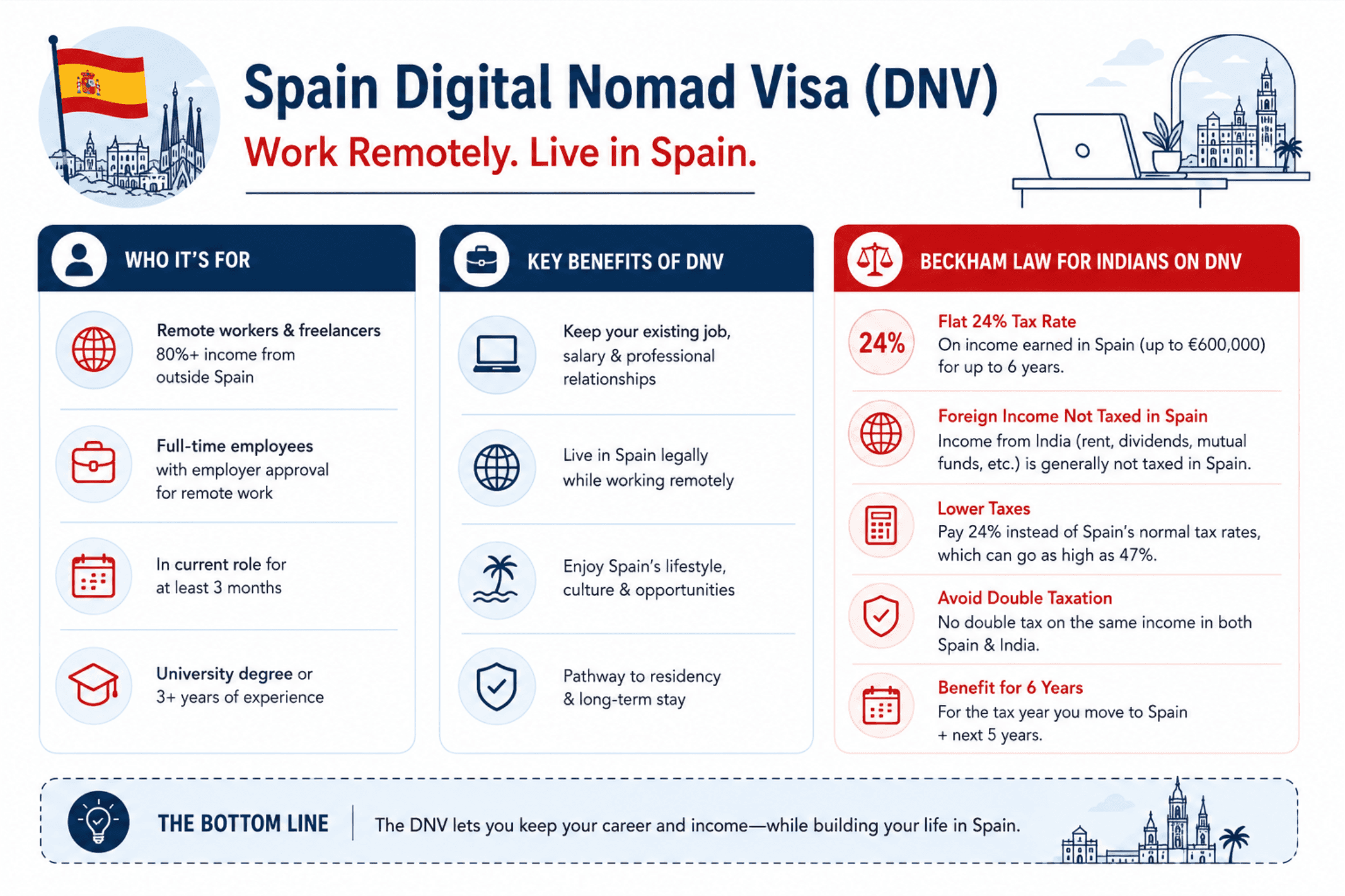
Launched in 2023 under Spain's Startup Act, the DNV is designed for those who earn their income remotely i.e. working for employers or clients based outside Spain. If you’re an Indian working in IT, consulting, finance, or any sector where remote work is the norm, and your employer has no objection to you working from another country, the DNV is probably the visa that was made for you. You keep your existing job, your existing salary, and your existing professional relationships - you simply move your laptop, and your life, to Spain.
Who it's actually for:
Beckham Law for Indians on DNV
The Beckham Law is a special tax benefit in Spain for foreigners who move there for work. If you qualify, you can pay a flat 24% tax rate on income earned in Spain (up to €600,000) for up to six years, instead of Spain’s normal tax rates, which can go as high as 47%.
Normally, once you become a tax resident in Spain, the Spanish government taxes your worldwide income. That means income from India, the US, or anywhere else could also be taxed in Spain. But the Beckham Law changes that.
Even though you live in Spain, you’re treated almost like a non-resident for tax purposes. In simple terms, Spain mainly taxes the income you earn from Spanish sources. Income from India, like rent from a property, dividends, or profits from mutual funds, is generally not taxed in Spain.This is especially useful for digital nomads and remote workers. Spain now allows people on the DNV to apply for Beckham Law benefits too. So if you’re an Indian professional working remotely from Spain for an Indian or international company, you could just pay 24% tax on your work income instead of the much higher normal Spanish tax rates.
You would still pay taxes in India on your Indian income if Indian law requires it, but you avoid being taxed twice on the same income by both countries.The benefit lasts for the tax year you move to Spain plus the next five years - six years in total. After that, you move into Spain’s regular tax system, where worldwide income is taxed.
If you want to live in Spain without working there, the Non-Lucrative Visa, or NLV, is the long-stay visa category for you. It has existed far longer than the Digital Nomad Visa and for decades, it has been the quiet favourite of retirees, wealthy individuals, and families wanting to live in Europe.
You can live in Spain indefinitely, as long as you can prove you don't need to earn money there. You are not allowed to work in Spain on this visa, not for a Spanish employer, not for a Spanish client. Your income has to come entirely from outside the country.
The basic requirement is that you can prove you have enough to support yourself (and any dependents) for the duration of your stay without relying on the Spanish economy for income.
The NLV suits you if:
One important note: if you land a job after your first year in Spain on this visa, you're legally required to switch to a work visa.
Spain’s student visa is for Indians who have gotten admission to a Spanish educational institution and want to pursue full-time studies there: university degree, vocational training course, certified professional program, master's, or doctoral program. The rule is, if your studies extend the threshold of 90 days, you will have to apply for the student visa. This visa is tied directly to your enrollment, and it lasts as long as you remain an active, registered student in good standing.
As a student on this visa, you are also permitted to work up to 30 hours per week during the academic term (as long as it doesn’t interfere with your studies). This can help you cover everyday expenses, especially since part-time jobs in areas like hospitality or tutoring are fairly easy to find. Upon completing your studies, you can get a post-study extension and stay in Spain for up to one year to look for a job before needing to transition to a work visa.
Most people assume you find a job in Spain and then apply for a work visa. That's not how this works.
A Spanish company that wants to hire an Indian national has to go through a process called the labour market test, proving that no suitable candidate exists within Spain or the EU before they can bring someone in from outside. The company applies for authorisation with Spain's immigration authorities. If that's approved, you're then notified to submit your visa application at the Spanish consulate in India.
This makes it one of the more demanding visa routes, because the process involves two parties, two sets of bureaucracy, and timelines that are mostly outside your control.
You can apply for the Spain Employee visa from India only if you:
This visa is for the immediate family members of foreigners who are already living in Spain as legal residents and EU/EEA nationals - to join them and build a shared life. It is not an independent visa. Everything about it flows from the person already in Spain: their residency status, their income, their housing, their legal standing. The family member in India is not applying to move to Spain on their own merit. They are applying to join someone who has already established a legitimate, documented life there.
The sponsor in Spain must have lived there legally for at least one year, with at least one more year of valid residency remaining at the time of your application.
It is one of the most emotionally significant visas, the one that reunites spouses separated by continents, brings parents to be near their children, and allows families to stop living across time zones. But it is also one that involves the most documentation, because the burden of proof rests almost entirely on the sponsor already in Spain rather than the applicant.
Who can be sponsored: spouses and registered partners of Spanish residents; unmarried children under 18 (under 21 if the sponsor holds Spanish citizenship); adult children who are financially dependent due to a disability; and parents over 65 who are financially dependent on the sponsor and can show that the sponsor is their primary means of financial support.
This visa is meant for highly skilled professionals that Spanish companies and research institutions cannot easily find within Europe. It is part of Spain’s work visa system, but it follows a much faster and simpler process. Unlike the regular Employee Work Visa, which can take months and requires proof that no EU candidate is available, this route assumes from the start that the person being hired has unique skills. Because of that, approvals are usually quicker and involve less paperwork.
For Indians, this visa is especially relevant. India is known for producing top talent in fields like technology, data science, artificial intelligence, cybersecurity, cloud infrastructure, financial services, and senior management. Many Spanish companies regularly look to India for this kind of talent. If you have been headhunted by a Spanish employer, transferred from an Indian office to Spain, or offered a specialised role that provides a salary well above average, this is most likely the visa your employer will apply for on your behalf.
Requirements for this visa:
As the name suggests, this visa is for Indians who already have a job in a company, and their employer is sending them to a registered entity or subsidiary operating in Spain. It is the visa that governs the movement of employees within a single corporate structure: from an Indian office to a Spanish headquarters. The company is constant. Spain is the new location. This visa allows the transfer to happen without the employee having to apply for jobs in Spain or their employer having to prove that no European candidate could fill the role.
There's just one requirement, that to qualify for this visa, you need to have been with the company for at least three months before the transfer.
The intra-company transfer visa is particularly common in India, as some of the country’s largest IT and consulting firms like Tata Consultancy Services, Infosys, Wipro, HCL, Tech Mahindra have operations across Europe, including Spain. And professionals like senior project managers, solution architects, delivery leads, and client engagement specialists are routinely moved between Indian delivery centres and European client locations.
This visa is known in Spain as the Autónomo Visa, and it is for Indians who do not want to work for anyone else in Spain. They want to build something of their own, like a consultancy, design studio, restaurant, technology product, or a freelance practice serving local clients. So, the self-employed work visa is basically for people who are not employees and are not passive income earners - they are workers, but they work for themselves, on their own terms, within Spain's economy.
The Autónomo Visa is also one of the most demanding visas. Spain does not simply take your word for it that your business will work. You need to prove it with the right qualifications or experience for your field, a clear and realistic business plan, evidence of capital, professional credentials, and in many cases a demonstrated understanding of the Spanish market you intend to enter. You should also have enough savings or funds to start your business and cover your living costs in the beginning.
How is it different from Digital Nomad Visa?
The main difference is where your income comes from. The DNV is for people working remotely for foreign companies or clients. The Autónomo Visa, on the other hand, is for those who want to earn from within Spain, by working with Spanish clients or running a business based there.
The Golden Visa was a route that allowed non-EU nationals, including Indians, to obtain Spanish residency in exchange for a significant financial investment in the country. Most people chose to buy real estate in Spain worth at least €500,000. Other options included investing in government bonds, company shares, or bank deposits in Spain. It was especially popular among high-net-worth Indians because it offered residency in Europe with very low stay requirements, allowed family members to be included, and could eventually lead to citizenship.
Why was it abolished?
In April 2025, Spain officially ended the Golden Visa program. The main reason was rising housing prices. The government believed that heavy property investment by foreign buyers was making homes less affordable for locals, especially in cities like Madrid, Barcelona, Valencia, and Málaga. The real estate investment route had already been under pressure for some time before it was finally removed.
What does it mean for Indians?
If you already had a valid Golden Visa before it was abolished, you’re not affected. Your permit remains valid and can still be renewed under the same rules. However, new applicants can no longer apply for this visa.
If you were planning to use this route, you’ll now need to look at other options based on your goals, such as the Non-Lucrative Visa, Digital Nomad Visa, or Entrepreneur Visa if you plan to invest in starting a business instead of buying property.
| Visa Type | Purpose |
| Entrepreneur Visa | For Indians who want to start or move an innovative business to Spain. This includes startups, scalable tech companies, or high-impact projects that Spain considers valuable for the economy. |
| Researcher Visa | For Indian scientists, academics, and researchers who have been officially accepted by a Spanish university, research centre, or institution to carry out an approved research project. |
| Internship Visa | For Indian students or recent graduates who have secured a formal internship or training position with a Spanish company or organisation. It allows them to gain practical work experience in Spain for a fixed period. |
| Relatives of Spanish Citizens Visa | For immediate family members such as spouses, children, and dependent relatives of Indian nationals who have Spanish citizenship. This visa grants residency rights based on EU family reunification rules rather than standard immigration pathways. |
| Work Permit Exemption Visa | For specific groups who are allowed to work in Spain without a standard work permit. This includes visiting professors/researchers, religious workers, crew members, performing artists at single events, and other narrowly defined roles that fall outside normal work authorisation rules. |
| Long-Term Recovery Visa | For people who previously held Spanish permanent residency but lost it after staying outside the EU for too long. This visa allows them to regain their residency status without restarting the full immigration process. |
No, not all Spanish national visas allow you to bring family members from India immediately or under the same conditions. While many of them are solely designed for families, others might have strict waiting periods or restricted definitions of who counts as a dependent.
Visas that allow immediate family accompaniment
These visas allow you to bring your family (spouse/partner, children, and parents) at the same time you apply.
Visas with Restrictions
Most of the standard work visas (for those employed by a Spanish company) follow a much stricter approach. You cannot bring your family immediately. You must usually live in Spain for one year and have renewed your residency permit at least once before you can apply for family reunification.
None of these visas are permanent from the start. The initial national visa is valid for up to one year. Once you're inside Spain, it converts into a residence permit (TIE card). From there, renewals are typically granted in two-year or three-year increments, as long as you continue to meet the conditions of your visa category.
If you legally live in Spain continuously for five years, you become eligible for long-term residency. After ten years of legal residence, you can finally apply for Spanish citizenship, subject to meeting the language and other legal requirements.
Spain has a strict legal window for renewals. You can submit your application starting 60 days before your TIE card expires, or up to 90 days after it expires. Outside that window, you're in more complicated territory.
Renewals happen entirely inside Spain. You don't need to return to India or visit a consulate again. Applications for Spain visa renewals can be made using two acceptable ways:
Many residents, particularly those who don't speak Spanish well, hire a gestor, a local administrative professional who handles paperwork submissions on your behalf. It's common, perfectly legal, and for non-Spanish speakers, it's usually the most practical option.
The documents list for a Spain visa is long enough that most Indian applicants, even careful ones, submit something wrong or missing on their first attempt. The frustrating part is that consular officers won't tell you what's missing before your appointment, they'll only tell you at the desk. Not only this, the documentation does not stay the same across visa categories. What you need as a student is different from what an employee, researcher, or entrepreneur is expected to submit.
The consequences are more disruptive than they might seem. Rescheduling a Spain visa appointment from India is not as simple as picking the next available slot. At peak travel seasons, finding an open appointment at a Spanish consulate can take anywhere from three to five weeks. That kind of delay can push back job start dates, academic enrollments, and travel plans by over a month! All because of a document that you never knew was required.
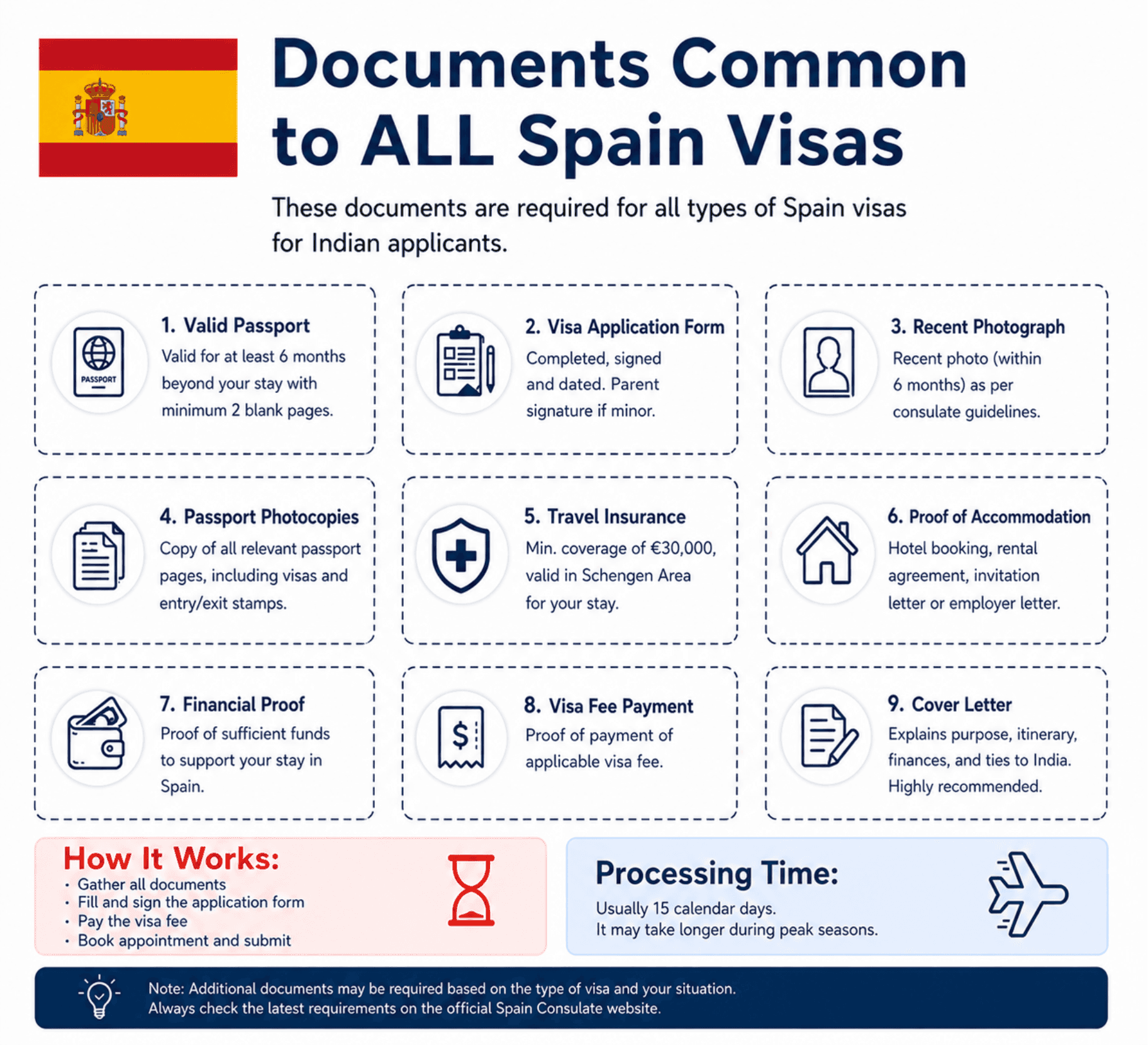
There are some documents that are required to apply for all kinds of Spain visas available for Indians. You have to keep them with you, regardless of the type of visa appointment you have. These include:
Photo Specifications
Along with your application form, you are required to submit one recent passport-sized photograph. The Spanish consulate is very strict about photo requirements. Any applications that include non-compliant photographs will be treated as incomplete and will not be processed until the issue is corrected.
The photograph needs to be in color and:
On top of the standard documents, you will need to show paperwork that explains why you are going, where you will be staying, and that you plan to come back. Spanish consular officers want to see clear evidence that you intend to leave before your visa expires. The documents that usually cover this are a return flight booking, hotel reservations for your entire stay, or an invitation letter from someone residing in Spain if you are visiting family or friends.
Beyond that, your specific documents required for Spain visa from India will depend on the type of short-stay visa you are applying for.
Schengen Visa
| Type of Spain Short-Stay Visa | Documents Required |
| Business Purpose | Invitation letter written in Spanish from the Spanish company, including the purpose of your visit, the nature of the existing business relationship between the company and yourself, your full name, passport number, and your expected travel dates. |
| Studying Purpose | Original and a photocopy of the certified letter from the Spanish institution where you will be studying mentioning the name and the exact start and end dates of the study program. |
| Other Purposes (tourism, leisure, medical treatment, etc) | Purpose specific proofs, such as hotel bookings, invitation letter, travel itinerary, doctor's appointment, medical reports, etc. |
Visa for Seaman
If you are an Indian seafarer travelling to join a vessel docked in Spain, you will need:
Your Seaman's Passbook
A Letter of Employment from your employer
An invitation letter from the Spanish maritime agency, which must include all details: your full name, date of birth, job position on board, the port where you will be boarding, and the expected duration of your assignmentVisa for Relatives of EU/EEA Citizens
If you are travelling to Spain because a family member is an EU, EEA, or Swiss citizen, you will need to prove two things: first, that you are actually related to that citizen, and second, that you are either travelling together or joining them in Spain.
For proof of the family relationship, you will need civil registry documents such as a birth certificate or marriage certificate, depending on your relationship. If you are in a registered partnership, a certificate of registration or any other document that establishes the partnership as equivalent to marriage will work.
Some document requirements get a little specific depending on where your EU family member currently is:
Spain issues long-stay national visas to Indians for many reasons, each of which require separate documents and proofs from your end. It’s very important to stay updated, because the application process for these visas from India is already very rigorous. You don’t need additional pressure of wrong/missing documents.
There are some common documents that you will need for all national visas of Spain:
| Document | Specifics |
| Medical certificate | If you're staying for more than 180 days, you'll need to submit the original plus a copy of a medical certificate, issued by a licensed medical practitioner, confirming that you don't have any condition that could pose a risk to public health. |
| Criminal record check certificate | Any adult applicant staying beyond 180 days also needs to provide a criminal record certificate covering the past 5 years - from every country they've lived in during that period. For Indian applicants specifically, this means getting your Police Clearance Certificate or PCC from your Regional Passport Office. |
The visa-specific document checklist for Indian applicants is given below:
Digital Nomad Visa
For the DNV, your entire employment setup needs to be provable on paper, not just your bank balance. Here's what you'll need specifically for the Digital Nomad Visa:
Non-Lucrative Residence Visa
An NLV-specific document requirement is the submission of your own copy of the EX-01 form. It is the official Spanish application form used to request residence authorization. Since you are applying for both a visa to enter the country and a temporary resident permit, the EX-01 is required for the residency authorization portion of the process. It includes legal declarations that you possess adequate financial means and private health insurance, and that you will not engage in any work or lucrative activity while in Spain.
Student Visa
Beyond the universal paperwork, here's what's additionally required for Spain Student Visa:
Employee Work Visa
For this visa, the paperwork and heavy lifting of all the additional documents is done by your employer:
Family Reunification Visa
There are two types of Family Reunification Visas: the one for the family members of non-EU citizens who hold a valid Spanish residence permit. The other one is for family members of Spanish citizens or EU/EEA/Swiss citizens who are living in Spain.
If your sponsor (the family member already residing in Spain) belongs to the first category, this is what you’ll need:
If your Sponsor is an EU/EEA National, the requirements are a bit different:
Highly Qualified & Intra-Company Transfer Visa
For both these visas, you’ll need the original and a copy of the residence permit issued by the Large Companies and Strategic Groups Unit. Your employer in Spain must first obtain this residence permit through the UGE before you apply for the visa.
Self-Employment and Freelance Visa
Along with the common documents, here's what you'll additionally need:
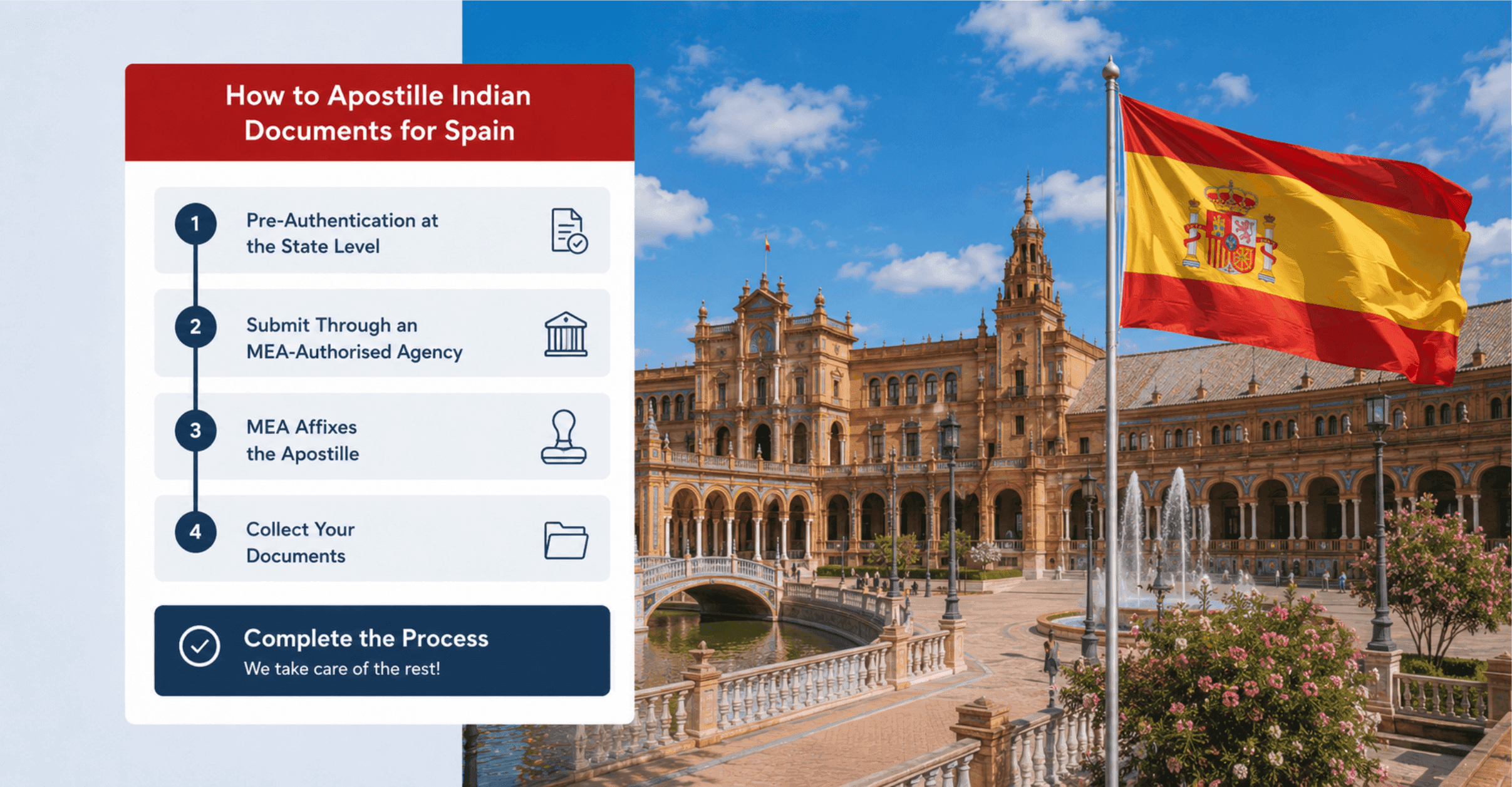
All the documents discussed above to apply for a Spain visa from India require an additional step - apostille. It is very important to get all your documents apostilled before submitting them for the visa application.
What is an apostille? An apostille is an international certification under the Hague Convention that authenticates your documents for use in member countries. Both India and Spain are members of the Hague Apostille Convention, so this process is significant and shouldn’t be skipped. In India, the Ministry of External Affairs (MEA) is the only authority for apostille/attestation services.
Step 1: Pre-Authentication at the State Level
Before your documents can be apostilled by the MEA, they first need to be authenticated at the state level. They confirm that the document is genuine before it moves up to the central government for the apostille.
The MEA has decentralised its apostille services across 16 cities through Branch Secretariats and Regional Passport Offices (RPOs). These are located in:
Ahmedabad · Bengaluru · Bhopal · Chennai · Chandigarh · Cochin · New Delhi · Guwahati · Hyderabad · Kolkata · Lucknow · Mumbai · Panaji · Jaipur · Patna · Thiruvananthapuram
Go to the RPO closest to you to get this done first.
Step 2: Submit Through an MEA-Authorised Agency
The MEA does not accept documents directly from individuals. You have to submit your documents through one of the outsourced agencies that are officially authorised by the MEA to handle this process on your behalf.
When you go, make sure you carry:The agency will take it from there and forward everything to the MEA for processing.
Step 3: MEA Affixes the Apostille
Once the MEA receives your documents from the agency, they verify the state-level authentication that was done in Step 1. If everything checks out, they affix an official Apostille sticker on the back of your document. Each sticker carries a unique identification number, which you can cross-verify on the MEA's official website. This is a useful way to confirm your apostille is legitimate before submitting it with your visa application.
Step 4: Collect Your Documents
Once the apostille has been affixed, your documents are returned to the same outsourced agency you submitted them through. You'll collect them directly from there. Make sure you keep the apostilled documents safe as these are what you'll be submitting to the Spanish consulate, and they can't be replaced easily.
After getting your Indian documents apostilled, they need to be translated to Spanish. Spain requires a Traducción Jurada (sworn translation), which is a legally certified translation done by an official translator approved by Spain’s Ministry of Foreign Affairs (MAEC). Without this, your documents simply won't be considered valid by Spanish authorities.
Option A: Use a Registered Agency in India (Easiest)
There are several translation agencies in India that contract directly with MAEC-authorized Traductor Jurados. They handle the digital scanning, coordination, and can deliver both digital copies and physical prints to your doorstep.
Option B: Hire a Translator Directly via the Spanish Government Website
If you want to cut out the middleman, you can find freelance sworn translators directly through Spain's Ministry of Foreign Affairs database. You can reach out to them via email to ask for a quote and turnaround time.
One of the most important requirements when applying for a Spanish visa from India is showing proof of sufficient funds. Messing this up is also the number one reason why most visa applications get rejected. Which is why it's important to know the exact financial requirements for the Spanish visa you're applying for as an Indian.
For short-stay Schengen visas, the requirement is pretty straightforward. You need to show that you have at least €122 per person per day, with a minimum of €1,099 regardless of the duration of your stay.
These documents are required across most Spain visa categories. Where things get a little tricky for Indian applicants is with National visas. Unlike Schengen visas, there is less flexibility here, and the exact figures vary depending on the visa category. We'll get into those in detail below.
To qualify for the DNV, you need to show a monthly income of at least 200% of Spain's national minimum wage, which is equivalent to roughly €2,849 per month or €34,188 per year. This is the baseline for a solo applicant.
If you're bringing family members along:
You can prove this income using work contracts, bank statements, payslips, or any other credible financial evidence.
The NLV is designed for people who want to live in Spain without working there, so naturally, Spain wants to see that you can sustain yourself financially. The minimum amount required is 400% of Spain's IPREM* (Public Multiple Effects Income Indicator), equivalent to €28,800, which needs to cover your living expenses for the first 12 months of your stay. If you have dependents joining you, add 100% of the IPREM for each family member in your care. You must also submit a cover letter explaining all your financial documents in detail.
*IPREM figures are reviewed annually; verify current rates before applying.
Before you apply for a Student Visa, you need to demonstrate that you can financially support yourself for the duration of your studies, or at least your first year. This is a fixed requirement, and Indian students are sometimes caught off guard by it, especially if they are counting on part-time work income from day one to cover their costs.
The specific financial requirements are a bit more layered, especially if a sponsor (like a parent) is funding your stay. The minimum amounts are:
If you've already paid for your accommodation in advance for the entire duration of your stay, that amount can be deducted from the required funds. So keep proof of that payment handy.
There is no separate personal savings threshold for this visa. The financial requirement is met through your employment contract, which confirms your salary and the terms of your engagement. So, you just need to have enough to cover daily expenses during your stay. This amount is set at €122 per person, per day for the duration of your trip, and a minimum of €1,099, even if you're going for just a few days.
In this visa, the financial burden falls on the sponsor in Spain (the family member already residing there), not the applicant travelling from India. They must demonstrate a stable monthly income of approximately €1,200-€1,500+ net, depending on family size. They should not rely on public funds to support the reunited family and have adequate housing with enough space for all. There's no fixed savings amount required, but financial stability and consistency matter more than a lump sum.
This visa has a clear salary threshold based on your role:
Your job offer or employment contract must reflect these figures to qualify. If the offer you've received is substantially below that range, your employer may be looking at a different visa category.
If you're being transferred to a Spanish branch of your company, your salary must meet at least the Spanish minimum wage and be in line with local market rates. Since your employer (the home company) covers costs, there's no personal savings requirement on your end.
For those planning to work independently in Spain, you'll need to make a convincing financial case through your business plan. Freelancers should show projected monthly earnings of at least €1,500-€2,000+.
Self-employed individuals need a business plan that demonstrates economic benefit to Spain and long-term financial sustainability. You are advised to show savings of around €8,000-€10,000+ to cover your initial months while your business gets off the ground.
To help you with the entire visa application process, the Ministry of Foreign Affairs of Spain has authorized BLS International as their official outsourced service provider in India. This means BLS is your first point of contact - they collect your documents, record your biometrics, and forward your application to the Embassy of Spain in India. The Embassy, however, makes the final call on whether your visa is approved or rejected.
India is divided into two jurisdictions - the Embassy of Spain in New Delhi and the Consulate General of Spain in Mumbai. You must apply at the BLS center that falls under your current area of residence.
| Spanish Consulates in India | Areas Covered |
| Embassy of Spain in New Delhi | Jammu and Kashmir, Uttar Pradesh, Arunachal Pradesh, Himachal Pradesh, Madhya Pradesh, Nagaland, Punjab, Bihar, Meghalaya, Chandigarh, Jharkhand, Manipur, Uttarakhand, West Bengal, Tripura, Haryana, Odisha, Mizoram, Delhi NCR, Sikkim, Lakshadweep Island, Rajasthan, Ladakh, Assam, and Andaman and Nicobar Islands. |
| Consulate General of Spain in Mumbai | Andhra Pradesh, Chhattisgarh, Goa, Gujarat, Karnataka, Kerala, Maharashtra, Tamil Nadu, Telangana and Union Territories of India: Dadra & Nagar Haveli, Daman & Diu, and Puducherry. |
One thing worth knowing is that your jurisdiction is decided by where you have been living for the past 6 months. So even if your passport was issued in Chennai but you've been living in Delhi, you apply through New Delhi.
Also, if you are not currently residing in India, say you live abroad and are just visiting, you cannot apply for your Spanish visa from India. You will need to apply through the Spanish consulate in your country of residence.
We have narrowed down the exact process of applying for a Spain visa from India here!
Step 1: Confirm Your Visa Type
The first step is figuring out which visa you actually need. Spain offers different visas depending on the purpose of your visit. Make sure you're applying for the right category before you do anything else, because the documents required will differ based on this.
Obtaining Initial Residence and Work Permit for Spain (not applicable for all visas)
Some of the Spain visas, like the self-employed work visa, require you to apply for an initial residence and work permit before applying for the visa. This is the process to follow in that case:
In case of the Employee Visa, this exact process will be done by your employer in Spain on your behalf. After the initial residence permit is approved by the Spanish authorities and signed by your employer, you have to apply for the Long-Stay Visa from India following the usual process.
Step 2: Book an Appointment
You must schedule an appointment at a BLS Spain Visa Application Centre (VAC)* through their official website. Make sure you book at the center corresponding to your state of residence. You can apply up to 6 months before your trip. But we recommend you to apply at least 3-4 weeks in advance, especially during peak summer seasons.
*If you are applying under the “Family Member of EEA/EU Citizens” category, you can also submit your visa application directly at the Consular Section in Delhi. To do this, you must first book an appointment by sending an email to emb.nuevadelhi.vis@maec.es
Step 3: Prepare Your Documents
Gather all the mandatory documents specific to your visa type. It's also a good habit to carry one or two photocopies of each document along with the originals. Consulates sometimes ask for them, and it saves you a last-minute run to the photocopy shop.
Step 4: Attend the Appointment
On your appointment day, arrive 15 minutes early at the VAC. There, you have to submit your physical application and documents. If you haven't provided fingerprints for a Schengen visa in the last 5 years, you will need to provide them during this visit.
The consulate may ask you for additional documents or information if anything is missing from your application. In some cases, they might also call you in for a personal interview.
Step 5: Pay the Visa Fee
Once your documents are ready, you'll need to pay the visa fee.
| Category | Amount (INR) |
| National Visa | 9,599 |
| Schengen Visas | 9,599 |
| Schengen Visas (children 6 to 12 years old) | 4,799 |
| Schengen Visas (children under 6 years old) | 0 |
| Visa for Family Member of EEA/EU Citizens | 0 |
| BLS International Service Charge | 1802 |
Spain visa from India fees current as of 2026, verify on the official BLS website before applying.
Step 6: Track Your Application
You can use the reference number on your receipt to track your status on the BLS website.
Step 7: Collect Your Passport
You'll receive an SMS/email when the passport is ready. Once processed, you can collect your passport from the center or have it couriered to your home for an additional fee.
Step 8: If Visa is Rejected
You will receive a rejection letter with reasons and you can appeal within 1 month or reapply with stronger documentation. The further steps you can take after your Spain visa application gets rejected are discussed in the next section of this guide!
The most recurring complaint among Indians is how difficult it is to get a Spanish visa appointment through BLS International. Because demand is incredibly high, mostly year-round, slots disappear within seconds of being released. June and July are the worst months by far, the summer surge from students and holiday travellers means some applicants in Delhi wait 6-8 weeks for a slot!
If you’re struggling to find an appointment, these tips may help:
What to do if you still can't find a slot from India?
If your travel dates are fixed and Spain appointments are completely unavailable, your only realistic backup plan is to change your main travel destination to another Schengen country, so it becomes your primary destination (where you spend the most nights), and book your visa slot through that country's respective portal instead.
Although not mandatory for all applicants, consulates in Delhi and Mumbai can call you for interviews, especially if you’re a first time applicant or they suspect any mismatches and need further clarifications. The interview questions for Indians travelling to Spain revolve mainly around their travel plans, purpose, itinerary, finances/sponsorship, stay details, etc, depending on their specific visa type.
Some of the most common questions are listed below, along with tips to how to answer them correctly:
| Questions | How to Answer |
| Why do you want to visit Spain? | Give a clear, specific purpose, like tourism, visiting landmarks, family trips, etc. You should mention 2-3 specific places you plan to visit. |
| What is your travel itinerary? | You should know your exact day-by-day plan. Be prepared to mention cities, major attractions, and approximate dates. Your spoken itinerary must exactly match the documents submitted. |
| Where will you be staying? | Provide the hotel name, city, and address. You should have pre-booked accommodation or a confirmed invitation letter. Never say "I'll figure it out there." |
| When are you travelling and for how long? | Tell them the exact departure and return dates matching your flight bookings. |
| Who is funding your trip? | Clearly answer whether it's self-funded or sponsored. If self-funded, reference your bank balance and salary. If sponsored, have a sponsor letter and their financial documents ready. |
| What do you do for a living? | Share your job title, employer name, and how long you've been employed. If you’re self-employed, mention your business. |
| Will you return to India after your trip? | This is the most important question. Answer with a firm "Yes" and back it up with your job, family, property, or any upcoming commitments in India. |
| Have you travelled abroad before? | Mention all previous international travel honestly. Never hide past travel or visa refusals. |
| Do you have travel insurance? | Confirm you have Schengen-compliant insurance covering a minimum of €30,000, valid for all countries and the entire duration of your stay. |
| Do you have family or contacts in Spain/Europe? | Answer honestly. If yes, clarify the relationship and that you are staying in a hotel (not with them), unless you have a legitimate invitation letter. |
| Why were you previously refused a visa? (if applicable) | Be honest and explain how you have made changes for the better, like better finances, clearer itinerary, stable job, etc. |
| What is your monthly income / how much will this trip cost? | Know your exact salary and total estimated trip budget. Your bank balance should ideally cover the trip cost comfortably. |
At the end of the day, you just have to be completely honest. The words out of your mouth and your intentions should clearly match the submitted documents. An actual face-to-face interview is relatively rare and is mostly reserved for complex cases, but being well-prepared regardless is always smart.
If you're planning a trip to Spain from India in 2026, the general rule of thumb for visa processing is 15 to 25 calendar days, but this can get extended to 45 days and vary significantly based on your visa type and the current season.
Tip for Indian Applicants: The "processing time" is not the only variable. In reality there are at least five sequential timelines stacked on top of each other: document gathering → apostille → translation → BLS appointment availability → consulate processing. During peak season, these can add up to 3-4 months from start to finish.
While applying for the Spain visa from India, you have to be very careful of websites or individuals promising guaranteed appointments or visas for an extra payment. BLS International does not allow any third party to sell appointments on their behalf. If someone is offering that, it's a scam. Always use the official BLS website to book appointments and make payments.
You may also come across Indian travel agents offering visa assistance. However, they are simply the middleman who helps you prepare your paperwork. Even if you hire an agent, you must still appear in person at a BLS center to provide your biometrics.
Spanish Consulates in India are known for being very strict about the visa application process. A small mistake, a missing document, or a number that doesn't add up, and your application is refused. Spain's visa refusal rate for Indian applicants currently hovers around 15% to 17%.
This sounds intimidating but not unusually so given that Spain processes one of the highest volumes of Schengen applications globally. This high volume naturally leads to a higher absolute number of rejections, with financial discrepancies and weak ties to India topping the list of reasons.
Data from consulates in Mumbai and Delhi show that visa rejections are never random, and have a traceable reason. Here are the most common ones, so you can avoid making the same mistakes.
Consulates do not just look at your final balance, they scrutinize your overall financial behavior.
| Rejection Reason | Explanation |
| Sudden, Unexplained Deposits | Dumping a large sum of money (like a sudden loan) into your account right before applying raises a massive red flag. |
| Mismatch with Income | If your bank statements show irregular activity or an average balance that does not align with your declared salary or profession, the visa officer will doubt your financial stability. |
| Missing Tax Records | Failing to provide your ITR or Form 16 for the last two years is a common cause for rejection. |
| Unstamped Bank Statements | Submitting internet bank downloads without the official bank stamp and signature. |
Under Schengen rules, you are assumed to be a potential immigrant unless you prove otherwise. The embassy needs to be absolutely certain you will return to India.
| Rejection Reason | Explanation |
| Lack of Employment Proof | If you are employed, you must provide an official Leave Sanction Letter from your employer. If you are a business owner, you need proper registration documents. |
| Demographics | Young, single applicants with entry-level jobs, no property assets in India, or no immediate family dependencies face higher rejection rates if their home ties aren’t properly documented. If you fall into this category, your cover letter and financial documentation need to work significantly harder than average. |
| No Bonafide Certificate | Students applying without a clear bonafide certificate or proof of ongoing enrollment from their Indian institution are frequently rejected. |
Your travel plan must make logical and financial sense.
| Rejection Reason | Explanation |
| The Generic Itinerary | Just mentioning that you are going for "business meetings" without specifying who you are meeting, where, and why will hurt your application. |
| Mismatched Bookings | Your flight dates, hotel bookings, and the dates mentioned in your cover letter must match perfectly. Even a one-day discrepancy can lead to a refusal. |
| Applying to the Wrong Consulate | If you are spending 5 days in France and 3 days in Spain, you must apply via France. If you apply to Spain because you think it's easier, they will reject it for wrong jurisdiction. Spain must be your main destination (longest duration of stay). |
This is an automated checklist item, and technical errors here mean instant rejection.
| Rejection Reason | Explanation |
| The €30,000 Rule | Your policy must have a minimum coverage of €30,000 for medical emergencies. |
| Date Mismatch | The insurance must cover your entire trip, including the transit days. A policy that falls even one day short will cause a rejection. |
| Unapproved Insurer | The policy must be issued by an insurance company officially recognized by the Schengen consulates in India. |
Your cover letter is your voice. It introduces who you are, what you do, why you are going, who is paying, and why you will eventually return home to India. A generic, two-line cover letter fails to establish trust and often leads to a quick rejection.
Your passport must be valid for at least 3 months after your planned return date and have at least 2 blank pages. Damaged or torn passports are rejected immediately.
If you had a previous Schengen rejection (from Spain or any other country) and you try to hide it or fail to explain it in your cover letter, your visa will likely be denied due to lack of credibility.
If your Spain visa application is rejected by the Spanish Consulate in India, you will receive a standard refusal letter with checked boxes indicating the reason. Now, you are left with two completely different paths forward: Appeal the decision or Submit a brand-new application. Choosing the wrong path can waste months of your time.
Option 1: File an Appeal (Recurso de Reposición)
An appeal is a formal request asking the Consulate to re-examine your file because you believe they made a mistake or misread your documentation.
The Protocol:
You must file the appeal within one month from the day after you or your agent collected the passport and refusal letter.
The appeal letter must be written in Spanish. If you write it in English, the consulate is highly likely to ignore or reject it.It must be submitted in-person to the Spanish Embassy in New Delhi or the Consulate General in Mumbai (depending on who processed your visa).What to Include in the Appeal Letter:
The consulate legally has up to one month to respond. If your travel date is less than 6 weeks away, an appeal is usually useless because you won't get an answer in time.
Option 2: Reapply (Submit a Fresh Application)
For 90% of Indian tourists, reapplying is faster, easier, and much more successful than appealing. You don’t have to wait for a specific time duration; you can book a new appointment with Spanish consulates the very next day.
Before appealing or reapplying, do not just submit the same file again. You must carefully address the specific box they checked. If you don't fix the root cause, you will get a second rejection stamp.
What You Should Do: Appeal vs. Reapply?
| Scenario | Best Route | Why? |
| Your travel date is within the next 30-45 days. | Reapply | Appeals take too long. A new application can be processed in 15 days. |
| The visa officer made a clear, factual error. | Appeal | You can prove them wrong instantly without paying the visa fee again. |
| Your paperwork was weak, missing documents, or unorganized. | Reapply | An appeal won't save a bad application. You need to build a fresh, better file. |
The moment your Spain visa gets approved, you'd think the hard part is over. And honestly, it mostly is. But there's still a gap between having the visa and actually being ready to leave from India. A lot of small things can slip through if you're not paying attention. You can refer to this basic checklist below:
You've landed. The flight is done, your neck pillow is somewhere in your bag, and you're finally in Spain. But before you step out of the airport, there's a small process you need to get through first. It's straightforward, but knowing what to expect makes it a lot less confusing. This is what happens after your flight lands.
Since you are arriving from India, you will be arriving from a non-Schengen country and must pass through passport control before doing anything else. Look for signs saying "Control de Passportes" or "All Passports" (do not queue in the EU/EEA lanes).
Have your passport open to your visa page. While it’s rare, border officers can occasionally ask to see your return flight ticket, hotel bookings, or proof of travel insurance. Keep these handy in your cabin baggage or on your phone offline.
With the rollout of EES in April 2026, on your first entry, you will no longer get a passport stamp. Instead, you'll undergo a biometric registration at the airport kiosk, where you’ll undergo facial and fingerprint scan. It takes about 5-10 minutes extra time for each person.
Once through immigration, follow the signs for "Recogida de Equipajes" (Baggage Reclaim). Look at the overhead monitors to find your flight number and its corresponding conveyor belt.
Walk through the customs area "Aduana". If you have nothing to declare, walk through the Green Channel "Nada que declarar". If you have something to declare, walk through the Red Channel "Mercancías que declarar".
Also, Spain has strict rules on bringing in food items from outside the EU. Do not carry loose dairy, meat products, or large quantities of seeds/plants, as they can be confiscated. This includes items commonly packed by Indian travellers such as homemade snacks, mithai, pickles, and certain dried spices.
Important: If you are carrying more than €10,000 in cash (or equivalent), you must declare it.
Do not leave the airport without a way to access Google Maps or translation apps. You have two main options:
Tip: Avoid generic souvenir tech kiosks, as they tend to overcharge. A local prepaid SIM with plenty of data usually costs around €15-€20.
You can pay for almost everything using a credit/debit card or forex card in Spain. However, keeping €20-€50 in cash is smart for emergencies. If you have a travel-friendly forex card such as Niyo Global or a BookMyForex card, these work well at most Spanish ATMs and mostly offer better conversion rates than standard Indian debit cards.
If you need cash at the airport, use a bank ATM inside the terminal rather than currency exchange counters like Global Exchange, as they have terrible conversion rates. Also, when withdrawing, always select "Without Conversion" / "Debited in Euros" if the machine asks. This makes sure that your Indian bank does the currency conversion, saving you massive dynamic currency conversion fees.
Do not accept rides from random people offering taxis in the arrivals hall. Follow the official signs for transport. Spain has a great connectivity of taxis, metro, and trains.
Although the country is generally very safe, its major airport arrival halls and train stations are
hotspots for highly skilled pickpockets. Keep your passport, cash, and phone inside a zipped bag close to your body, and never leave your luggage unattended while buying a transit ticket or a SIM card.We have researched and prepared a list of some popular apps below, that can help simplify your overall stay in Spain:
| App Name | What it Offers |
| Renfe | The official Spanish railway app. Use it for high-speed AVE tickets between cities |
| Cabify | Spain’s version of Uber. It is much cleaner and more professional than standard taxis. |
| Free Now | Perfect for hailing official city taxis. It gives you a fixed price so you don't have to worry about the meter running high. |
| Citymapper | While Google Maps is okay, Citymapper is the king of public transport in Madrid and Barcelona. |
| Glovo | Spain’s primary delivery app (like Swiggy/Zomato). |
| DeepL | While Google Translate is good, DeepL is significantly more accurate for European Spanish nuances. |
| AlertCops | The official security app for citizens. It has an SOS button that sends your location directly to the nearest police station. |
| Airalo or Holafly | Since you're coming from India, these apps allow you to buy an eSIM before you land. |
If you're on a tourist or short-stay visa, you're good to go from here. But if you've moved to Spain on a long-stay visa, there's a bit more to handle once you're out of the airport.
The list of important things to do doesn't end when you come out of the airport. There are still a few things that you have to take care of, for a smooth arrival in this new country. The Spanish bureaucracy can feel a bit confusing when you first land, but following these steps in order can make things easier for you.
Registering at the Local Town Hall (Ayuntamiento)
Before you can get your actual residency card, Spain needs to know exactly where you are staying. This process is called Empadronamiento. As soon as you sign a long-term rental contract for an apartment or room, you need to book an appointment at your local Ayuntamiento. You have to carry your passport, your rental agreement, and a utility bill to prove where you live. They will hand you a certificate called a Volante de Empadronamiento, which is officially recognized proof of your Spanish address and is required for almost every official process.
Get your NIE and Open a Bank Account
Your NIE (Número de Identidad de Extranjero) is basically your tax identification number in Spain. It's not a physical card on its own, it's just a number, and is required for all transactions, like opening a bank account, signing a rental contract, buying property, setting up utilities (like internet or electricity), getting a mobile phone contract, registering for social security, or starting a job.
You can either apply for it from India through the consular office or upon your arrival in Spain through the foreigner’s office or certain police stations. It’s advised to apply for it as soon as possible, within 2-3 weeks of your arrival.
Note: If you are an Indian on a Digital Nomad Visa, applying and receiving the NIE certificate is already a part of the application process.
Once you have this number, your very next step should be to walk into a local Spanish bank and open a regular bank account, as you will need it to pay for your phone bill, rent, and future official government fees.
Apply for Your TIE
While the NIE is just a number, the TIE (Tarjeta de Identidad de Extranjero) is your actual, physical plastic residency card complete with your photo and fingerprint, and it's the most important document you'll need as a long-stay resident in Spain. By law, you are supposed to start this process within your first 30 days of arriving in Spain.
You will need to book an online appointment at your local immigration office or National Police station, pay a small government tax at the bank, and bring your passport, your visa, photos, and that address registration paper you just got from the town hall. After they take your fingerprints, it takes about a month for your physical card to be printed and ready for pickup.
Register with Social Security
If you are moving to Spain to work, intern, or if you are a digital nomad, you must get a Social Security Number (Número de Afiliación a la Seguridad Social). If you are employed by a Spanish company, your HR department will usually handle this for you. But if you are self-employed or doing it yourself, you will need to register online through the official Spanish government app for Social Security registration Importaas using your NIE and passport. Getting this number is a must because it officially registers you to pay taxes and, most importantly, gives you access to Spain’s fantastic public healthcare system.
Also Read Our Guide for Canadians Moving To Spain
Spain is one of the most rewarding countries an Indian traveller can visit, or move to. The weather, the culture, the food, the quality of life, it delivers on every front. But between hunting for appointment slots that disappear in seconds, gathering documents that nobody told you about, figuring out which BLS centre to go to, and then waiting nervously for your passport to come back - it can feel like a lot.
Almost every Indian traveller going through this process has had at least one moment of "why is this so complicated?”
The honest truth is just that the system isn't very forgiving of mistakes, not even minor ones. And since appointments are so hard to come by in the first place, you really don't want to go in underprepared.That's exactly why we created this guide, keeping all of your doubts and questions in mind.
Good luck, and enjoy Spain when you get there!
Your complete guide to fingerprinting in India, covering Aadhaar, passports, background checks, immigration, property registration, and your legal rights.
Everything Indians need to move to New Zealand in 2026 - visas, Green List occupations, taxes, healthcare, schools, jobs, and a full moving checklist.

Planning to move to Australia from India in 2026? This complete guide covers Australia PR pathways, skilled visas, jobs, IELTS/PTE, state nomination, costs, housing, healthcare, salaries, and settlement tips for Indian migrants.

