
By Sejal Jain · Updated July 1, 2026
Moving to Australia from India is one of the most preferred decisions among Indian nationals, alongside Canada and the UK. The country uses a points-based immigration system, has strong demand for skilled workers, and has an established Indian community across all major cities.
This guide covers the full process - from choosing the right visa to settling in after arrival. It includes visa types, eligibility rules, skills assessments, English test requirements, costs, housing, employment, healthcare, tax, and education.
More than 800,000 Indian-born people currently live in Australia, making Indians the second-largest overseas-born group in the country. This number grows each year, driven mainly by skilled and student visa programs.

Australia's economy is diverse, with strong sectors in technology, healthcare, engineering, and finance. These are the same fields where many Indian professionals are trained and experienced, which makes the transition to the Australian job market more straightforward than in some other countries.
Salaries are significantly higher than in India for comparable roles. A software engineer earns between AUD 100,000 and AUD 130,000 in Australia, compared to a much lower figure in Indian cities. This difference remains meaningful even after accounting for the higher cost of living.Flight times between major Indian and Australian cities range from 10 to 14 hours. This is shorter than flights to Canada or the UK, which makes annual visits to India more practical and affordable.Australia's public healthcare system covers permanent residents at no additional cost. Prescription medicines are subsidised through the Pharmaceutical Benefits Scheme. State schools are free for permanent residents and citizens. These factors reduce the overall cost of raising a family compared to countries with private-only healthcare and education systems.Australia's immigration system is administered by the Department of Home Affairs. The system operates through a combination of employer-sponsored, skills-based, family-based, and humanitarian visa programs.
For Indian nationals, the most commonly used pathways are:Australia's skilled migration program uses an Expression of Interest (EOI) system called SkillSelect. This is a database managed by the Department of Home Affairs. Applicants submit an EOI and are ranked by their points score. The department or state/territory governments then invite high-scoring applicants to apply for a visa.
A higher points score improves the chances of receiving an invitation. The minimum points threshold for most skilled visas is 65 points. However, in practice, the scores at which invitations are issued are higher, often between 75 and 90 points or more, because competition among applicants is high.Points are awarded across several criteria:| Criterion | Points (maximum) |
| Age (25–32 years) | 30 |
| English language ability (Superior) | 20 |
| Skilled employment outside Australia (8+ years) | 20 |
| Skilled employment in Australia (8+ years) | 20 |
| Educational qualifications (PhD) | 20 |
| State/territory nomination | 5 or 15 |
| Partner skills | 10 |
| Designated language other than English | 5 |
| Study in regional Australia | 5 |
| Professional Year in Australia | 5 |
| Accredited community language | 5 |
| STEM qualification | 10 |
| NAATI credentialed translator/interpreter | 5 |
Points for age decrease progressively after 32 and become zero at age 45. This is one of the most significant constraints for older applicants.
Note: STEM points (10) are given only if your qualification is assessed as equal to an Australian STEM bachelor’s degree or higher. A 3-year Indian engineering degree is usually accepted under the Washington Accord, but you should confirm with the assessing authority.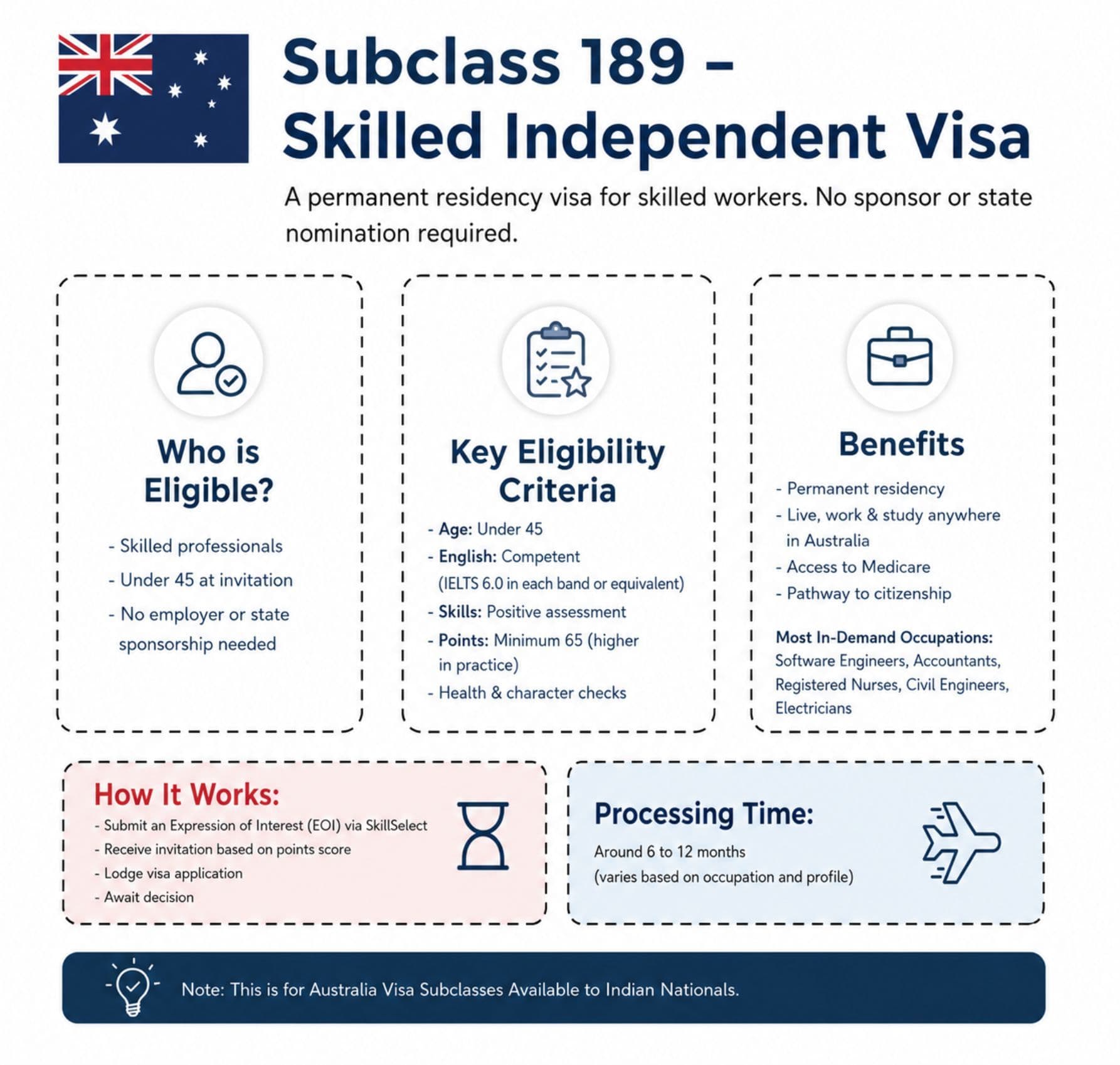
The Subclass 189 visa is the primary permanent residency visa in Australia's skilled migration program. It does not require sponsorship from an employer or nomination from a state government. Applicants need a positive skills assessment, a qualifying English test score, and a points score high enough to receive an invitation through SkillSelect.
The 189 visa grants the holder and their family members the right to live, work, and study anywhere in Australia permanently. It also provides access to Medicare and a pathway to citizenship after meeting residency requirements.The most competitive occupations under subclass 189 are those on the Medium and Long-term Strategic Skills List (MLTSSL). Examples include software engineers, accountants, registered nurses, civil engineers, and electricians.Key eligibility criteria:The Subclass 190 visa is also a permanent residency visa but requires nomination from one of Australia's states or territories. Each state nominates applicants based on their own skill shortages and migration targets.
Being nominated under the 190 program adds 5 points to a candidate's total points score. More importantly, the points cutoff for state-nominated invitations is often lower than for the 189, making it more accessible for applicants who cannot achieve the higher thresholds required for the independent stream.Recipients of a 190 visa are expected (though not legally compelled) to live and work in the nominating state for at least two years. The visa itself grants permanent residency across all of Australia.Each state publishes a list of occupations it is willing to nominate. This list changes frequently, sometimes monthly, based on labour market conditions. Applicants must match an occupation on the state's current list and meet the state's specific criteria, which vary considerably.The Subclass 491 is a temporary visa valid for five years. It is points-tested and requires nomination from a state or territory or sponsorship from a qualifying family member living in a regional area of Australia.
The 491 visa adds 15 points to the applicant's total score, making it easier to receive an invitation than the 189 or 190 for candidates with lower base scores. However, 491 holders must live and work in a regional area of Australia for at least three years and meet income thresholds before they can apply for permanent residency through the Subclass 191 visa.Regional areas under this scheme include most of Australia except Sydney, Melbourne, and Brisbane's urban cores. Cities like Adelaide, Hobart, Canberra, Darwin, Perth, Gold Coast, Sunshine Coast, and Newcastle are classified as regional for this purpose.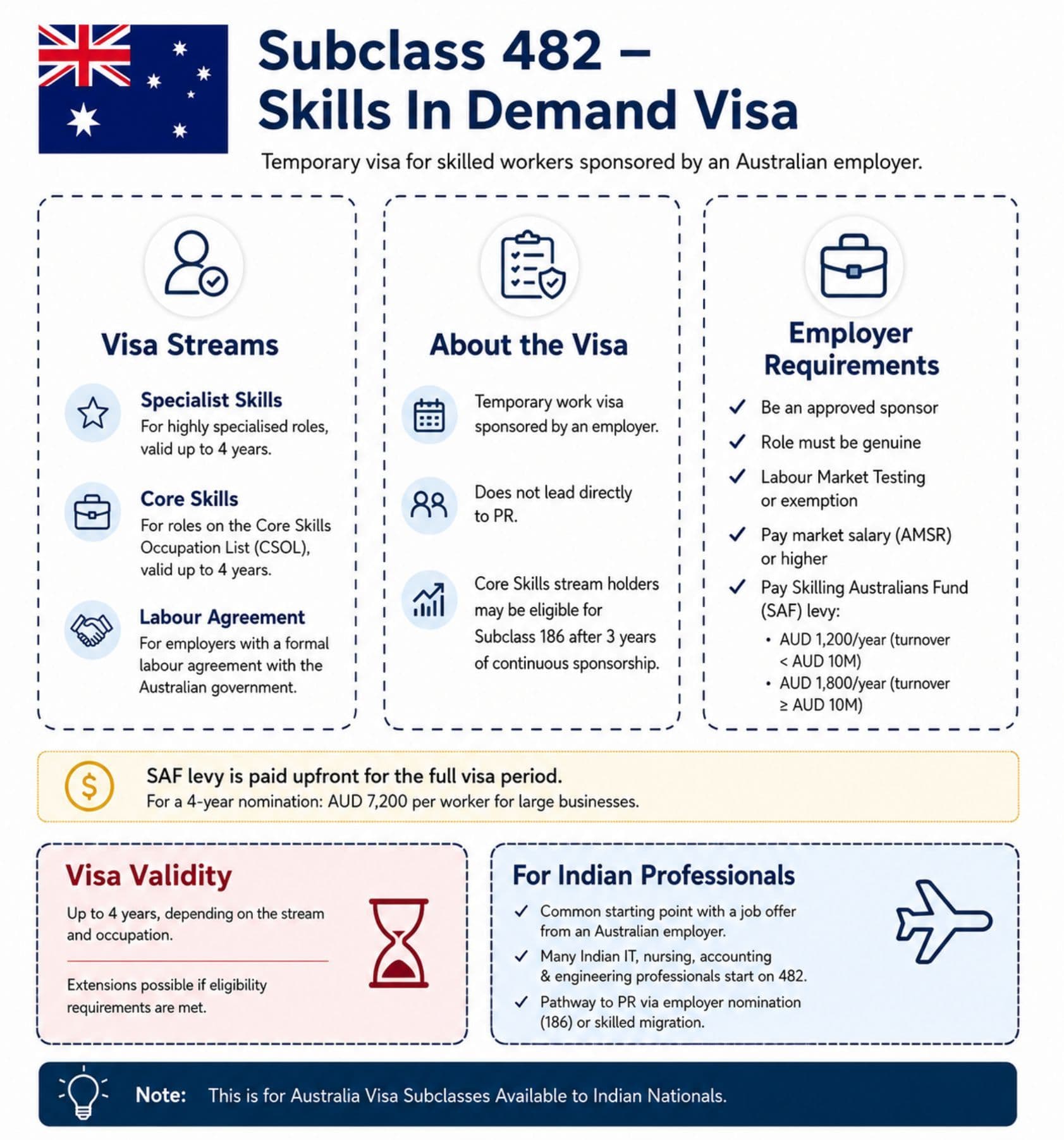
The Subclass 482 Skills in Demand visa allows Australian employers to sponsor skilled workers from overseas on a temporary basis. The visa has three streams:
The Subclass 186 is a permanent residency visa sponsored by an approved Australian employer. It has two main streams:
The Subclass 485 visa is designed for international students who have completed qualifications in Australia. It allows recent graduates to live and work in Australia temporarily while they gain experience and (if they choose) prepare for a skilled migration application.
There are two streams:Partner visas allow Australian citizens, permanent residents, or eligible New Zealand citizens to sponsor their spouse or de facto partner for residency. The process is two-stage:
The Subclass 500 visa allows Indian nationals to study full-time at a registered Australian institution (CRICOS-registered). The visa grants 40 hours of work rights per fortnight during study and unlimited hours during official vacation periods.
Australia is the fourth-largest international education destination globally. Tuition costs for international students range from AUD 20,000 to AUD 45,000 per year for undergraduate programs and AUD 22,000 to AUD 55,000 for postgraduate. Students are required to hold Overseas Student Health Cover (OSHC) for the duration of their stay.The student visa pathway is important because it frequently leads to the 485 graduate visa and subsequently to a skilled migration pathway.Parents of Australian citizens or permanent residents can apply to join their children in Australia. The most common parent visa subclasses are:
The points test is the foundation of Australia's General Skilled Migration program. Understanding how each criterion is scored allows applicants to plan their migration timeline strategically.
Age points are the highest available (30 points) but decline sharply after 32:
| Age at invitation | Points |
| 18–24 | 25 |
| 25–32 | 30 |
| 33–39 | 25 |
| 40–44 | 15 |
| 45 and over | 0 |
Age is fixed, it cannot be improved. For applicants over 40, it becomes critical to maximise every other criterion.
English proficiency is assessed through standardised tests. The test score must be obtained before the EOI is submitted (or updated). Results are valid for three years.
| Proficiency level | IELTS | PTE Academic | TOEFL iBT | OET | Points |
| Competent | 6.0 in each band | 50 in each communicative skill | 12 L / 13 R / 21 S / 24 W | B in each test | 0 |
| Proficient | 7.0 in each band | 65 in each communicative skill | 24 L / 24 R / 23 S / 27 W | B in each test (OET) | 10 |
| Superior | 8.0 in each band | 79 in each communicative skill | 28 L / 29 R / 28 S / 30 W | A in each test | 20 |
Most Indian applicants take IELTS (International English Language Testing System) or PTE Academic (Pearson Test of English). The PTE is administered at Pearson-authorised centres in major Indian cities.
Achieving a Superior score (IELTS 8.0 in all bands) adds 20 points, the same as 8+ years of skilled employment. For younger applicants with strong English, targeting this is one of the most efficient ways to increase their score.| Qualification | Points |
| PhD (doctorate) | 20 |
| Bachelor degree or higher (not PhD) | 15 |
| Diploma or trade qualification | 10 |
| Award (recognised qualification below diploma) | 10 |
The qualification must be Australian or assessed as equivalent to an Australian qualification. For Indian degrees, this requires a skills assessment or a separate qualification assessment by a body such as AIM (Australian Institute of Management) or the relevant assessing authority.
Work experience is split into two categories: experience in Australia and experience outside Australia. Australian experience scores higher per year.
Skilled employment in Australia:| Period | Points |
| 1–2 years | 5 |
| 3–4 years | 10 |
| 5–7 years | 15 |
| 8+ years | 20 |
Skilled employment outside Australia:
| Period | Points |
| 3–4 years | 5 |
| 5–7 years | 10 |
| 8+ years | 15 |
Work experience must be in the same occupation (or a closely related one) as the nominated skilled occupation. It must be paid employment, voluntary work does not count.
A STEM (Science, Technology, Engineering, Mathematics) qualification from an Australian institution or from an overseas institution assessed as equivalent adds 10 points. This was introduced to address Australia's need for STEM-qualified skilled workers.
A Professional Year in Australia, a structured program of professional development and work experience available in accounting, IT, and engineering, adds 5 points. These programs run for approximately 44 weeks.NAATI certification (National Accreditation Authority for Translators and Interpreters) in any language other than English adds 5 points. Some Indian applicants with professional-level competency in Hindi (if they are non-native Hindi speakers) or other Indian languages may be eligible.Every applicant under the skilled migration program must have their skills assessed by the relevant assessing authority before submitting an EOI. The assessment confirms that the applicant's qualifications and experience meet Australian standards for the nominated occupation.
The assessing body depends on the occupation. Key assessing bodies for Indian professionals:| Assessing Body | Occupations |
| Engineers Australia (EA) | Civil, mechanical, electrical, chemical, software engineers |
| Australian Computer Society (ACS) | ICT professionals (software developers, systems analysts, database admins) |
| CPA Australia / CAANZ / IPA | Accountants |
| AHPRA | Medical practitioners, nurses, pharmacists, physiotherapists |
| TRA (Trades Recognition Australia) | Electricians, plumbers, mechanics, cooks |
| VETASSESS | Over 360 professional, technical, and trade occupations |
| ACWA | Social workers |
| Speech Pathology Australia | Speech pathologists |
| AIQS | Quantity surveyors |
| ANMAC | Nurses and midwives |
Engineers Australia uses a competency-based assessment. Applicants must demonstrate that their qualifications and work experience meet the Stage 1 competencies of the Australian Engineering Competency Standards.
There are four pathways:ACS assesses ICT occupations. The assessment has two parts: a qualification assessment and a skills assessment. ACS maps the applicant's prior qualifications and work experience to an equivalent Australian qualification level and determines which ANZSCO occupation the applicant's skills match.
ACS offers two main tracks:For medical professionals, doctors, nurses, pharmacists, physiotherapists - AHPRA (Australian Health Practitioner Regulation Agency) handles registration rather than a standalone skills assessment. Indian medical practitioners must:
VETASSESS assesses applicants across a wide range of professional, technical, and trade occupations - more than 360 in total. Many Indian applicants in occupations not covered by a specialist body (such as marketing professionals, project managers, human resources managers, and chefs) go through VETASSESS.
VETASSESS has two assessment types:The most frequent reason for negative or delayed skills assessments from Indian applicants involves mismatched job titles. An applicant may have the title "Software Developer" in India but their duties include project management or business analysis. The assessing body evaluates actual duties performed, not job titles.
Applicants who worked in roles with evolving duties, common in Indian IT environments, must provide detailed position descriptions and evidence of actual work performed. This includes project documentation, team structures, and employment contracts or offer letters.English proficiency is compulsory for all skilled migration applicants. The minimum requirement is Competent English (typically IELTS 6.0 in all four bands or equivalent). Some visa subclasses require Proficient or Superior English.
For employer-sponsored visa subclasses (482, 186), the English requirement can sometimes be waived for applicants from certain countries or in certain occupations, though this does not apply broadly to Indian nationals.The International English Language Testing System is the most widely used test in Australia's immigration context. There are two versions:
Pearson Test of English Academic is increasingly used by Indian applicants, particularly because results are available within 2–5 business days, often sooner (compared to 13 days for IELTS). PTE is a computer-based test conducted at Pearson test centres.
PTE scores are mapped to the IELTS scale for migration purposes. Achieving 65 in each communicative skill equates to Proficient English; 79 in each equates to Superior.Test fee: approximately INR 16,000–17,000.The Occupational English Test is specifically designed for healthcare professionals. Nurses, doctors, and allied health applicants who find the general English tests challenging can use OET, which tests English in a medical context. A minimum score of B in each component is required for Competent English; for some AHPRA registrations, higher scores may be needed.
For the Subclass 190 and 491 visas, state and territory nomination is required. Each jurisdiction maintains its own occupation list, eligibility criteria, and application process.
Australia has six states (New South Wales, Victoria, Queensland, South Australia, Western Australia, Tasmania) and two territories (Australian Capital Territory and Northern Territory). Each has a distinct labour market, and this is reflected in their nomination priorities.The process works as follows:
New South Wales (NSW)
NSW is home to Sydney, Australia's largest city. It is highly competitive for nominations because of its desirability. The NSW Skilled Nominated Visa program focuses on critical skills. NSW has imposed additional criteria for many occupations, including requiring applicants to have a genuine intention to live and work in NSW and sometimes requiring prior employment or connection to the state.Key occupations commonly nominated: software engineers, registered nurses, civil engineers, accountants, ICT project managers.VictoriaVictoria (Melbourne) runs the Victorian Skilled Migration program. Victoria uses an EOI system of its own (VSMR - Victoria Skilled Migration Registration) and selects applicants based on skills, experience, and connection to Victoria.Victoria prioritises occupations in health, technology, construction, and education. It also has interstate transfer provisions for 491 holders.QueenslandQueensland's Skilled Nominated program requires applicants to demonstrate a genuine commitment to living and working in Queensland. Queensland also has a strong regional component applicants willing to settle in regional Queensland are given preference for the 491 visa.Key occupations: civil engineers, construction project managers, accountants, software engineers, healthcare professionals.South AustraliaSouth Australia (Adelaide) is one of the more accessible states for Indian applicants because the points cutoffs from invitations issued through SA are often lower than NSW or Victoria. South Australia has a strong focus on retention, nominees are expected to remain in the state.SA also runs specific programs for international graduates from South Australian universities.Western AustraliaWestern Australia's economy is driven significantly by mining, resources, and construction. Occupations in these sectors are well-represented on WA's nomination list. The state has its own Skilled Migration Program (WASMP) and processes applications independently.WA is geographically distant from other major cities, which affects lifestyle considerations, though Perth itself is a large, well-serviced city.TasmaniaTasmania's skilled migration program accepts applicants with lower points scores than the east coast states. It actively recruits skilled migrants to address skill shortages. The state has a significantly smaller population and a quieter pace of life. Many Indian applicants use Tasmania as an entry point before relocating once they obtain permanent residency.Tasmania also offers pathways for 491 visa holders who cannot meet the 190 criteria elsewhere.Australian Capital Territory (ACT)Canberra is Australia's capital city and home to federal government departments and agencies. The ACT Skilled Nominated Visa accepts applications from skilled workers across a broad range of occupations. Canberra has a high standard of living, strong public infrastructure, and lower housing costs than Sydney or Melbourne.Northern TerritoryThe Northern Territory accepts applicants for occupations that address its specific labour market needs, often in healthcare, engineering, and education in remote and regional areas. The NT's nomination adds 15 points (as a regional nomination), which is significant.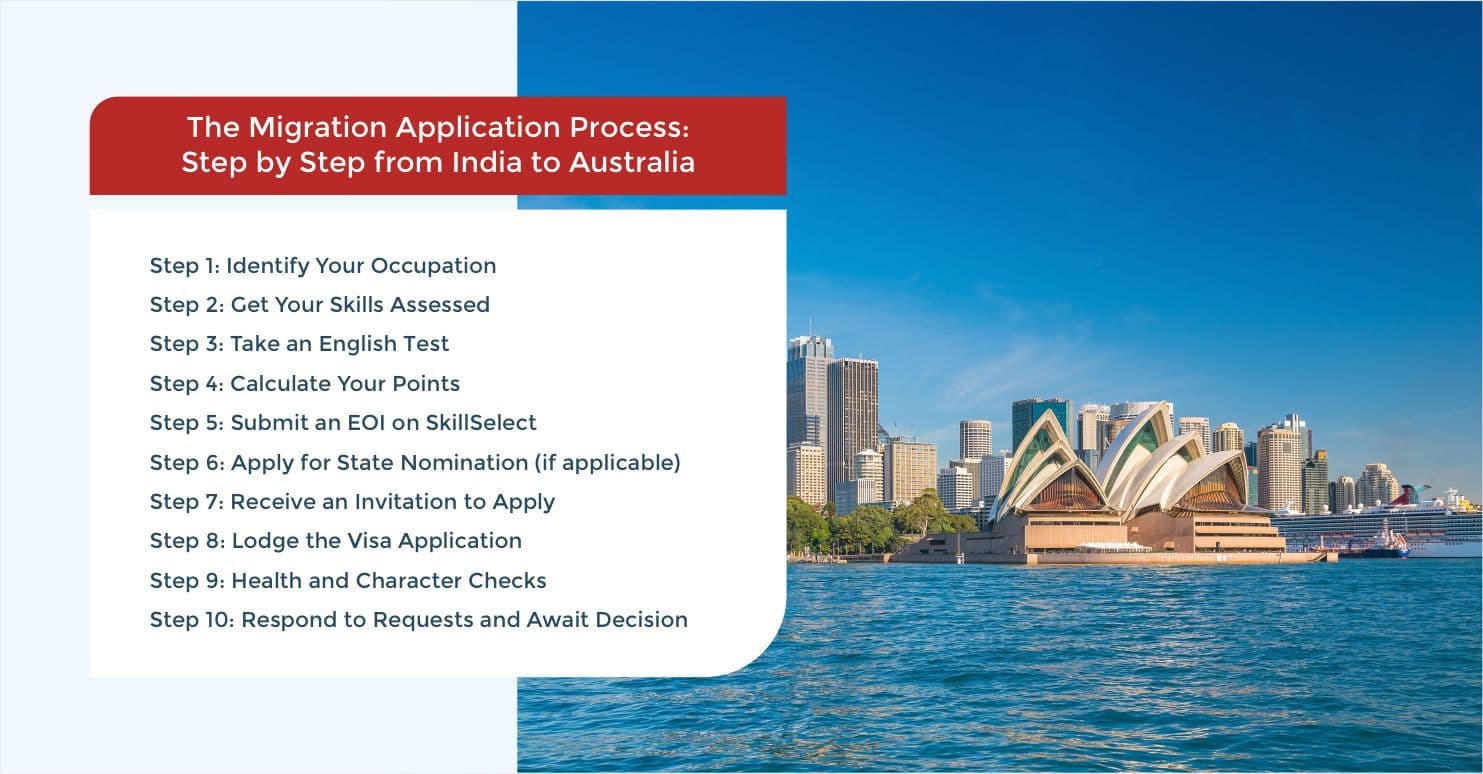
The skilled migration application process from India involves multiple sequential steps. Each step must be completed before the next can begin in most cases.
Step 1: Identify Your OccupationConfirm that your occupation is on the MLTSSL or the relevant skilled occupation list. The ANZSCO (Australian and New Zealand Standard Classification of Occupations) code for your occupation determines which assessing body handles your assessment and which visa subclasses are available to you.Use the Department of Home Affairs' official occupation list tool to check. Some occupations appear on multiple lists, which gives more flexibility.Step 2: Get Your Skills AssessedApply to the relevant skills assessing body. Submit your qualification documents (original degree certificates, transcripts, mark sheets), employment evidence (offer letters, experience letters, pay slips, tax documents), and pay the assessment fee.Allow 8 to 16 weeks for the assessment outcome. Prepare your documentation thoroughly incomplete submissions are a common reason for delays.Step 3: Take an English TestBook and sit an accepted English language test (IELTS, PTE Academic, TOEFL iBT, OET, or Cambridge C1 Advanced). Schedule this step well in advance of your target application date since test sittings are limited and results take time.If your first attempt does not achieve the required score, you can retake the test. Use the higher of your valid scores.Step 4: Calculate Your PointsUsing the official points calculator on the Department of Home Affairs website, estimate your total score. Be conservative do not include points you are not confident about or have not yet earned.If your score is below 65, review what can be improved (English score, Professional Year, regional connections, partner skills).Step 5: Submit an EOI on SkillSelectCreate an account on the SkillSelect portal and submit your Expression of Interest. Include your occupation, points claims, and visa subclass preferences (189, 190, 491). You can nominate multiple states/territories in your EOI.Update your EOI if your circumstances change higher English test scores, new work experience, or a Professional Year completion will increase your points.Step 6: Apply for State Nomination (if applicable)If you are targeting a 190 or 491 visa, submit a state nomination application through the relevant state's portal. Prepare state-specific documentation as required. Most states require a completed EOI before a nomination application can be submitted.State nomination processing times vary from a few weeks to several months. Some states send invitations to EOI holders (rather than accepting direct applications), so you may need to wait.Step 7: Receive an Invitation to ApplyOnce invited by the Department of Home Affairs (or by a state/territory), you have 60 days to submit a full visa application. This deadline is strict. Do not wait for the invitation before preparing your documents.Step 8: Lodge the Visa ApplicationSubmit the visa application through ImmiAccount (the Department of Home Affairs' online portal). Pay the application fee at the time of lodgement. Attach all required documents.Step 9: Health and Character ChecksYou will be asked to complete:Compiling documentation correctly is critical. Missing or improperly certified documents are the most common reason for delays and requests for further information.
All documents not in English must be translated by a NAATI-accredited translator. Original-language documents and their translations must both be submitted.
Documents submitted electronically must be scanned clearly. The Department of Home Affairs accepts colour scans of original documents. Documents submitted as certified copies must be certified by a Justice of the Peace (JP), a notary public, or a person authorised to witness documents under applicable law in the country of origin.The total cost of migration from India to Australia is substantial. Applicants should plan for both the direct costs of the visa application and the indirect costs of preparation and relocation.
| Visa Subclass | Primary Applicant | Secondary Adult | Secondary Child |
| Subclass 189 | AUD 4,640 | AUD 2,325 | AUD 1,160 |
| Subclass 190 | AUD 4,640 | AUD 2,325 | AUD 1,160 |
| Subclass 491 | AUD 4,640 | AUD 2,325 | AUD 1,160 |
| Subclass 482 (SID) | AUD 3,115 | AUD 1,560 | AUD 780 |
| Subclass 186 (ENS) | AUD 4,770 | AUD 2,385 | AUD 1,195 |
| Subclass 485 | AUD 1,895 | AUD 945 | AUD 470 |
These fees are charged in Australian dollars and are non-refundable even if the application is refused.
| Assessing Body | Approximate Fee |
| Engineers Australia | AUD 700–900 |
| ACS | AUD 500–700 |
| VETASSESS | AUD 600–1,200 |
| ANMAC | AUD 500–700 |
| TRA | AUD 300–600 |
| Test | Approximate Fee (INR) |
| IELTS Academic/General | INR 17,000–18,500 |
| PTE Academic | INR 15,000–17,000 |
| TOEFL iBT | INR 15,000–18,000 |
| OET | INR 21,000–23,000 |
Registered Migration Agents (RMA) are licensed by the Office of the Migration Agents Registration Authority (OMARA) in Australia. Using an RMA is not mandatory but is advisable for complex cases.
Agent fees vary:Health examinations are conducted by authorised Panel Physicians in India. Costs vary by clinic and location but are typically AUD 200–350 per adult and AUD 150–200 per child.
Police clearance for Australian visa applications is obtained through the NCRB via the DigiLocker portal or the official NCRB PCC service at pcc.ncrb.gov.in which cost approximately INR 500–700 depending on processing type. State-level clearances are required by some states in addition which need 4–6 weeks. Clearance is valid for 12 months from issue date. For other countries where you have lived, fees depend on the country.
For a family of two adults applying for a Subclass 189 visa with professional assessment and agent support:
| Item | Approximate Cost |
| Visa application (2 adults) | AUD 6,965 |
| Skills assessment (main applicant) | AUD 700 |
| English tests (2 adults) | INR 34,000–37,000 |
| Health examinations (2 adults) | AUD 500–700 |
| Police clearances | INR 3,000–5,000 |
| Migration agent fees | AUD 4,000–7,000 |
| Document translation (estimated) | AUD 200–500 |
| Total (approximate) | AUD 12,500–15,000 + INR 40,000 |
This does not include relocation costs (air freight, shipping, flights), initial accommodation in Australia, or early settlement costs.
Rent in Sydney will be your biggest shock. Not because it's expensive in absolute terms, you probably knew that, but because the competition is brutal. Vacancy rates have been below 2% for the last two years, which means a decent 2-bedroom in Parramatta gets 20 applications on the day it's listed.
Renting rather than buying is almost universal for new arrivals. Most newly arrived migrants rent for the first 1–3 years while establishing credit history, employment stability, and familiarity with neighbourhoods.
Rental prices vary significantly by city:| City | Median Weekly Rent (Unit, 2BR) | Median Weekly Rent (House, 3BR) |
| Sydney | AUD 750–950 | AUD 950–1,400 |
| Melbourne | AUD 580–780 | AUD 680–950 |
| Brisbane | AUD 580–750 | AUD 680–900 |
| Perth | AUD 600–780 | AUD 700–1,000 |
| Adelaide | AUD 480–620 | AUD 550–720 |
| Canberra | AUD 550–700 | AUD 700–900 |
| Hobart | AUD 480–620 | AUD 550–700 |
The main platforms for rental listings in Australia are:
Most Indian migrants book serviced apartments or short-stay apartments (via Airbnb, Airbnb Plus, or corporate housing platforms) for the first two to four weeks while searching for a permanent rental. Serviced apartments cost AUD 1,500–3,500 per week in major cities.
Some families stay with Indian friends or family members initially, which is common within the Indian community particularly in Melbourne, Sydney, and Brisbane.Permanent residents can purchase property in Australia. Foreign nationals on temporary visas have restrictions they must apply for approval from the Foreign Investment Review Board (FIRB) before purchasing established dwellings. The FIRB application fee varies by property value: for a property valued at AUD 1 million, the fee is AUD 14,100. New properties (off-the-plan or newly built) are available to temporary residents without FIRB approval in most circumstances.
The property purchase process in Australia:Australia is a car-dependent country outside the inner zones of Sydney and Melbourne. Public transport trains, trams, and buses serves inner and middle suburbs of major cities well but becomes less frequent in outer areas. Having a car is near-essential in most suburbs of Perth, Brisbane, Adelaide, and Canberra.
In Sydney, the Opal card is used on trains, buses, and ferries. Melbourne uses the Myki card on trains and trams. These prepaid travel cards can be purchased and topped up at convenience stores and transport stations. Monthly commuting costs using public transport in a major city range from AUD 150 to AUD 300 depending on distance.Uber and DiDi operate in all major Australian cities and are widely used. Taxi services are available but significantly more expensive.Cycling infrastructure is improving in major cities, and many Indian migrants find cycling a practical option for short commutes in flat, inner-city areas of Adelaide, Brisbane, and Melbourne.The job market question Indian migrants ask most often isn't "will I find work", it's "how long will it take." For IT professionals with cloud skills, the honest answer is 4–8 weeks from arrival if your LinkedIn is active and your resume is reformatted. For engineers and nurses, 2–6 weeks. For accountants without CPA Australia membership, allow 3 months.
Information Technology
Australia's technology sector has grown significantly, driven by digital transformation across banking, government, healthcare, and retail. The demand for software engineers, data scientists, cloud architects, cybersecurity analysts, and DevOps engineers consistently exceeds local supply. Indian IT professionals are among the most sought-after in this market, particularly those with Java, Python, cloud computing (AWS, Azure, GCP), and data engineering backgrounds.Major technology employers in Australia include Commonwealth Bank, Westpac, NAB, ANZ (all with large internal tech teams), Telstra, Amazon, Google, Microsoft, Atlassian, Canva, and a growing startup ecosystem in Sydney and Melbourne. Government digital agencies including the Australian Taxation Office, Services Australia, and various state digital agencies also employ large numbers of IT professionals.Consulting firms (Deloitte, KPMG, PwC, Accenture, TCS Australia, Infosys Australia, Wipro) have substantial Australian operations and frequently hire Indian professionals, particularly those already in Australia on migration visas.Healthcare and NursingAustralia faces a significant nursing shortage, particularly in aged care, regional hospitals, and intensive care. Registered nurses from India who meet AHPRA registration requirements are in strong demand. Entry-level registered nurses in Australia earn AUD 65,000–75,000; nurses with specialist certifications (ICU, ED, theatre) earn AUD 80,000–100,000 or more.Indian-trained doctors have a structured pathway to registration in Australia, though it is demanding. General practitioners who establish practices in regional or remote areas receive additional incentives and are in particularly short supply.Civil and Structural EngineeringAustralia's construction sector has experienced sustained growth driven by infrastructure investment highways, rail, bridges, tunnels, and commercial development. Indian civil and structural engineers are well-regarded, particularly for large infrastructure projects. Engineers with BIM (Building Information Modelling), geotechnical, structural design, or project management backgrounds find strong employment.Sydney and Melbourne are the centres of Australia's construction market, but Perth's resources sector also generates high demand for civil and mining engineers.Accounting and FinanceChartered Accountants (CA) and CPAs from India find strong career pathways in Australia. The Institute of Chartered Accountants of India (ICAI) membership is recognised by CPA Australia and Chartered Accountants Australia and New Zealand (CAANZ) through mutual recognition agreements, though additional exams may be required for full membership.Roles in corporate accounting, audit, tax consulting, and financial advisory are in consistent demand. Big Four accounting firms (Deloitte, PwC, EY, KPMG) and second-tier firms (Grant Thornton, BDO, RSM) are significant employers of Indian professionals.Beginning the job search from India before arrival is possible but has limitations. Australian employers prefer to interview candidates who can attend in person. Remote interviews are more common post-pandemic, but final hiring decisions often wait for the candidate to be locally available.
Platforms for job searching:The Australian résumé format differs from the Indian CV format in several ways:
Australian workplace culture differs from Indian corporate culture in ways that affect professional relationships and career advancement. Understanding these differences helps Indian migrants integrate more effectively.
Communication style: Australian workplaces tend toward flat hierarchies. Senior managers are addressed by first name. Disagreeing with a manager's view in a meeting politely and constructively is expected rather than discouraged. The indirect communication patterns common in Indian professional environments, where criticism is softened significantly or avoided entirely, can be misread in Australia as lack of confidence or poor communication.Time expectations: Meetings start on time and run to their scheduled duration. Arriving late is taken seriously. Deadlines are firm asking for an extension is acceptable, but only if requested in advance, not after the deadline has passed.Work-life integration: Australian employees, on average, take their full four weeks of annual leave and leave on time without social pressure to stay late as a signal of dedication. Overwork is not celebrated. This represents a significant cultural shift for many Indian professionals who come from environments where long hours are a visible marker of commitment.Socialisation: Workplace socialisation including Friday afternoon drinks, team lunches, and informal conversations is part of professional relationship-building in Australia. Indian professionals who avoid these interactions due to alcohol or dietary preferences (many Indians are vegetarian or avoid alcohol for religious reasons) can find networking more challenging. Being willing to attend social events, even without drinking, matters.Qualifications from Indian institutions are respected, particularly from IITs, NITs, BITS Pilani, and prominent medical colleges. However, work experience in the Indian context does not always directly translate into equivalent seniority in Australia.
Common adjustments include:Salary benchmarks for Indian professionals in Australia (approximate annual, full-time, 2024–2025):
| Occupation | Annual Salary Range (AUD) |
| Software Engineer (3–6 years) | 90,000–130,000 |
| Senior Software Engineer | 130,000–180,000 |
| Data Scientist | 100,000–160,000 |
| Cloud Architect | 140,000–200,000 |
| Cybersecurity Analyst | 100,000–150,000 |
| Civil Engineer (3–6 years) | 80,000–110,000 |
| Senior Civil Engineer | 110,000–150,000 |
| Registered Nurse | 75,000–95,000 |
| ICU/ED Nurse (specialist) | 90,000–110,000 |
| Medical Doctor (general practice) | 150,000–250,000+ |
| Accountant (CA or CPA) | 75,000–110,000 |
| Senior Accountant / Finance Manager | 110,000–150,000 |
| Project Manager (IT or construction) | 110,000–170,000 |
| Secondary School Teacher | 70,000–95,000 |
| University Lecturer (continuing) | 100,000–130,000 |
| Pharmacist | 80,000–110,000 |
Salaries are stated as gross (before tax). The actual take-home pay depends on individual tax rates and superannuation contributions (which are employer-paid, in addition to salary, at 12% as of 2026). Superannuation is effectively additional compensation, a person earning AUD 100,000 gross receives AUD 11,500 into their retirement savings account above and beyond their salary.
Salary negotiation in Australia is expected and not considered impolite. Job offers are typically made with some room to negotiate. Candidates who research market rates and make informed counteroffers are respected. Using SEEK Salary Insights, LinkedIn Salary, or Glassdoor to benchmark salaries before negotiation is common practice.
Contracts in Australia are typically either permanent full-time, permanent part-time, or casual. Fixed-term contracts and contract/consulting arrangements are common in IT. Award wages set legal minimums for most occupational categories, but most professional roles are engaged above the award.Australia has strong employment protections. The Fair Work Act 2009 governs minimum conditions of employment. The National Minimum Wage is set annually by the Fair Work Commission. As of 2025-26, it is AUD 24.95 per hour.
Workers are entitled to: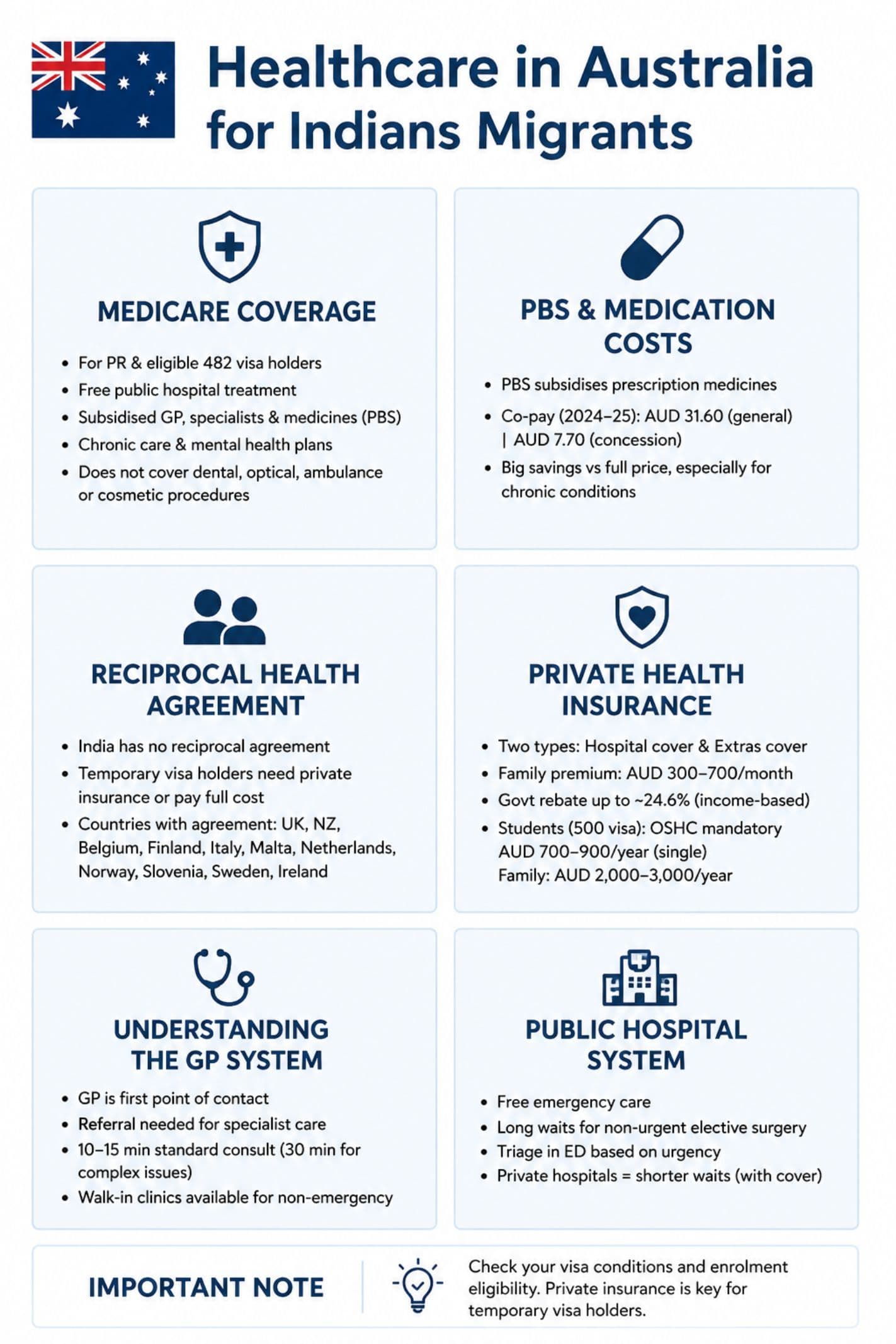
Australia operates a universal public health insurance scheme called Medicare. It covers Australian citizens and permanent residents. Temporary visa holders are not covered by Medicare unless they are from a country that has a reciprocal healthcare agreement with Australia.
However, holders of certain temporary work visas, including some 482 visa holders, may be eligible to enrol in Medicare under a Ministerial Order if their visa does not carry condition 8501. Check your visa grant letter and confirm eligibility with Services Australia before purchasing private health insurance.Medicare provides access to:
The Pharmaceutical Benefits Scheme subsidises many prescription medications. As of 2024–25, the maximum co-payment per PBS prescription is AUD 31.60 for general patients and AUD 7.70 for concession card holders. This is a significant reduction from the full cost of many medicines.
Indian migrants who manage chronic conditions (diabetes, hypertension, thyroid disorders, all common among Indian-origin populations) will find that PBS-subsidised medications are far cheaper than in India for high-cost pharmaceuticals, though cheaper generics widely available in India may not have an exact equivalent in Australia.India does not have a reciprocal healthcare agreement with Australia. This means Indian nationals on temporary visas (482, 485, 500, 309) are not eligible for Medicare. They must hold private health insurance or pay out-of-pocket for medical care.
Countries that do have reciprocal agreements with Australia include the United Kingdom, New Zealand, Belgium, Finland, Italy, Malta, the Netherlands, Norway, Slovenia, Sweden, and the Republic of Ireland.Private health insurance in Australia has two components:
General Practitioners (GPs) are the primary point of contact for medical care in Australia. All non-emergency specialist care requires a referral from a GP. This gatekeeper model is different from the more direct specialist access common in India.
GPs in Australia provide a wide range of services including chronic disease management, mental health assessments, vaccination, women's health, minor procedures, and referrals. Finding a regular GP ("My Doctor") and maintaining that relationship is important GPs who know their patients' histories provide better continuity of care.Appointments with GPs last 10–15 minutes for standard consultations. For complex issues, a long appointment (30 minutes) should be requested. Walk-in urgent care clinics exist in most suburbs for non-emergency acute issues when your regular GP has no same-day availability.Australia's public hospitals are funded by state and territory governments and the federal government. Wait times for elective procedures in public hospitals can be long months to years for non-urgent procedures such as joint replacements or hernia repairs. For urgent and emergency care, the public system is well-equipped and free at the point of care.
Emergency departments triage patients by clinical urgency using the Australasian Triage Scale (ATS). Category 1 (immediately life-threatening) is seen immediately. Category 5 (less urgent) may wait up to 2 hours. Waiting times for lower-category presentations in major city hospitals can be long.Major teaching hospitals associated with Group of Eight universities are particularly well-resourced. Royal Melbourne Hospital, Sydney Hospital, Princess Alexandra Hospital (Brisbane), and Royal Perth Hospital are among the flagship public institutions.Mental health support is available through:
Dental care is not covered by Medicare for adults. Routine check-ups, fillings, extractions, and orthodontic treatment are private costs. Dental care costs in Australia:
Opening a bank account in Australia is straightforward for newly arrived migrants. Most major banks allow applicants to open an account from overseas up to three months before their arrival.
Australia's banking sector is dominated by four large banks ("the Big Four"):
To open an account as a new arrival:
Transferring money from India to Australia must comply with Reserve Bank of India (RBI) regulations. Under the Liberalised Remittance Scheme (LRS), Indian residents can remit up to USD 250,000 (approximately AUD 380,000 at current rates) per financial year for permitted purposes including emigration.
Services for international transfers:New arrivals in Australia start with no credit history. This affects the ability to obtain a credit card, mobile phone contract, or car loan. Building credit history takes approximately 6–12 months of consistent bill payments, bank account activity, and potentially a secured credit card.
Comprehensive Credit Reporting (CCR) Australia's credit reporting framework considers both negative information (late payments, defaults) and positive information (consistent repayment history).Australia's tax system is administered by the Australian Taxation Office (ATO). All individuals earning income in Australia are subject to Australian tax law, regardless of their citizenship or migration status.
The Tax File Number is a unique identifier issued by the ATO. Everyone earning income in Australia needs a TFN. Without a TFN, employers are required to withhold tax at the highest marginal rate (currently 47% including the Medicare levy).
TFN applications are submitted through the ATO website. Australian residents typically receive their TFN within 28 days.Tax residency in Australia is determined by the ATO based on domicile, habitual abode, and residency tests not by visa status. A person who moves to Australia with the intention of staying is generally a tax resident from the date of arrival.
| Taxable income | Tax on this income |
| $0 – $18,200 | Nil |
| $18,201 – $45,000 | 16% over $18,200 |
| $45,001 – $135,000 | $4,288 + 30% over $45,000 |
| $135,001 – $190,000 | $31,288 + 37% over $135,000 |
| $190,001+ | $51,638 + 45% over $190,000 |
Source: https://www.ato.gov.au/tax-rates-and-codes/tax-rates-australian-residents
| Taxable income | Tax on this income |
| $0 – $135,000 | 30% of income |
| $135,001 – $190,000 | $40,500 + 37% over $135,000 |
| $190,001+ | $60,850 + 45% over $190,000 |
Source: https://www.ato.gov.au/tax-rates-and-codes/tax-rates-foreign-residents
A Medicare levy of 2% applies on top of income tax for residents eligible for Medicare. A Medicare Levy Surcharge of 1–1.5% applies to higher-income earners who do not hold private hospital insurance.Non-residents are taxed at a flat rate of 32.5% on all Australian-source income up to AUD 120,000, with no tax-free threshold.
Superannuation is Australia's compulsory retirement savings system. Employers are required to contribute 11.5% of an employee's ordinary time earnings to a superannuation fund in 2024. The rate increases to 12% from 1 July 2025.
Superannuation contributions are taxed at a concessional rate of 15% rather than the individual's marginal rate. Funds accumulate tax-advantaged until retirement.Indian migrants who leave Australia before retirement can access their superannuation as a Departing Australia Superannuation Payment (DASP) after their visa expires. DASP is taxed at 35% for taxable components (or 65% for working holiday makers). For most skilled migrants who plan to stay in Australia long term, superannuation accumulates as regular retirement savings.Australia's financial (tax) year runs from 1 July to 30 June. Tax returns for the year must be submitted to the ATO by 31 October, or by 15 May of the following year if lodged through a registered tax agent.
Individuals receive an Income Statement in myGov from each employer showing gross income and tax withheld. Most employees submit their tax return through myTax (via the ATO's myGov portal) or through a tax agent. Filing online through myGov is free and straightforward for those with salary income only. Tax refunds common in the first year if you start mid-year are processed within two to four weeks of lodgement.Australian tax residents can claim work-related expenses as deductions against taxable income. Common deductions include:
GST is a 10% value-added tax on most goods and services sold in Australia. It is embedded in prices as displayed and is not added separately at the point of sale. The price you see on a shelf or menu is the price you pay.
Businesses and self-employed individuals with annual turnover above AUD 75,000 must register for GST, collect it from customers, and lodge quarterly Business Activity Statements (BAS) with the ATO.Self-employed individuals working as sole traders or contractors must register for an Australian Business Number (ABN) through the Australian Business Register. They are responsible for:
India and Australia have a Double Taxation Avoidance Agreement (DTAA), signed in 1991. Under this treaty, income earned in one country by a resident of the other is taxed in only one jurisdiction, preventing double taxation.
For Indian migrants who become Australian tax residents, their global income is taxable in Australia from the date of becoming a resident. India-sourced income rental income from property in India, dividends from Indian shares, capital gains from the sale of Indian assets must be reported in Australian tax returns. Credit is given for taxes paid in India under DTAA provisions, preventing double taxation but not eliminating Australian tax liability entirely.Indian mutual fund investments are treated as foreign investments for Australian tax purposes. Capital gains from selling units in Indian mutual funds are assessable in Australia. The Foreign Income Tax Offset (FITO) system within the Australian tax framework manages these overlapping obligations.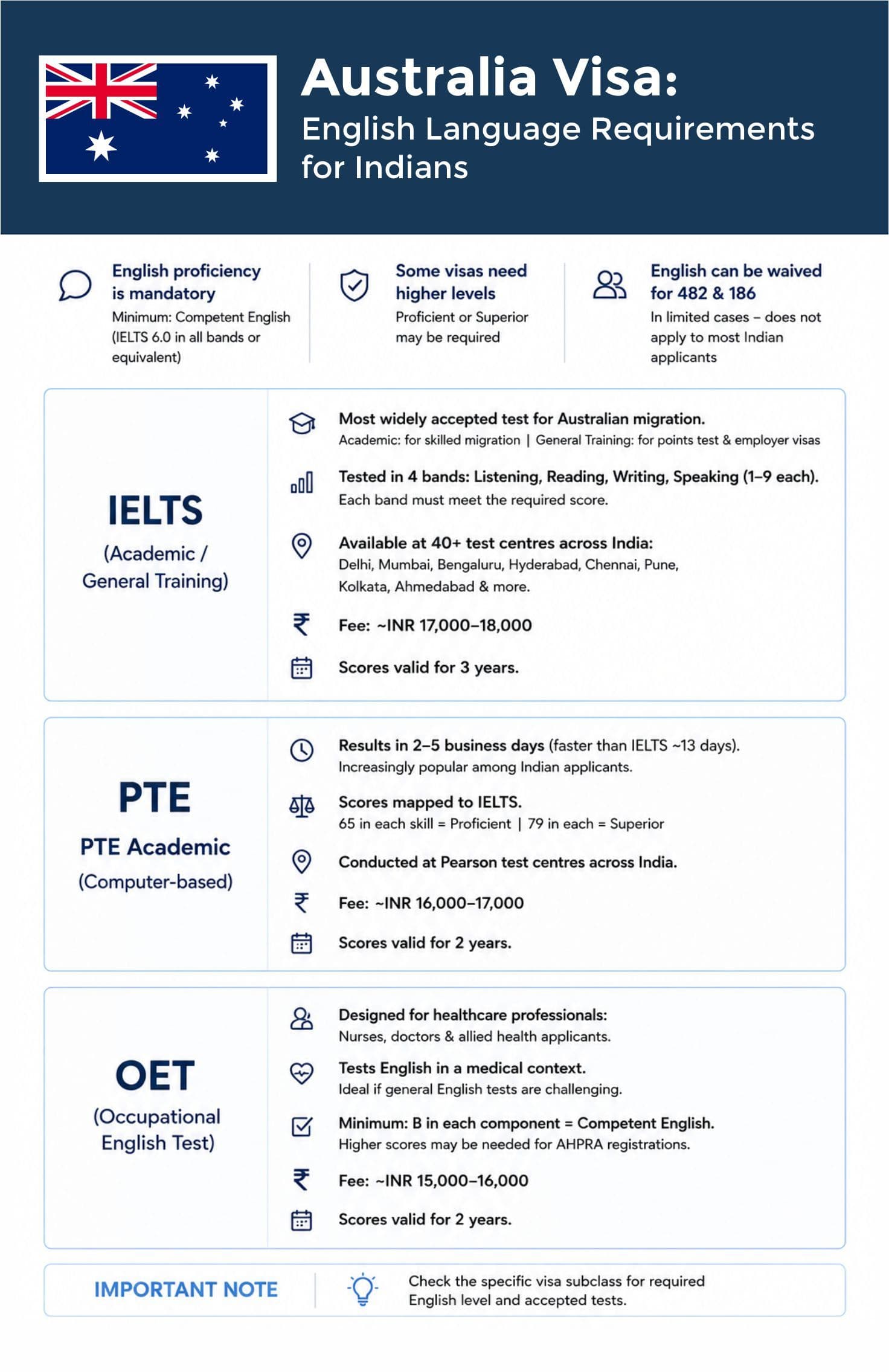
For Indian families moving to Australia with school-age children, the education system is an important consideration. Australia provides free public education from Kindergarten (age 5–6) through Year 12 (age 17–18) for permanent residents and citizens.
The school system structure varies slightly by state but follows this broad framework:
| Stage | Years | Age Range |
| Early childhood (Kindergarten/Prep) | Year 1 | 5–6 |
| Primary school | Years 1–6 (or 7 in some states) | 6–12 |
| Secondary school | Years 7–10 (or 8–10) | 12–16 |
| Senior secondary | Years 11–12 | 16–18 |
The senior secondary years culminate in a state-administered qualification: HSC (New South Wales), VCE (Victoria), QCE (Queensland), WACE (Western Australia), SACE (South Australia), or TCE (Tasmania). These results determine eligibility for university admission through a rank score (ATARScore Australian Tertiary Admission Rank).
Government (public) schools are funded by the state and are free for permanent residents. Private schools (independent and Catholic systemic) charge tuition fees ranging from AUD 5,000 per year at budget independent schools to AUD 35,000 or more at elite private schools.
Indian families frequently opt for public schools in well-performing zones or selective high schools, which admit students based on competitive testing. In NSW, selective high schools such as James Ruse Agricultural High, North Sydney Boys, and Baulkham Hills are highly sought after. In Victoria, Melbourne High and MacRobertson Girls' High are equivalent selective institutions.Selective school entry is competitive and relies on academic performance tests. Indian students, many of whom come from academically rigorous backgrounds, perform well in these tests.Australia conducts the National Assessment Program Literacy and Numeracy (NAPLAN) in Years 3, 5, 7, and 9. NAPLAN tests reading, writing, language conventions, and numeracy. Results are provided to parents and used for internal benchmarking. NAPLAN results are publicly reported by school.
Australia has 43 universities, of which 8 are members of the Group of Eight (Go8) - a coalition of research-intensive universities:
For international students (on Subclass 500), there is no access to HECS-HELP. Full tuition must be paid directly and upfront or via the institution's payment plan. This is one of the financial advantages of achieving permanent residency before commencing study in Australia.
University admission for domestic students is competitive and managed through state-based admissions centres (UAC in NSW, VTAC in Victoria, QTAC in Queensland). The ATAR score from Year 12 is the primary admission criterion for school leaver entry. For mature-age entry, universities assess prior qualifications, work experience, and in some cases portfolio or interview.Indian students who completed their senior secondary education in India (Class 12 / HSC / CBSE / ICSE) need to have their results assessed for equivalency to the Australian ATAR. This is done through assessment by QTAC International or equivalent bodies in other states. Most Indian Class 12 results translate to competitive ATAR equivalencies for many degree programs.Australia conducts the National Assessment Program - Literacy and Numeracy (NAPLAN) in Years 3, 5, 7, and 9. NAPLAN tests reading, writing, language conventions, and numeracy. Results are reported on a proficiency scale and provided to parents and schools. Schools' NAPLAN results are publicly reported through the MySchool website (myschool.edu.au), which allows parents to compare schools on these and other indicators.
For Indian families selecting a school, NAPLAN results are one publicly available measure of academic performance. Private and selective schools generally show higher NAPLAN averages than non-selective government schools in the same area. However, NAPLAN is a standardised test measuring a narrow range of skills, and school choice based solely on NAPLAN data can be misleading.Australia's Vocational Education and Training (VET) sector provides certificate and diploma-level qualifications in trade, technical, and service occupations. TAFE (Technical and Further Education) institutes are the main public providers. Private Registered Training Organisations (RTOs) also deliver VET qualifications.
Indian migrants who need to upgrade practical skills, obtain Australian trade qualifications, or gain certificates for specific occupations (childcare, aged care, construction, cooking, hospitality) use the VET sector. TAFE courses range from a few months (Certificate II) to two years (Diploma). Domestic students (permanent residents and citizens) access TAFE at subsidised rates under state government funding.Childcare in Australia is managed through private operators, community-based centres, and long day care facilities. The Child Care Subsidy (CCS) reduces out-of-pocket costs for eligible families based on income and the number of hours worked by the parents. Permanent residents are eligible for CCS from the date of visa grant.
Without subsidy, full-time long day care in a major city costs approximately AUD 400–600 per week per child. With maximum CCS (for families earning under AUD 80,000), out-of-pocket costs reduce substantially. Child care for families with two working parents is a major household expense, planning for this cost is important when assessing the financial viability of moving to Australia.Most Indian migrants need to convert their Indian driving licence to an Australian one. Each state handles licence conversion separately.
The rules differ by state. In New South Wales, International Licence holders from India can drive on their Indian licence for the first three months, but must then apply for an Australian licence through the NSW Roads and Maritime Services (RMS). In Victoria, the conversion process through VicRoads applies. In most states, Indian licence holders from countries not on the automatic conversion list are required to sit a knowledge test (theory) and in some cases a driving test.
Indian driving licences are accepted for conversion in many states without requiring a full driving test particularly for car licence holders. However, requirements change, and checking the current rules with the relevant state authority is essential.Australia drives on the left side of the road, as in India. Speed limits are typically 50 km/h in urban streets, 60–80 km/h in outer suburban areas, and 100–110 km/h on highways. Speed cameras and mobile camera units are extensively deployed.
Alcohol limits: Blood alcohol content (BAC) of 0.05% for full licence holders. Zero BAC applies to probationary licence holders and drivers of heavy vehicles.Roundabout rules, pedestrian crossing protocols, and overtaking rules are well-defined and enforced. Familiarising yourself with the Australian road rules handbook (available from each state's transport authority) before driving is advisable.Cars are expensive in Australia. A second-hand car in good condition costs AUD 10,000–25,000. New entry-level vehicles start from approximately AUD 20,000–25,000.
Compulsory Third Party (CTP) insurance is mandatory for all registered vehicles. It covers personal injury claims. Comprehensive car insurance (covering damage to your own vehicle and third-party property) is separate and strongly advised.Registration (rego) is managed by state transport authorities and costs AUD 700–1,200 per year depending on the vehicle and state.Permanent residents of Australia have most of the same rights as citizens, with a few exceptions:
Rights included:A permanent visa grant is not unconditional. The travel component of a permanent visa which allows re-entry to Australia after overseas travel is typically valid for 5 years from the date of grant. After this period, holders who have not become citizens must apply for a Resident Return Visa (RRV) before travelling abroad.
Permanent residents can have their visa cancelled if convicted of criminal offences carrying sentences of imprisonment, if false information was provided during the visa application, or if they fail to meet character requirements.The Racial Discrimination Act 1975 (Commonwealth) prohibits discrimination on the grounds of race, colour, descent, or national or ethnic origin in areas including employment, accommodation, education, and access to goods and services.
Each state also has its own equal opportunity or anti-discrimination legislation. The Australian Human Rights Commission handles complaints under federal anti-discrimination law. Indian migrants who experience racial discrimination at work or in accessing services have formal complaint channels.Permanent residents can apply for Australian citizenship after meeting residency requirements:
All residents (permanent and temporary) are required to:
Australia's cities differ substantially in character, cost, climate, employment market, and community size. Choosing the right city has a significant impact on quality of life and career prospects.
Sydney is Australia's largest city with a population of approximately 5.3 million. It is the financial services capital of Australia and the headquarters of many multinational companies' Australian operations. Sydney has the most established Indian community with strong cultural infrastructure.
The drawbacks are well-documented: Sydney has among the most expensive housing in the world. The median house price exceeds AUD 1.4 million. Commutes are long. Traffic is congested. Many Indian professionals in Sydney choose the western suburbs (Parramatta, Blacktown, Westmead, Marsden Park) where Indian communities are concentrated and housing is more affordable.Climate: Hot, humid summers (35–40°C at peak), mild winters. The city is coastal with beach access, which many find attractive.Best suited to: Finance, IT, professional services, mediaMelbourne is the cultural capital of Australia and consistently ranks among the world's most liveable cities. It has the highest concentration of Indian migrants among all Australian cities. The city is known for its cafe culture, arts scene, sport, and diverse neighbourhoods.
Housing is expensive but less so than Sydney. Median house prices are approximately AUD 900,000–1 million. The city has good public transport and cycling infrastructure.Climate: Variable and changeable Melbourne is known for experiencing "four seasons in one day." Winters are cold by Australian standards (5–10°C). Summers are hot (35–40°C at peak).Best suited to: Education, healthcare, IT, finance, hospitality, artsBrisbane is the capital of Queensland and will host the 2032 Olympic Games, which is driving significant infrastructure investment. The city's property market has grown rapidly but remains more affordable than Sydney or Melbourne.
The Queensland economy has strong construction, healthcare, mining services, and tourism components. Brisbane's Indian community is smaller than Sydney's or Melbourne's but is growing quickly.Climate: Subtropical warm, humid summers; mild, sunny winters. This suits many Indian migrants accustomed to warmer climates.Best suited to: Construction, engineering, healthcare, educationPerth is geographically isolated a 4-hour flight from Sydney but this is offset by its high quality of life, strong mining and resources economy, and affordable housing compared to east coast cities. Median house prices are around AUD 750,000–900,000.
Perth has a significant Indian community concentrated in the southern and eastern suburbs. The city has strong demand for engineers, particularly mining, civil, and mechanical engineers.Climate: Mediterranean hot, dry summers (35–45°C); mild, wet winters. Many Indian migrants from northwestern India find it climatically familiar.Best suited to: Mining and resources, engineering, healthcare, constructionAdelaide is often recommended to Indian migrants as a city that combines affordability, liveability, and more accessible state nomination (South Australia has been more generous with 190 and 491 nominations than NSW or Victoria for many occupations).
Housing is the most affordable of all major Australian capitals. The median house price is approximately AUD 740,000. Adelaide has a strong arts scene, food culture, and growing technology and defence sectors.Best suited to: Healthcare, defence, education, wine and food industries, ITCanberra is the federal capital and home to the Australian Public Service. Many Indian migrants in IT, policy, engineering, and finance find stable government-sector employment here. Cost of living is lower than Sydney despite proximity.
Canberra has limited public transport and is car-dependent. Winters are cold (below 0°C overnight in July). It is a relatively small city (approximately 470,000 people) with a strong research and education sector anchored by the Australian National University.Best suited to: Government, IT, defence, research and academiaRegional areas cities and towns outside the major metropolitan areas offer state nomination pathways with additional points incentives and sometimes lower cost of living. For the 491 visa pathway to permanent residency, living and working in a designated regional area is a legal requirement for three years.
Regional centres with significant Indian communities and employment options include Newcastle (NSW), Wollongong (NSW), Geelong (VIC), Ballarat (VIC), Toowoomba (QLD), and Cairns (QLD). Healthcare and education sectors in regional areas are often actively recruiting skilled migrants.The immediate priorities after arriving in Australia are:
The Australian Government provides settlement support through the AMEP (Adult Migrant English Program) and the Settlement Engagement and Transition Support (SETS) program. AMEP offers up to 510 hours of free English language tuition to eligible migrants and humanitarian entrants.
Settlement services organisations, including the Migrant Resource Centre, AMES Australia, and state-based multicultural organisations, provide orientation, employment support, community connection, and referrals to other services.The Indian community in Australia is large, well-organised, and geographically concentrated in certain areas. Indian migrants make up a significant proportion of residents in suburbs such as:
Hinduism is the most widely practised religion among Indian migrants in Australia. Hindu temples are present in all major cities. Major temples include the Shri Venkateswara Temple (Helensburgh, NSW), ISKCON Melbourne, Shri Shiva Vishnu Temple (Carrum Downs, Melbourne), and Hindu Temple (Morningside, Brisbane).
Mosques serving Muslim Indian migrants, Sikh Gurdwaras (significant communities in Melbourne's western suburbs, Sydney's west, and Brisbane), Jain temples, and churches serving Christian Indian communities are also present in all major cities. For most Indian religious traditions, finding a place of worship in a major Australian city is not difficult.Cultural festivals, Diwali, Holi, Navratri, Onam, Eid, Baisakhi, Lohri, and others, are celebrated publicly in Australian cities. The Federation Square Diwali event in Melbourne and the city-wide Diwali celebrations in Sydney's Parramatta draw tens of thousands of attendees annually. These events also serve as networking opportunities and community anchor points for new arrivals.English is the sole official language of Australia. While Indian migrants from professional backgrounds are proficient in English, Australian communication styles, including the accent, idiom, and pace, take adjustment. Australians use a distinctive set of slang expressions and colloquialisms that can confuse new arrivals.
Formal and informal communication operate on a flat register in Australian workplaces. The same person might sign an email "Cheers, Dave" to their department head as to a junior colleague. This informality does not indicate disrespect, it is a feature of the culture.For Indian professionals who grew up in environments where addressing a senior colleague by first name would be inappropriate, the Australian preference for first names across all levels can feel awkward initially. Adopting this norm early, while maintaining professional standards in the substance of communication, accelerates integration.Families with elderly parents visiting from India, children in school, or partners who are not employed often face specific challenges. Spouses of skilled migrants who hold secondary applicant status on a permanent visa have full work rights and can seek employment. This is significant for dual-income households.
For spouses who arrive without an existing professional network in Australia, building one from scratch takes time. Professional reregistration (for professions with licensing requirements), credential recognition, and Australian workplace experience are the same challenges the primary applicant faced, and the partner faces them independently.Support resources for Indian migrant families include:For context, a broad comparison of monthly costs (approximate) for a family of four in a major Australian city versus a Tier 1 Indian city:
| Expense | Sydney (AUD/month) | Bengaluru (INR/month) |
| Rent (3BR apartment, suburb) | 3,500–4,500 | 30,000–60,000 |
| Groceries | 1,200–1,800 | 15,000–25,000 |
| Utilities (electricity, gas, internet) | 400–600 | 5,000–10,000 |
| Transport (public or car costs) | 500–900 | 8,000–15,000 |
| Childcare or school (2 children) | 1,200–2,500 | 20,000–60,000 |
| Healthcare (insurance/out-of-pocket) | 400–700 | 5,000–15,000 |
| Dining out (family, twice monthly) | 300–500 | 5,000–12,000 |
| Total approximate | 7,500–11,500 | 88,000–1,97,000 |
The numbers in a cost comparison table never tell the full story. Yes, rent in Sydney is AUD 3,500–4,500 a month for a decent 3-bedroom. But a software engineer bringing home AUD 120,000 after tax has roughly AUD 7,200 a month left after rent which is more discretionary income than the same role in Bengaluru at ₹25 lakh, once you strip out housing and basics.
The first year in Australia is typically financially difficult. Visa costs, relocation expenses, bond and advance rent, furniture and appliances, establishment of transport, and professional reregistration costs all occur before steady income is established. Having at least AUD 30,000–50,000 in liquid savings before arrival gives a family sufficient buffer.
From the second year onward, as employment stabilises and the family settles into routines, financial stress reduces materially. Most Indian migrant families reach a stable financial footing within two years of arrival.The ANZSCO code selected for the skills assessment and EOI must accurately represent the work the applicant has actually done. Selecting a code that sounds closer to their dream role, rather than their actual experience, leads to a failed skills assessment or an invalid EOI.
Solution: Research the ANZSCO definition carefully. Read the tasks listed under the occupation in the ANZSCO manual. If two codes fit, choose the one where the match to actual duties is strongest.Indian employers often provide generic reference letters that do not match the specifics of the applicant's actual duties. The Department of Home Affairs and assessing bodies look at consistency across all documents, if the job title on a pay slip says "Associate" but the reference letter describes "team leadership and project management," the discrepancy creates doubt.
Solution: Request employer letters that specifically list your actual duties and responsibilities. Supplement them with project documentation, emails, appraisals, and tax filings.Many Indian professionals, particularly those who have used English professionally for years underestimate how demanding the high-band IELTS or PTE requirements are. Writing band 8 on IELTS requires near-native fluency in formal written English. Reading and listening at band 8 require high precision.
Solution: Take a practice test before booking the real exam. If aiming for Superior English (IELTS 8.0), allow 3–6 months of preparation for those not already at that level.Applicants who receive an invitation to apply have exactly 60 days to lodge the visa application. Failing to lodge within 60 days results in the invitation lapsing. All documents, including the medical examination must be submitted within this window.
Solution: Begin gathering all documents while waiting for an invitation, not after it arrives.India has a large industry of unregistered migration consultants who charge fees and provide inaccurate advice. Providing incorrect information in a visa application even unintentionally can result in refusal on character grounds.
Solution: Use only OMARA-registered agents. Verify registration at the OMARA website (omara.gov.au) before paying any fees.Processing times for some visa subclasses especially family-stream and certain skilled visas are long. A two-year processing period is not unusual for Subclass 190 or partner visas. Not planning finances, career progression, and family arrangements around this timeline leads to significant stress.
Solution: Submit applications as early as possible. Do not make major life decisions (quitting employment, selling property) contingent on visa approval until the grant is confirmed.New Australian tax residents who continue to earn rental income from Indian property, receive dividends from Indian shares, or receive salary from Indian employers are required to declare this income to the ATO. Failing to do so constitutes tax evasion.
Solution: Consult a tax professional familiar with both Indian and Australian tax law in the first year of arrival. Proper DTAA treaty credit claims prevent double taxation legally.Many Indian migrants in Australia are currently on temporary visas (482, 485, student) and are working toward permanent residency. The pathways differ depending on the current visa.
482 core skill stream holders who have been employed by the same employer for at least three years in an eligible occupation can apply for the Subclass 186 (Employer Nomination Scheme) visa through the Temporary Residence Transition stream. This is one of the most direct pathways from employer-sponsored temporary residency to permanent residency.
Requirements:Graduate visa (485) holders who gain Australian work experience can substantially increase their points score for a skilled migration application. Working three years in a skilled occupation in Australia under a 485 visa adds 15 points to the points test (if the occupation is assessed as matching the nomination). This, combined with other factors, often pushes applicants above the practical invitation threshold.
The Subclass 191 (Permanent Residence - Skilled Regional) pathway allows 491 holders to transition to permanent residency after three years of living and working in a designated regional area and earning above the minimum income threshold (currently approximately AUD $54,000–$56,000 ) verify the current threshold at homeaffairs.gov.au before applying, as it is indexed annually. The 191 visa grants permanent residency across all of Australia.
Students who complete their degree in Australia, then gain work experience on a 485 visa, can build a strong skilled migration application. Australian study in STEM or healthcare adds points. Australian work experience adds more. This pathway, while requiring 4–8 years in total, results in a strong points score and competitive chances of receiving an invitation.
Moving to Australia from India is a multi-year, multi-stage process that requires careful planning, accurate documentation, and a realistic understanding of costs and timelines.
The skilled migration pathway, subclasses 189, 190, and 491 is the most common route for Indian professionals. It requires a positive skills assessment from the relevant Australian body, English test results at or above the Competent level, a points score high enough to receive an invitation, and clear documentation of qualifications and work experience.Employer-sponsored pathways (482, 186) are viable for applicants with a confirmed Australian job offer, while the student-to-graduate-to-skilled-migration route provides a longer but structured path for younger applicants.After arrival, the priorities are obtaining a Tax File Number, enrolling in Medicare (for permanent residents), finding housing, building a credit history, and understanding the Australian employment and tax environments. Indian professionals in Australia generally find that salary levels and working conditions are significantly better than in India, though the cost of living, especially housing, is substantially higher.The Indian community is well-established across Australia's major cities. Cultural infrastructure, religious facilities, and professional networks exist in every major urban centre. Settlement challenges are real but manageable, particularly for English-proficient professionals with a strong occupational skill set.
Your complete guide to fingerprinting in India, covering Aadhaar, passports, background checks, immigration, property registration, and your legal rights.
Everything Indians need to move to New Zealand in 2026 - visas, Green List occupations, taxes, healthcare, schools, jobs, and a full moving checklist.

The only Spain visa guide Indians need in 2026 - visa types, documents checklist, BLS appointments, financial proof, rejection fixes, and arrival steps, all in one place.

