

By Ayushi Trivedi · Updated May 29, 2026
For Indian students planning to study in Spain, the decision in 2026 looks different from what it did five years ago., not because of marketing, but because the combination of strong public universities, tuition costs a fraction of the UK, expanding English-medium programmes, and improving post-study work options makes it worth serious consideration. This guide covers everything you actually need to know before committing like how the Spanish degree system maps to your Indian qualifications, honest city-by-city cost breakdowns, the student visa process step by step with the documents that get rejected and the timelines, scholarships Indian students are eligible for, the language reality that no prospectus will tell you because those are the alternatives most Indian students are weighing. Every chapter is written to give you the information to make a decision you will not regret, whether that decision is Spain or somewhere else entirely.
Spain wasn’t on most Indian students’ shortlists a few years ago. It was seen more as a travel destination than a study option. That has changed. Today, students are looking more closely at value for money, and Spain is holding up well. International enrolment has steadily increased, with Indian students in cities like Madrid, Barcelona, Valencia, and Seville across universities and business schools.
So what’s driving this shift? Several factors are coming together.
The cost gap with the UK and US
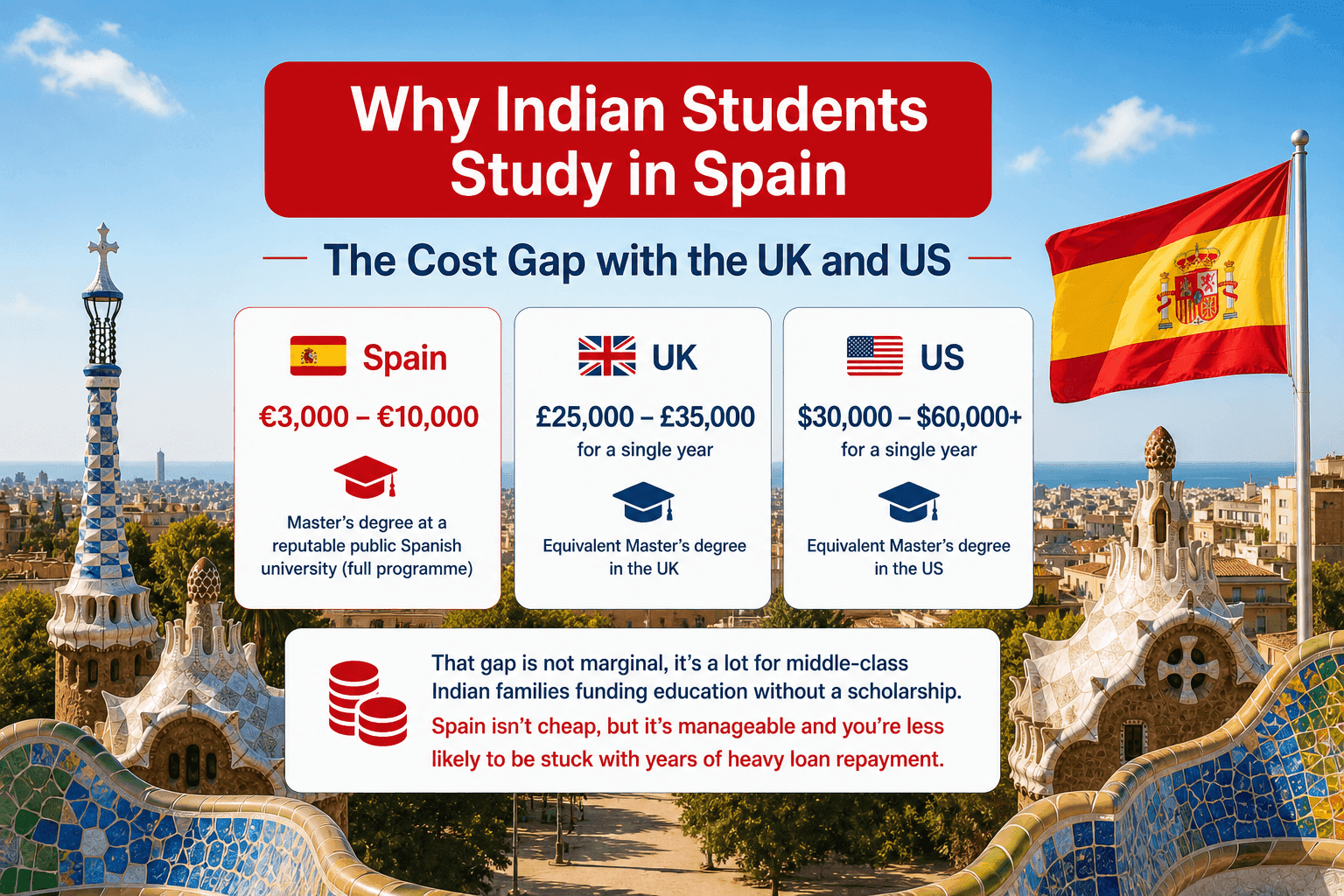
A Master's degree at a reputable public Spanish university costs an Indian student somewhere between €3,000 and €10,000 in tuition across the full programme, though some specialised programmes may be higher. The equivalent degree in the UK routinely costs £25,000 to £35,000 for a single year. That gap is not marginal, it is a lot for middle-class Indian families funding education without a scholarship.Spain isn’t cheap, but it’s manageable and you’re less likely to be stuck with years of heavy loan repayment.
English-taught programmes have expanded
This is the change that most directly opened Spain to Indian students. Universities like Universidad Carlos III de Madrid, Universitat Politècnica de Catalunya, and Universitat de Barcelona offer dozens of fully English-medium postgraduate programmes. Private business schools like ESADE, IESE, and IE University have been English-medium for decades. The language barrier at the academic level, while still real in some programmes, is no longer the wall it once was.
Quality of Life Matters More Than You Think
Spain gives students the space to actually absorb what they are learning, rather than just keeping up with constant pressure. Spain is widely regarded as one of the safer countries in Europe, with a strong emphasis on social life, community, and work-life balance. The pace of life is more measured, and rest is not treated as a failure or lack of ambition. For students coming from India’s highly competitive board and entrance exam system, this shift can make a meaningful difference - not just to mental well-being, but to how effectively they learn, engage, and perform academically.
Post-study options have improved.
Spain's 2023 Startup Law (Ley de Startups) strengthened the framework for international graduates, including a 12-month job-search permit after graduation and a clearer entrepreneur visa pathway for those starting a business. These are not a direct route to permanent residency. But for Indian students thinking about building a career in Europe rather than just getting a degree and leaving, Spain now offers more than it did even three years ago.
Before you apply anywhere, you need to understand how Spain structures its degrees because it follows a European framework that works differently from the Indian system, and the gaps between the two create avoidable mistakes. Indian students regularly arrive confused about credit systems, degree lengths, and whether their qualifications actually make them eligible for what they applied to.
Spain is part of the European Higher Education Area (EHEA) and follows the Bologna Process, a standardisation framework adopted across 49 European countries. The goal of Bologna was to make degrees comparable and transferable across borders. For Indian students, this is largely good news- a Spanish degree is recognised across the EU, and the structure is simple once you understand it.
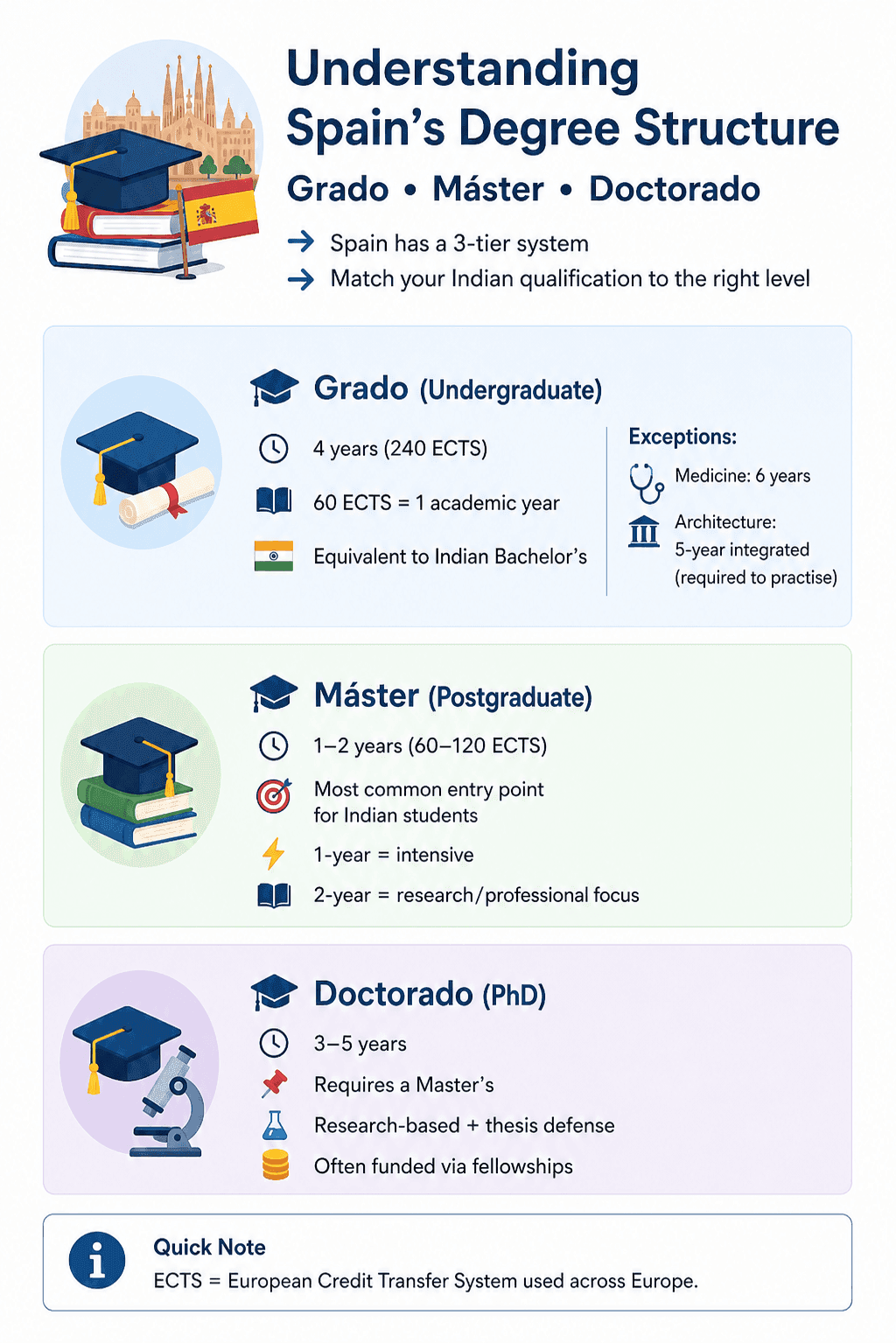
The Spanish system has three levels, and knowing which one your Indian qualification maps to is the first question to answer.
Grado: The Grado is the undergraduate degree- mostly four years, built around 240 ECTS credits. ECTS stands for European Credit Transfer and Accumulation System, the standard unit of academic measurement across Europe. One full academic year equals 60 ECTS credits. The Grado broadly corresponds to a four-year Indian Bachelor's degree, though the credit distribution across semesters can look different.
Two fields are exceptions worth knowing:
A four-year Grado in Architectural Fundamentals exists but does not qualify you as a licensed architect.
Master: The Master Universitario is the postgraduate taught degree. This is one to two years and 60 to 120 ECTS credits. This is where the majority of Indian students enter the Spanish system. Either coming directly from an Indian Bachelor's degree or after completing a Grado. A one-year Master's in Spain is mostly one academic year with a full workload. Two-year programmes are more common in research-intensive fields and professional disciplines.
Doctorado: The Doctorado is the doctoral degree, equivalent to a PhD. It requires a completed Master for entry and takes between three and five years. Three years is the standard full-time timeline under current regulations (RD 576/2023), with extensions available. Doctoral candidates work within a research group or department and the degree is awarded after submitting and publicly defending a thesis. Competitive fellowship schemes fund many doctoral positions.
When you apply to a Spanish Master's programme, your Indian degree is assessed for its ECTS equivalent. This evaluation directly affects your eligibility.
A three-year Indian Bachelor's degree is valued at 180 ECTS credits. A four-year degree, including most engineering degrees, integrated programmes, and honours degrees is valued at 240 ECTS credits. The distinction matters because many Master's programmes in Spain, particularly competitive ones, specify a minimum of 240 ECTS for entry. If you hold a three-year degree, some universities will still consider your application with additional documentation or relevant experience but others will not. Always check the specific programme's entry requirements before applying.
Spain has over 90 officially recognised universities, roughly 50 public and 30-plus private. The difference between them goes well beyond fees.
| Factor | Public Universities | Private Universities |
| Funding | State-funded | Privately funded |
| Fees (Grado) | €1,500 - €3,500/year | €8,000 - €20,000/year |
| Fees (Master’s) | €2,000 - €6,000/year | €10,000 - €100,000+ (top business schools) |
| Admissions | Slower, documentation-heavy | Faster, more flexible |
| Language | Mostly Spanish (some English programmes) | Largely English-medium |
| Academic Focus | Strong for research and academia | Strong for business and global careers |
| Reputation | Strong within Spain/EU | Top schools have global brand value |
| Best for | Budget-conscious, long-term EU plans | Career switch, international exposure |
If your priority is affordability and long-term integration in Spain, public universities are the better choice. If your priority is speed, English-medium education, and global career mobility, private institutions may justify the higher cost.
Spain's 17 autonomous communities, similar to Indian states but with greater control over education policy, have real authority over education. This means the experience of studying in Barcelona is different from studying in Madrid, not just culturally but administratively.
In Catalonia, Catalan is co-official alongside Spanish, and public universities like Universitat de Barcelona and Universitat Autònoma de Barcelona use it extensively at undergraduate level. International Master's programmes run in Spanish or English, but administrative communications and some course materials may involve Catalan. This is not a problem for most international students, but it is important to be aware of before arriving.
Madrid operates almost entirely in Spanish in academic and administrative contexts. This makes Madrid the most straightforward environment for Indian students arriving without prior language preparation. Valencia, the Basque Country, and Galicia have their own regional languages, though the working language at international programmes in these regions remains Spanish.
Regional autonomy also affects fees. The same Master's programme can cost different amounts depending on which community the university is in.Madrid and Catalonia tend to be at the higher end, while Andalusia and Castilla y Leon are lower.
The Spanish academic year runs from mid-September to late June, structured around two semesters. The first semester runs September to January, and the second runs February to June. Exams take place in January and May-June, many universities offer a July resit session for students who do not pass in the main exam period.
Application windows for most Master's programmes open between January and April for September entry. Competitive programmes like Engineering, Data Science, and Business, often close well before April as places fill. Applying in January is better than applying in March. For Indian students, this means the preparation process like apostilling documents, obtaining test scores, and requesting transcripts should begin at least 9 to 12 months before your intended start date.
A three-year Indian Bachelor's degree maps to 180 ECTS and is considered for Master's entry at many Spanish universities, but may not meet the 240 ECTS requirement at competitive programmes. A four-year degree like engineering, integrated, or honours maps cleanly to 240 ECTS and is treated as equivalent to a Spanish Grado for postgraduate entry.
For undergraduate entry from India, Class 12- whether CBSE, ICSE, or State Board, is not automatically accepted as equivalent to the Spanish Bachillerato. The standard pathway is the UNED PCE examination.
Spain's higher education system is not a back door into a European degree. Universities expect proper academic preparation, language readiness, and complete documentation. The students who struggle are always those who did not do the preparation required.
Getting into a Spanish university as an Indian student is entirely achievable. It is also the stage where most applications go wrong, not because of academic merit, but because of paperwork done incorrectly, deadlines missed by a few weeks, or a misunderstanding of how Spain evaluates Indian qualifications.
Spain does not have a blanket equivalency agreement with India. What it has is a structured evaluation process and understanding that process is the first thing to do before you touch a single application form.
The evaluation depends on which level you are applying at.
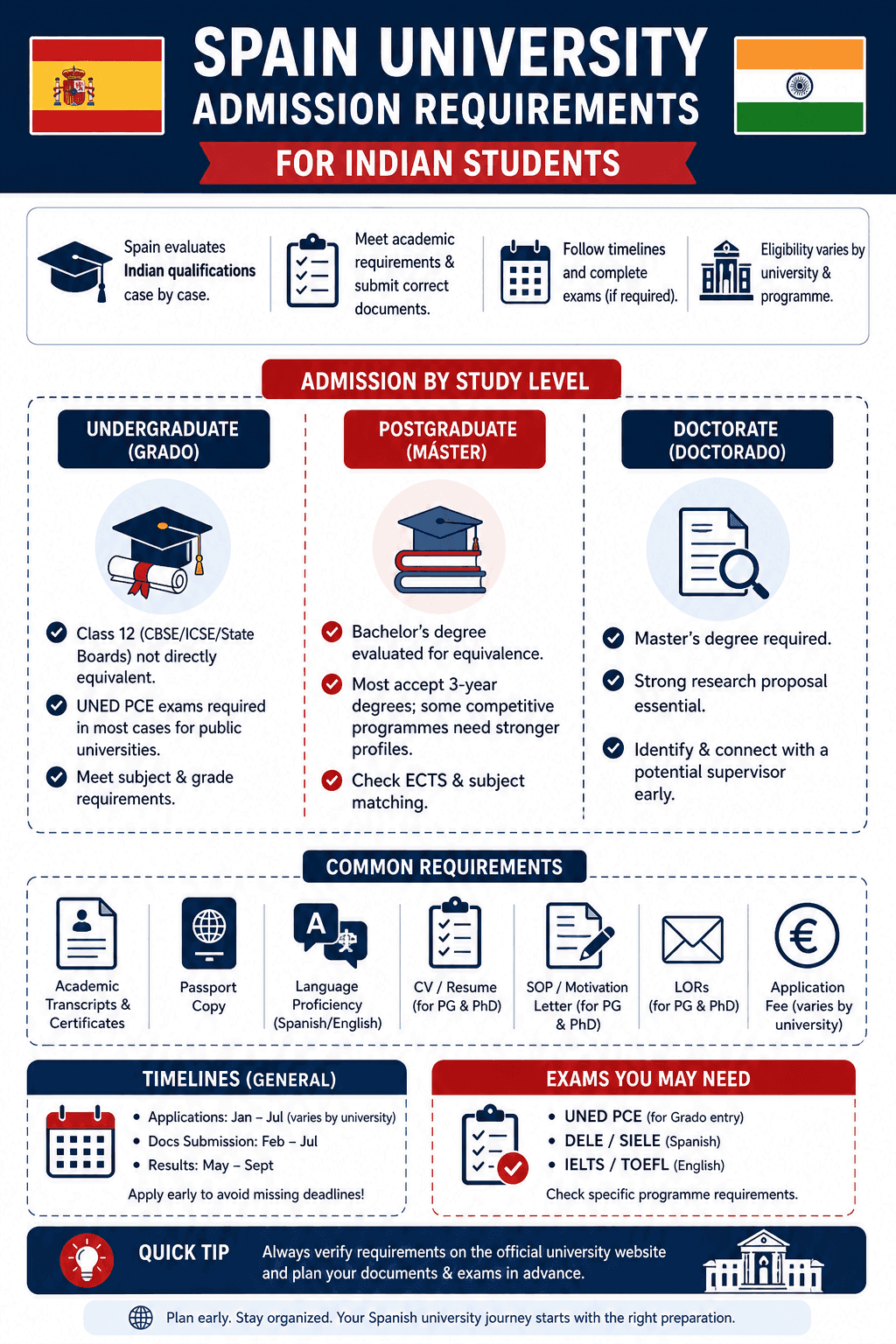
For undergraduate (Grado) entry, Class 12 from CBSE, ICSE, or State Boards is not automatically considered equivalent to the Spanish Bachillerato in Spain. In most cases, students must complete additional requirements such as the UNED PCE examinations, which apply to public universities and most standard private admissions.
For postgraduate (Máster) entry, universities assess Indian bachelor’s degrees for academic equivalence. Eligibility varies by programme, and while many accept three-year degrees, some competitive courses may require stronger academic profiles or equivalent preparation.
For doctoral (Doctorado) programmes, a completed Master’s degree and a strong research proposal are required. In many cases, identifying a suitable supervisor in advance is an important first step in the admission process.
For Indian students entering undergraduate programmes in Spain, the UNED PCE (Pruebas de Competencias Específicas) is a widely used pathway for university admission. It is accepted by public universities and many private institutions as part of their entry requirements.
Students choose subjects based on their intended degree. Engineering applicants mostly select Mathematics and Physics, while Medicine applicants often choose Biology and Chemistry. Spanish Language (Lengua Castellana) is commonly required as a core subject. Most students take two to four subjects depending on programme requirements, with emphasis on scoring well in relevant subjects.
The PCE is held annually in May-June, with a possible additional session in September. Exam centres for Indian students are usually available in New Delhi and Mumbai, depending on the official UNED listings for that year. Registration opens a few months before the exam dates.
University admission scores are calculated using a combination of Class 12 results and PCE subject scores, though the exact weighting varies by university and programme. A strong school performance is helpful, but dedicated preparation for PCE subjects, especially Spanish Language is essential for competitive programmes.
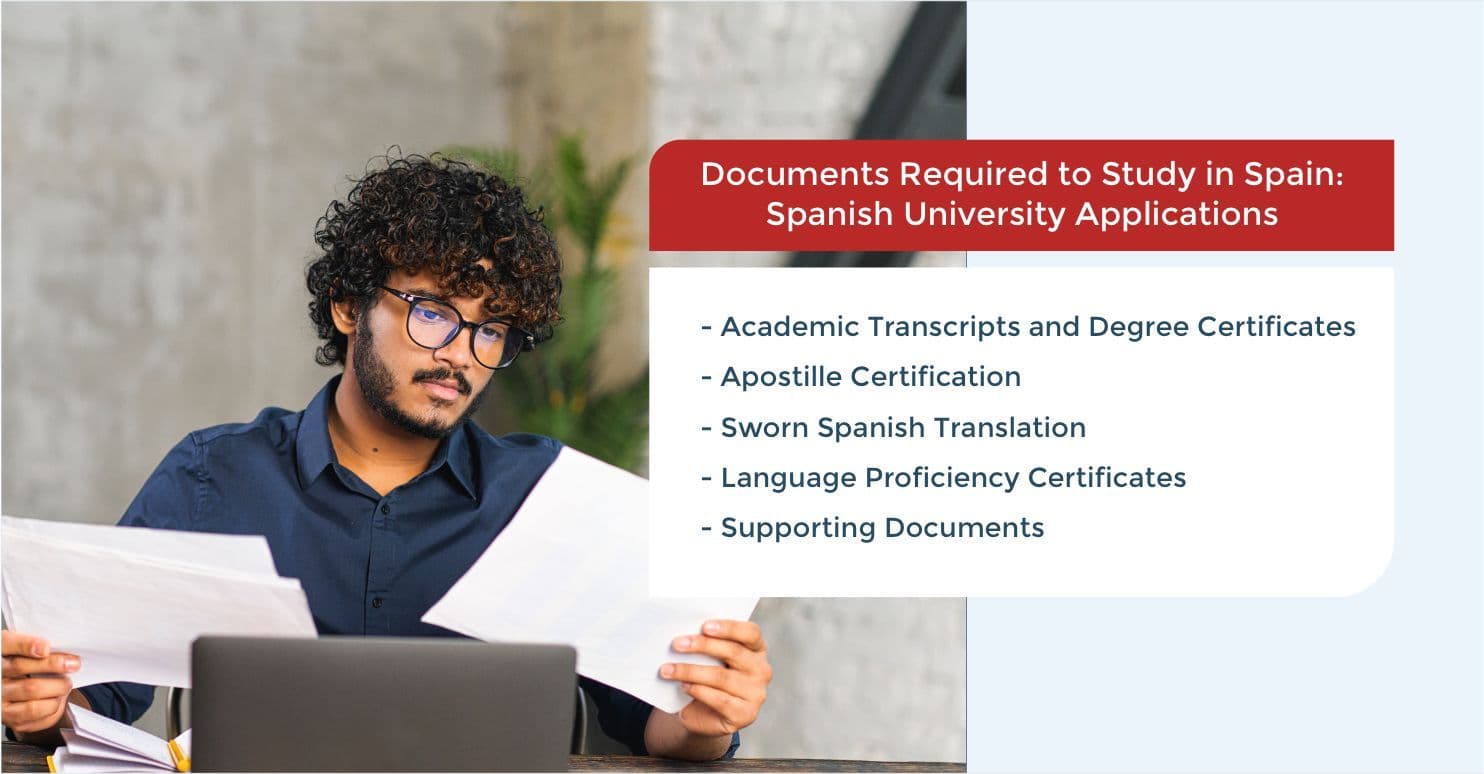
Regardless of whether you are applying for a Grado, Master, or Doctorado in Spain, universities will require a core set of standardized documents. For Indian applicants, accuracy in format and certification is often more important than the documents themselves.
Academic Transcripts and Degree Certificates
Official documents issued directly by your institution and not portal printouts or photocopies. For a Master's application, Bachelor's degree certificate and all year-wise or semester-wise transcripts. For doctoral applications, both Bachelor's and Master's documentation.
Apostille Certification
Apostille certification is mandatory under the Hague Convention, of which India and Spain are members. Documents may be processed through digital or physical apostille routes depending on eligibility and document type, issued by India’s Ministry of External Affairs.
Sworn Spanish Translation
Documents not in Spanish or English must be translated by a Traductor Jurado- a sworn translator officially certified by the Spanish Ministry of Foreign Affairs.
Language Proficiency Certificates
English-medium programmes require proof of language proficiency such as IELTS (generally in the range of 6.0-7.0 depending on the programme) or equivalent TOEFL scores, while Spanish-medium programmes require DELE or equivalent certification, usually at B2 level.
Supporting Documents
Documents such as Statement of Purpose, Letters of Recommendation, CV (often in Europass format), passport, and proof of financial means are also required. Financial proof is commonly assessed against a monthly baseline (around €600 per month for visa purposes), though exact requirements depend on consulate rules and programme type.
Spain has no centralised application system equivalent to the UK's UCAS. You apply directly to each university through its own portal or admissions process. Private universities tend to be faster and more responsive. Whereas public universities are slower and more documentation-heavy, though their admissions offices are reliable once contacted directly..
For Master's programmes, application windows open between January to April for September entry. Competitive programmes in fields such as Engineering, Data Science, and Business may fill early, often by February or March. Applicants can usually apply with provisional documents, with final admission confirmed once official transcripts and degree results are submitted.
For doctoral (PhD) programmes, admissions are often flexible but depend on supervisor availability and funding cycles. The most effective approach is a targeted email to potential supervisors, including a clear research proposal and academic background. Generic enquiries without a defined research focus are less likely to receive responses.
| When | What to do |
| 16-18 months before | Research programmes, shortlist universities, check UNED PCE requirements if applying at undergraduate level |
| 12-14 months before | Initiate apostille process (e-Apostille or physical). Register for IELTS/TOEFL. Begin Spanish if applying to Spanish-medium programmes |
| 10-12 months before | Request official transcripts. For PhD applicants, begin contacting potential supervisors with research proposals. |
| 8-10 months before | Begin submitting applications as portals open (nearly January onwards for September intake). |
| 6-8 months before | Receive offers, confirm admissions, and begin scholarship applications if applicable. |
| 4-6 months before | Apply for a student visa at the Spanish consulate in India once admission is secured. |
| 1-2 months before | Arrange accommodation, health insurance, initial finances. |
| On arrival | Complete empadronamiento (municipal registration) within the first week. Book TIE appointment immediately |
You can enrol in an English-taught programme, manage your degree entirely in English, and technically survive in Spain without speaking Spanish. Students do it. But surviving and actually living in Spain are two different things and the gap between them is largely a language gap.
Spain consistently ranks in the lower third for English proficiency among Western European countries. Outside university classrooms, tourist areas, and the international business districts of Madrid and Barcelona, English is not a reliable means of daily communication. Your landlord, your rental contract, your local clinic, your pharmacy, municipal registration, your bank, university administrative staff outside the international office, all Spanish. Part-time jobs and building connections outside the international student circle also need basic Spanish. It’s not a drawback of Spain but it’s just how things work, and it’s something many students underestimate.
This depends on what you are studying and what you want from your time there.
For English-medium programmes at private universities: you can start with no Spanish and still complete your degree. But daily life will be harder than it needs to be for the first year. Arriving at A2-B1 makes things manageable. B2 makes them comfortable.
For Spanish-medium programmes at public universities: B2 is the admission requirement and the minimum you need to follow lectures and complete assessments. Arriving at B1 hoping to catch up mid-semester rarely works.
For part-time work: B2 is the realistic floor for hospitality, retail, and most customer-facing roles. English tutoring is the main exception but positions are limited and competitive.
For staying and working in Spain after graduation: C1 is where the job market opens up. Below that, your options are narrow.
The standard certification is the DELE, administered by the Instituto Cervantes. DELE B2 is what most Spanish universities require for Spanish-medium entry and what employers increasingly ask of non-native speakers.
If you study in Barcelona, you will encounter Catalan, regularly. The Universitat de Barcelona, Universitat Autònoma de Barcelona, Universitat Pompeu Fabra, and Universitat Politècnica de Catalunya all use Catalan extensively, particularly at undergraduate level and in administrative communications. International programmes run in Spanish or English, but notice boards, admin emails, and interactions with local staff will often be in Catalan. You are not expected to speak it but knowing it exists and is distinct from Spanish will save you confusion.
Valencia uses Valencian, Galicia uses Galician, and the Basque Country uses Basque- a language with no relation to Spanish. For most Indian students at international programmes in these regions, Spanish remains the working language. But if you are deciding between Madrid and Barcelona and your Spanish is still developing, Madrid is the simpler environment.
Start before you arrive. Immersion alone does not produce fluency- it helps, but structured learning is what builds the grammar, accuracy and confidence. Apps like Duolingo are useful for vocabulary but not sufficient on their own. A strong target before arrival is A2 through structured learning platforms such as Instituto Cervantes online, SpanishPod101, or similar courses.
After arrival, the Escuelas Oficiales de Idiomas (EOI) are government-run language schools in every Spanish city offering Spanish courses from A1 to C2 at very low cost, approximately €80 to €300 per year depending on the city. Enrolment fills quickly in September, so register as early as possible. Most universities also offer free or subsidised Spanish courses for international students which are worth taking regardless of your starting level.
A common challenge is reaching B1 and then plateauing because social life remains entirely within English-speaking circles. Overcoming this requires deliberate effort- language exchange partners, local clubs, volunteering, and conversation platforms like Tandem. The plateau feels comfortable, which is exactly why it becomes the biggest barrier to fluency.
Spanish has approximately 500 million native speakers across Spain, Latin America, and the United States. A student who reaches B2 to C1 does not just become functional in one country, they become communicative across a language community that spans four continents. For Indian professionals who already speak English and a regional Indian language, adding Spanish creates a rare profile in international organisations, multinationals, and development sector careers. Students who leave Spain with both a degree and real Spanish consistently say the language was the more valuable of the two.
Rankings are a starting point, not a finishing point. What matters is whether the institution actually serves your goals- field, language, budget, and what you want after graduation.
Universidad Complutense de Madrid (UCM)
Spain's largest university, strong in Law, Political Science, Humanities, and Medicine. Medicine admission is extremely competitive and rarely accessible to international students through standard routes. It has a predominantly Spanish-speaking environment. Best for students who want to integrate into Spanish academic life.
Universidad Autónoma de Madrid (UAM)
One of Spain's top research universities. This university is strong in Sciences, Economics, and Psychology. Good doctoral environment with EU research ties. Growing English-medium Master's provision. The campus is in northern Madrid, well connected by metro.
Universidad Politécnica de Madrid (UPM)
Spain's largest technical university. Strong across Engineering disciplines and Architecture. ETSAM is one of Spain's most prestigious architecture schools. Primarily Spanish-medium at undergraduate level, with English-medium options at Master's level.
This is Spain's strongest university for research output and best for postgraduate and doctoral study in Life Sciences, Biomedicine, Chemistry, and Economics. Affiliated with the Barcelona Institute of Science and Technology. Expect Catalan in administrative communications alongside Spanish.
Universitat Autònoma de Barcelona (UAB)
Strong in Translation and Interpreting, Veterinary Science, Environmental Science, and Social Sciences. Self-contained campus in Bellaterra, 30 minutes from Barcelona. One of only six accredited Veterinary schools in Spain.
Universidad Carlos III de Madrid (UC3M)
The most internationally oriented public university in Spain. Strong in Law, Economics, Business Analytics, and Engineering. Best English-medium provision among Spanish public universities. Central Madrid campus (Puerta de Toledo) for postgraduate students.
Universitat Politècnica de Catalunya (UPC)
Spain's leading technical university, based in Barcelona. Affiliated with the Barcelona Supercomputing Centre. Strong English-medium Master's in Data Science, AI, and Engineering disciplines. Master's fees for non-EU students: €2,500–€4,500 per year, one of the best value options for Indian engineering graduates.
Universitat Politècnica de València (UPV)
Strong in Industrial Engineering, Computer Science, and Fine Arts. Valencia's lower cost of living makes this a financially compelling option compared to Madrid or Barcelona equivalents.
Large university with strong Computer Science and Data Science research. One of Spain's most affordable student cities- monthly costs €600-€850. Good option for Indian students wanting academic depth without big-city prices.
Fully English-medium with 140+ nationalities. Strong in Business, Law, International Relations, and Technology. Active Indian alumni network. Merit scholarships available reducing tuition by 20-40%.
UG fees: €22,000-€25,000/year.
Master's: €25,000-€40,000 total.
ESADE Business School, Barcelona
This is consistently ranked among the world's top business schools and has strong placement in consulting, finance, and technology. MBA is 15 months, approximately €81,500. MSc programmes in Finance, Marketing, and Business Analytics.
The average MBA candidate has five to six years of work experience.IESE Business School, Barcelona/Madrid
Spain's most globally recognised business school, regularly top 10 in Europe for MBA. Two-year programme, approximately €98,200. The network and placement outcomes are what justify the cost. Apply for scholarships seriously.
Universidad de Navarra (UNAV), Pamplona
Strong in Medicine, Pharmacy, and Biomedical Research. CIMA research centre is one of Spain's leading biomedical institutions. Smaller city, lower costs, tight campus environment.
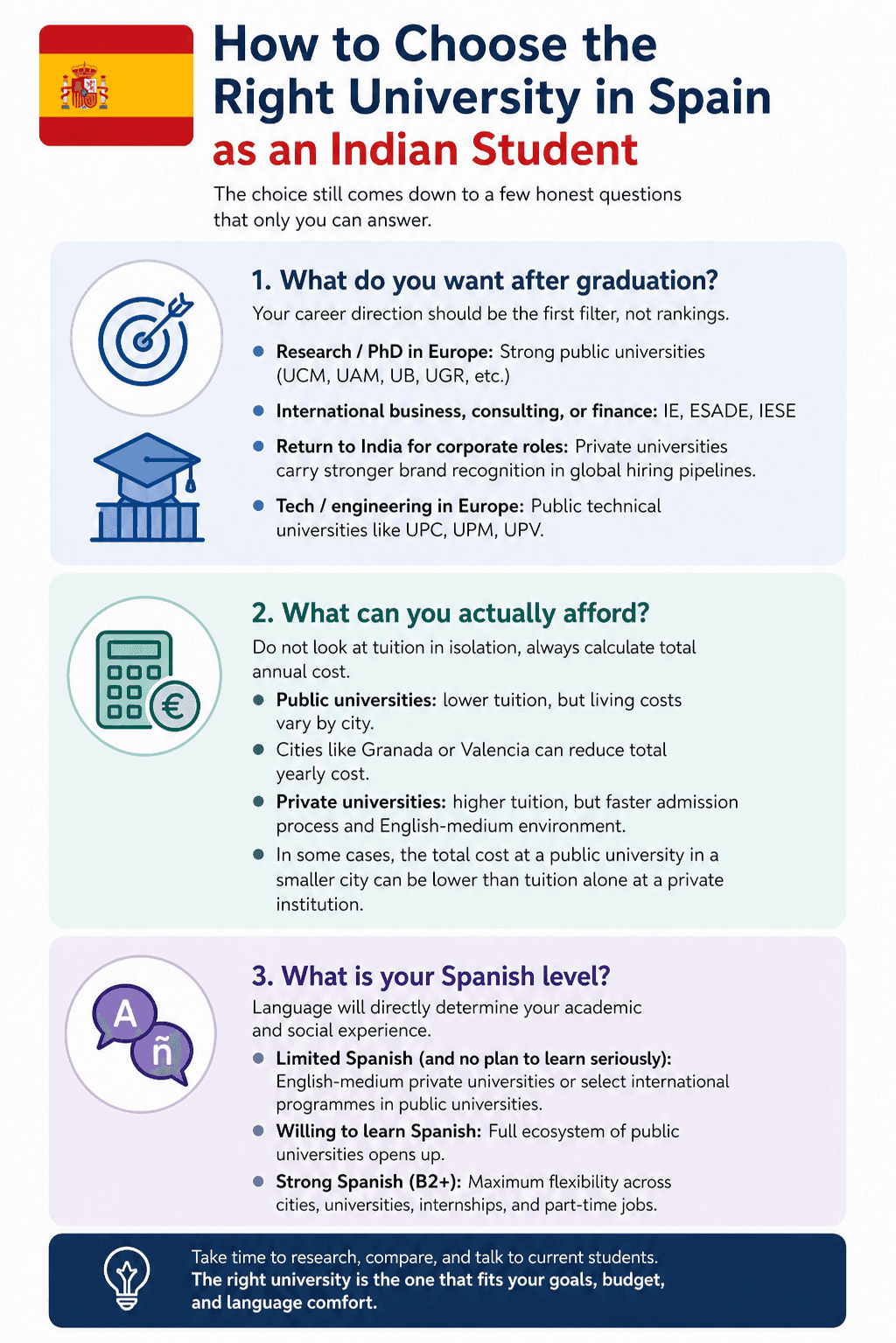
The choice still comes down to a few honest questions that only you can answer.
What do you want after graduation?
Your career direction should be the first filter, not rankings.
What can you actually afford?
Do not look at tuition in isolation, always calculate total annual cost.
What is your Spanish level?
Language will directly determine your academic and social experience.
Spain offers strong programmes in Engineering, Business, Medicine, Architecture, and Social Sciences. The right choice depends on your field, language ability, budget, and long-term career plans.
Top institutions include UPC Barcelona, UPM Madrid, and UPV Valencia. At undergraduate level, most engineering programmes are taught in Spanish, so a B2 level of Spanish is essential for managing coursework and exams.
For Indian students entering after Class 12, admission goes through the UNED PCE pathway, combined with strong academic preparation and language readiness.
Key Master’s programmes (more English-medium options)
Note: Spain’s tech job market is smaller than Germany, the UK, or the Netherlands. Strong Spanish and active networking improves employability if you plan to stay.
Affordable public options: UC3M, UAM, and UB all offer solid Business and Economics Master's programmes at public university fees.
Private tier for global careers: IE's Master in Management (~€36,500, one year), ESADE's MSc in Management and Finance, and the IE-ESADE-IESE MBA triumvirate- all English-medium, all requiring 4- 6 years of experience for competitive MBA applications. Strong Indian alumni networks at all three.
Medicine in Spain is a six-year Grado, taught entirely in Spanish, and is one of the most competitive programmes in the country.
Admission for international students is through UNED PCE, and scores required are highly competitive. From the third year onward, students require advanced clinical Spanish.
After graduation, students must pass the MIR exam (Médico Interno Residente) to specialise- Spain’s national residency entrance exam, similar in structure and competitiveness to NEET-PG.
Indian MBBS graduates who wish to practise in Spain must complete homologación (degree recognition) through the Spanish Ministry of Education, which is a multi-step process involving documentation, exams, and language proficiency.
More accessible postgraduate pathways include:
UNAV’s CIMA research centre is notable for doctoral research in oncology and biomedical fields.
ETSAM (UPM, Madrid) and ETSAB (UPC, Barcelona) are Spain's two most prestigious architecture schools, Spanish-medium, and have a strong European reputation. IE University offers English-medium Master's in Architecture and Urbanism.
For Design, IED has campuses in Madrid and Barcelona with strong Fashion, Graphic, and Product Design programmes. Practising architecture in Spain requires local licensing and professional-level Spanish.
For international careers- UC3M's Master in International Law, IE Law School's International LLM, and ESADE's LLM are the strongest options. They have English-medium, good placement in arbitration, corporate law, and international organisations.
Spain is one of the world's top three tourist destinations with over 85.1 million visitors in 2023. EUHT StPOL (Barcelona) and Les Roches Marbella are the leading hospitality schools. Strong industry placement pipelines and one of the more realistic employment pathways for non-EU graduates in Spain.
Strong programmes at UAM, UB, and Universidad de Santiago de Compostela. Good for research and clinical careers but be realistic about employment outcomes in Humanities broadly.
The student visa is the part of the Spain journey that causes the most anxiety among Indian applicants and most of that anxiety comes from incomplete or outdated information. The Spanish student visa process is not particularly difficult. It is document-heavy and timeline-sensitive. The students who struggle are almost always those who started too late, used the wrong documents, or relied on information that had not been updated to reflect recent regulatory changes.
Below you will learn about which visa you need, what documents are required, where and how to apply in India, what happens after you arrive, work rights during your studies, and the post-study options. The information here reflects requirements as of 2026, but visa regulations do change, and you should always verify current requirements directly with the Spanish Embassy or Consulate in India before submitting your application.
Spain issues different visa categories depending on the length and nature of your stay. For Indian students, the relevant categories are:
Short-Stay Schengen Visa (Type C): Valid for stays of up to 90 days within any 180-day period across the Schengen Area. This is appropriate only for very short language courses or intensive programmes of less than three months. It does not allow you to enroll in a degree programme and does not permit work. Most Indian students planning to study in Spain do not need this visa.
Long-Stay Student Visa (Type D): This is the visa you need for any programme lasting more than 90 days, which includes virtually all university degrees, most language courses of meaningful duration, and any programme leading to a qualification. The Type D student visa is issued for the duration of your programme, typically one academic year at a time, and is renewable from within Spain.
There is also a subcategory distinction within the Type D visa based on programme length:
The TIE is not just a bureaucratic formality. It is your primary identification document in Spain as a non-EU resident, and you will need it for opening a bank account, accessing healthcare, signing a rental contract, and any employment-related process.
Spain's student visa applications in India are handled through BLS International- the official outsourced visa application service authorised by the Spanish government. You do not submit directly at the consulate. You book your appointment through BLS, submit documents at a BLS centre, and BLS forwards everything to the relevant consulate for assessment and decision.
BLS centres are available across multiple Indian cities including Delhi, Mumbai, Bangalore, Chennai, Kolkata, Hyderabad, and Ahmedabad. Always use the official BLS Spain visa portal to book appointments, confirm current document requirements, and check centre locations. BLS service fees are charged separately from the consulate visa fee and are non-refundable.
Which consulate processes your application depends on your permanent residential address:
| Consulate | States and territories covered |
| Embassy of Spain, New Delhi | Delhi NCR, UP, Rajasthan, Punjab, Haryana, HP, Uttarakhand, J&K, Ladakh, Bihar, Jharkhand, Odisha, West Bengal, Assam, Sikkim, Arunachal Pradesh, Nagaland, Manipur, Meghalaya, Mizoram, Tripura, Chandigarh, Lakshadweep, Andaman & Nicobar Islands |
| Consulate General, Mumbai | Maharashtra, Goa, Gujarat, Karnataka, Kerala, Tamil Nadu, Andhra Pradesh, Telangana, Chhattisgarh, MP, Dadra & Nagar Haveli, Daman & Diu, Puducherry |
Embassy of Spain, New Delhi: 4, Golf Links, New Delhi 110003 | emb.nuevadelhi.vis@maec.es | Mon–Fri, 09:00–13:00
Consulate General of Spain, Mumbai: Express Towers, 3rd Floor, Barrister Rajni Patel Marg, Nariman Point, Mumbai 400021 | cog.mumbai.vis@maec.es | Mon–Fri, 09:00–14:00
Important: India also has Honorary Consulates in Bangalore and Chennai. These cannot process visa applications for Indian nationals. Residents of Bangalore, Chennai, Kolkata, and surrounding states must apply through BLS, their applications will be processed by the Mumbai Consulate General.
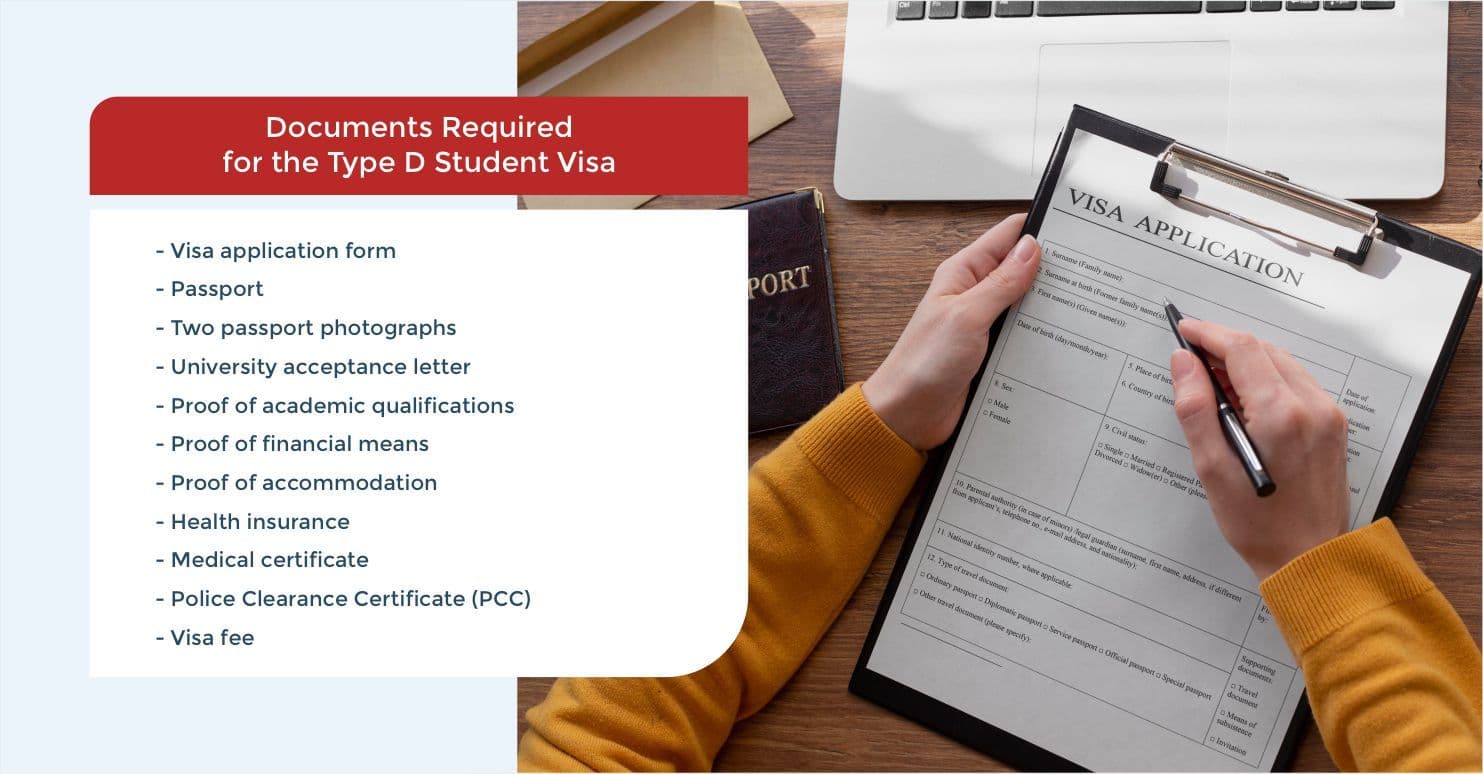
Step 1: Secure your university admission.
Begin the visa process only after you have an acceptance letter. Applying without confirmed admission wastes time and risks rejection.
Step 2: Gather and authenticate your documents.
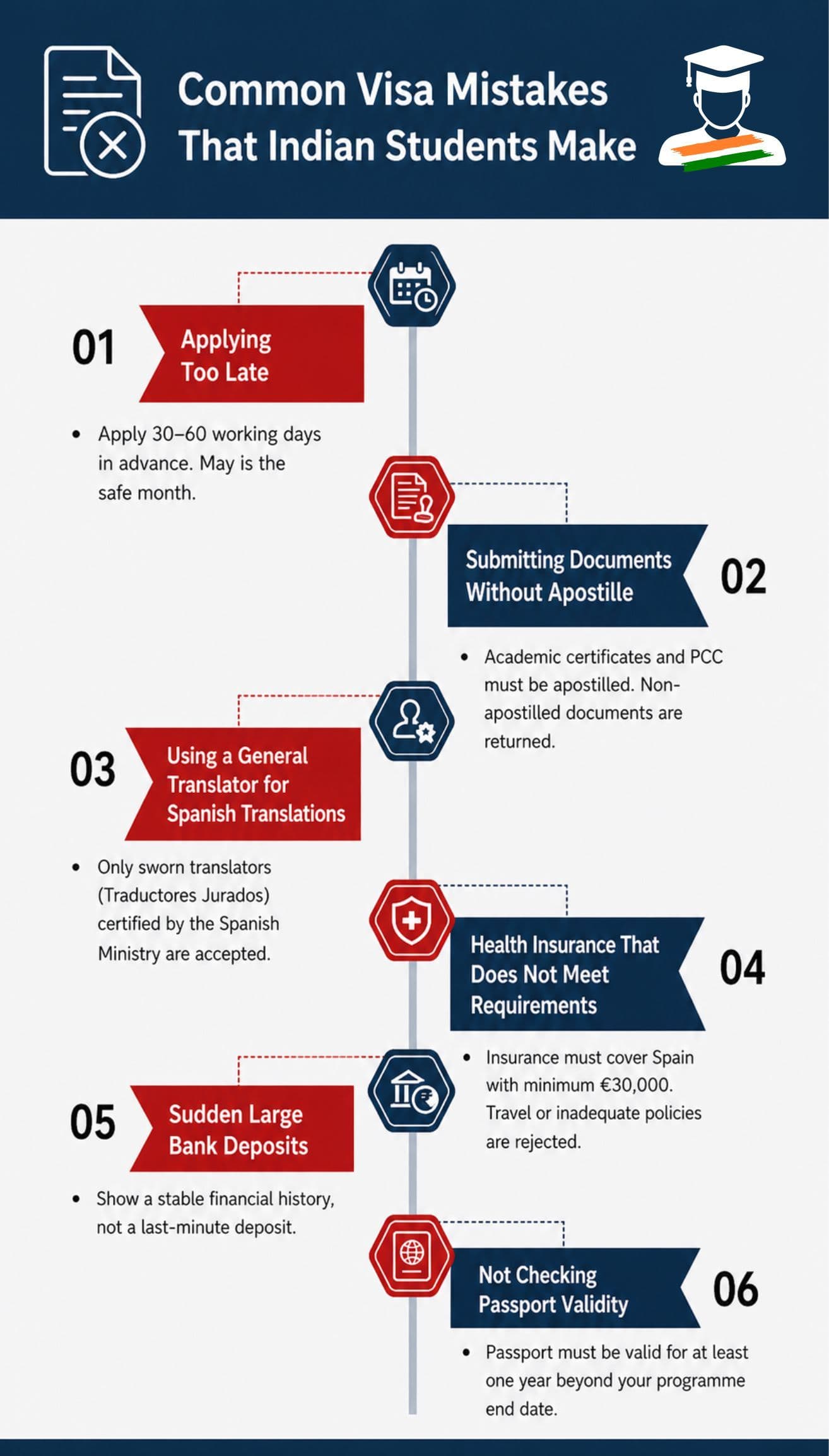
Start the apostille process for your academic documents and Police Clearance Certificate immediately after receiving your acceptance letter. These steps take the longest and are the most common source of delay. Do not wait until your other documents are ready before initiating the apostille process.
Step 3: Book your consulate appointment
Book your visa appointment through the official website of the Spanish Consulate or its authorised visa service provider (such as BLS International, depending on your jurisdiction). Appointments are limited and fill quickly, especially between May and July. If no slots are available, check daily as cancellations are common and new slots are released periodically.
Step 4: Submit your application.
Attend your appointment with your complete document set like originals and photocopies. Your biometric data (fingerprints and photograph) will be collected, and your application will be formally submitted to the consulate for processing. Incomplete applications are a common reason for delays or rejection, so ensure every document meets the stated requirements before your appointment.
Step 5: Wait for processing.
Standard processing time for a Spanish student visa from India is 30 to 60 working days. Processing times can extend during peak periods. Applying in May or June for a September intake is standard practice, but applying in March or April gives you more buffer for unexpected delays.
Step 6: Collect your visa.
Once approved, your passport will be returned with the visa sticker. Check all details on the visa like name spelling, validity dates, number of entries immediately. Errors must be corrected before you travel.
Step 7: Travel to Spain.
You must enter Spain within the validity window stated on your visa. Most Type D student visas allow entry up to 30 days before the programme start date.
Empadronamiento (municipal registration): Register your address at your local Ayuntamiento within the first week. It's free and hardly takes 30 minutes. You need your passport, visa, and proof of address. The certificate you receive is required for your bank account, healthcare access, and TIE application.
TIE application: Book your appointment at the local Extranjería office (National Police) immediately on arrival. Slots in Madrid and Barcelona are in high demand and can take several weeks to secure. Documents needed are passport, Type D visa, university enrolment certificate, proof of financial means, health insurance, and empadronamiento certificate. TIE card is usually take 8 to 12 weeks to be ready for collection in major cities. You receive a receipt as proof of legal status while you wait.
This is an important aspect of the student visa for Indian students, and Spain made a positive change here in 2023.
As of the updated immigration regulations that came into force following the passage of the Ley de Startups and associated immigration reforms, international students in Spain on a Type D student visa are permitted to work up to 30 hours per week during the academic term, and full-time during official academic holidays. This is an increase from the previous limit of 20 hours per week and brings Spain's student work provisions closer to those of the UK and Ireland.
The work authorisation is not automatic. Your employer must apply for a work permit on your behalf through the immigration authorities. You cannot simply take on work without this authorisation in place. The process is handled by the employer, but you need to understand it exists and confirm that any employer you work for is willing to go through it. Established companies and university-affiliated employers are familiar with the process. Informal or cash-in-hand arrangements are not legal and carry real risk.
The types of work available to Indian students in Spain will depend on their Spanish level. University campuses, international companies, English-language teaching, and hospitality in international tourist areas are the most accessible sectors. Professional internships in your field of study are also possible and can often be arranged through your university's career services department- these are frequently structured as curricular practices which are integrated into the degree and may not require separate work authorisation.
If your programme spans more than one academic year, which includes all four-year Grado programmes, two-year Master's programmes, and doctoral programmes then you will need to renew your student residence authorisation (TIE) annually from inside Spain rather than returning to India for a new visa.
The renewal is processed through the Extranjería office and requires proof of continued enrolment, proof of financial means for the coming year, and valid health insurance. The renewal should be initiated at least 60 days before your current TIE expires. Overstaying a lapsed TIE, even by a few days while a renewal is pending, can create complications that are time-consuming and stressful to resolve. Set a calendar reminder and initiate the renewal process early.
Spain introduced meaningful improvements and these changes are directly relevant to Indian students thinking about career options after graduation.
Job-seeking permit: International graduates who complete a university degree in Spain can now apply for a 12-month job-seeking permit after graduation. This allows you to remain legally in Spain while searching for employment, without needing to maintain your student status. The application is made at the Extranjería office before your student visa expires.
Startup visa provisions: Graduates who wish to launch a business or startup in Spain can apply for an entrepreneur visa under the new Ley de Startups framework, which provides a pathway to longer-term residence for those who can demonstrate a viable business plan and initial funding.
Transition to work visa: Once you secure employment in Spain after graduation, your employer can sponsor a work permit application that transitions your legal status from student to worker. This is a standard process and is the route most graduates who stay and work in Spain follow.
“Spain is affordable” is a half-truth. Costs vary depending on where you study- a room in central Madrid can easily cost twice what you would pay in Salamanca or Granada. Your city choice will shape your monthly budget as much as your lifestyle does.
Public universities remain relatively affordable, but fees vary by region and fields like Engineering, Architecture, and Health Sciences are consistently more expensive than Humanities and Social Sciences. At doctoral level, the picture improves further- competitive positions funded through national schemes like FPI and FPU often cover tuition fully and provide a monthly stipend.
| Tuition Fees | Non-EU students |
| Public university UG (Grado) | €1,500-€3,500/year |
| Public university Master's | €2,000-€6,000/year |
| Public university PhD | €300-€600/year |
| Private university UG | €8,000-€22,000/year |
| Private university Master's | €15,000-€40,000 total |
| MBA (IESE, ESADE, IE) | €81,500-€98,200 total |
Engineering, Architecture, and Health Sciences carry higher fees within public universities than Humanities. PhD positions with FPI or FPU fellowships cover fees entirely and include a monthly stipend.
| City | Monthly Total |
| Madrid | €850-€1,300 |
| Barcelona | €950-€1,350 |
| Valencia | €700-€950 |
| Seville | €650-€900 |
| Granada | €600-€850 |
Madrid: Spain's capital and most expensive student city. Best for students who want maximum career networking, a large Indian community, and access to the headquarters of most major companies operating in Spain. Outer neighbourhoods bring costs down significantly.
Barcelona: Global city with strong startup culture, world-class universities, and a vibrant international student scene. Slightly pricier than Madrid for accommodation. Expect Catalan alongside Spanish in daily life.
Valencia: Consistently underrated. Strong technical and general universities, beach city lifestyle, genuinely warm culture, and cheaper than Madrid or Barcelona. Best cost-quality ratio in Spain.
Seville: Andalusia's capital with a large, well-regarded university and a relaxed pace of life. Walkable city centre, strong tapas culture, and among the most affordable major cities in Spain.
Granada: One of Europe's great student cities. Over 60,000 students in a compact, walkable city. Deeply affordable, culturally rich, and one of the few places left in Spain where free tapas with every drink is still standard practice.
Salamanca: Historic university city, one of the oldest in Europe. Ideal for students prioritising Spanish language immersion- widely considered home to the clearest Castilian Spanish spoken anywhere. Most affordable city on this list.
Most Indian students budget for monthly living costs and forget that the first month costs more than every month after it. Accommodation alone requires the security deposit - around one to two months' rent plus the first month's rent, all paid at signing. Add household basics like kitchen items, and toiletries, a SIM card, transport card setup, and initial university materials, and you are looking at a realistic first-month buffer of €1,500 to €2,500 depending on the city. Have this available before you arrive , not as money you plan to sort out after landing.
Open a Spanish bank account within the first month. This is needed for salary, rent direct debits, and avoiding transaction fees. CaixaBank, BBVA, and Santander all have no-fee student accounts. You need your passport, TIE (or receipt), and empadronamiento certificate.
For transfers from India, you can use Wise rather than bank-to-bank transfers. Revolut and N26 also work well for day-to-day spending without a Spanish account.
Students working part-time pay Spanish income tax and your employer handles withholding automatically. If you earn above the minimum threshold, you will file an annual tax return in spring. The Agencia Tributaria's online system pre-fills most of it.
Scholarships for Spain are real and accessible for Indian students, but they are highly competitive and require early preparation. Unlike the US or UK, Spain offers fewer fully funded seats, so most funding comes from a combination of government programmes, EU schemes, universities, and private foundations. Students who start searching after admission often miss the main application cycles, which open months in advance.
AECID (MAEC-AECID Scholarships) is one of the most important Spain-specific funding options for international students from developing countries. India may be eligible in some calls, but availability for Indian applicants is limited and highly competitive. It supports Master’s, doctoral studies, and research stays at Spanish universities. The scholarship covers tuition fees and provides a monthly stipend of approximately €1,100-€1,200, and in some cases travel expenses. Selection is based on academic merit and the relevance of the applicant’s study to development goals. Applications generally open between October and December.
Fundación Carolina is another major Spanish institution that funds postgraduate study and research for international students. India falls under the “rest of the world” category, which makes Indian students eligible for selected programmes, but availability is limited and competition is high compared to Latin American applicants. It primarily supports Master’s degrees and research stays, offering either partial or full tuition coverage along with a living stipend depending on the programme. Competition is strong, and applicants are expected to have strong academic records and a clear professional or research trajectory. Applications open between November and March.
Erasmus Mundus Joint Master Degrees are among the most generous scholarships available globally. These programmes fully fund tuition, provide a monthly stipend of around €1,000-€1,400, and also include travel and installation allowances. Students study across multiple universities in different countries, and many programmes include at least one semester in Spain. Although extremely competitive, Indian students are regularly awarded these scholarships due to strong academic performance and diverse applications.
Erasmus+ Credit Mobility supports short-term study exchanges between partner universities. It is available for 3 to 12 months and provides a monthly stipend of approximately €700-€850 along with travel support. Eligibility depends on whether the student’s Indian university has an active Erasmus+ agreement with a Spanish institution. Universities such as IITs, University of Delhi, JNU, and BITS Pilani often participate in these partnerships.
The La Caixa Foundation scholarships are among the most prestigious and well-funded opportunities for postgraduate study in Spain and Europe. They cover tuition fees, living expenses, and travel costs for Master’s and PhD programmes. These scholarships are open across a wide range of fields, including STEM, economics, social sciences, and health-related disciplines. Selection is highly competitive, but successful candidates receive comprehensive financial support that allows them to study without financial pressure.
Most Spanish universities offer their own merit-based or international student scholarships, which are usually partial but still valuable. IE University offers merit scholarships that reduce tuition by 20-40%. ESADE provides awards ranging from €5,000 to €20,000 for Master’s and MBA programmes. UC3M and UPC Barcelona also offer merit-based grants for international postgraduate students, especially in engineering, economics, and data science fields. These scholarships are usually applied for during the admissions process, and availability varies by programme.
The National Overseas Scholarship (NOS) is an Indian government scheme for students from SC, ST, Denotified Tribes, and other eligible categories. It covers tuition fees, living expenses, and airfare for Master’s and PhD studies abroad, including Spain. It is highly competitive and strictly category-based, with limited annual seats.
The Indian Council for Cultural Relations (ICCR) also offers scholarships for study abroad, including Spain, under its cultural exchange programmes. These cover tuition and provide a living stipend, though availability varies each year depending on bilateral agreements and programme selection.
Becas Santander is a global scholarship initiative by Banco Santander that partners with Spanish universities to offer funding for international students. Awards approx range from €1,000 to €5,000 and can be used for tuition support, research, or mobility grants. These scholarships are distributed through participating universities and are often open multiple times a year.
PhD funding in Spain is primarily structured through two major schemes - FPI and FPU. The FPI (Formación de Personal Investigador) programme is linked to specific research projects and covers full tuition along with a monthly stipend of around €1,200-€1,500 for up to 4 years. The FPU (Formación del Profesorado Universitario) programme is more competitive and is designed for candidates aiming for academic careers, offering similar financial support.
Both funding routes require early contact with a Spanish supervisor and are usually secured through direct involvement in research groups before or during the application stage. For PhD candidates, this is the most important step in securing funding in Spain.
Spain moves at a different pace than what many Indian students are used to. Dinner often starts around 9pm or later, especially in cities like Madrid and Barcelona. Many shops close for a few hours in the afternoon for a break, family-run businesses outside major commercial areas. Administrative processes can be slow and rarely come with urgency.
Plans are also more flexible than fixed. It is normal for social meetups to shift on the same day, and punctuality is understood with some flexibility in informal settings. For students coming from highly structured academic environments, this can feel disorienting at first. Most students adjust within a couple of months. Once they do, many find the slower pace easier to live with than expected. Fighting it usually leads to frustration; adapting to it makes day-to-day life smoother.
The Indian student community in cities like Madrid, Barcelona, Valencia, and Granada is active and well-connected, especially through WhatsApp groups and student associations. Cultural festivals like Diwali and Holi are often celebrated within these networks, which can make the first few weeks much easier.
Using this community as an entry point is helpful. Relying only on it long-term is where many students unintentionally limit their experience. The students who tend to describe Spain most positively later are usually those who gradually branch out building friendships with Spanish and international students, learning the language, and engaging with the city beyond their campus routine.
Spain isn’t the easiest option for Indian students, and it won’t suit everyone. But if you go in with clear expectations like understanding the language commitment, budgeting realistically, and choosing your programme carefully then it delivers real value.
You get strong universities at a fraction of UK costs, a quality of life that’s hard to match, improving post-study options, and a language that opens doors far beyond Spain. The difference comes down to preparation. Students who plan well tend to do well. That’s exactly what this guide is here to help you do.
Your complete guide to fingerprinting in India, covering Aadhaar, passports, background checks, immigration, property registration, and your legal rights.

Everything Indians need to move to New Zealand in 2026 - visas, Green List occupations, taxes, healthcare, schools, jobs, and a full moving checklist.
The only Spain visa guide Indians need in 2026 - visa types, documents checklist, BLS appointments, financial proof, rejection fixes, and arrival steps, all in one place.

