

Before you apply anywhere, you need to understand how Spain structures its degrees because it follows a European framework that works differently from the Indian system, and the gaps between the two create avoidable mistakes. Indian students regularly arrive confused about credit systems, degree lengths, and whether their qualifications actually make them eligible for what they applied to.
Spain is part of the European Higher Education Area (EHEA) and follows the Bologna Process, a standardisation framework adopted across 49 European countries. The goal of Bologna was to make degrees comparable and transferable across borders. For Indian students, this is largely good news- a Spanish degree is recognised across the EU, and the structure is simple once you understand it.
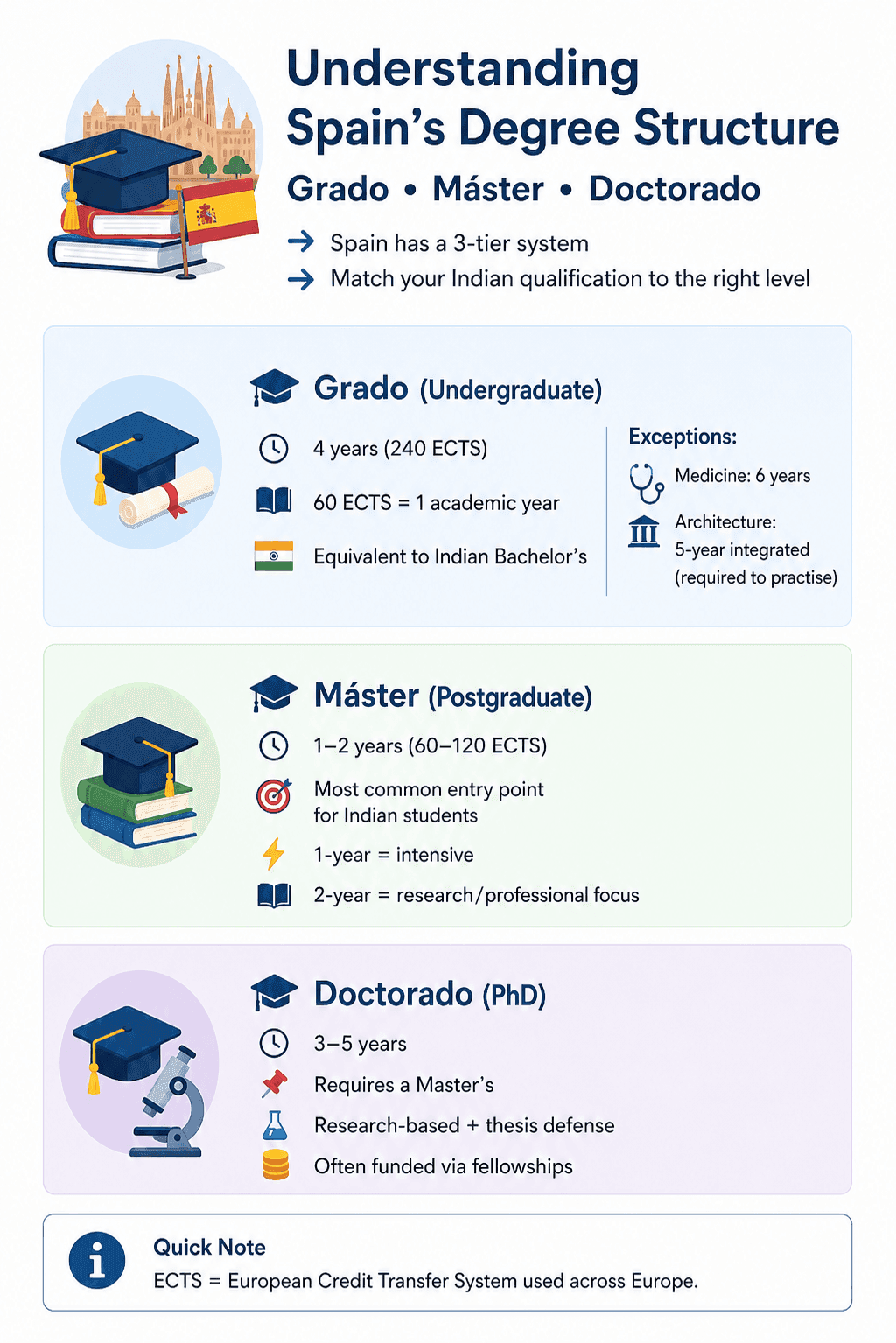
The Spanish system has three levels, and knowing which one your Indian qualification maps to is the first question to answer.
Grado: The Grado is the undergraduate degree- mostly four years, built around 240 ECTS credits. ECTS stands for European Credit Transfer and Accumulation System, the standard unit of academic measurement across Europe. One full academic year equals 60 ECTS credits. The Grado broadly corresponds to a four-year Indian Bachelor's degree, though the credit distribution across semesters can look different.
Two fields are exceptions worth knowing:
A four-year Grado in Architectural Fundamentals exists but does not qualify you as a licensed architect.
Master: The Master Universitario is the postgraduate taught degree. This is one to two years and 60 to 120 ECTS credits. This is where the majority of Indian students enter the Spanish system. Either coming directly from an Indian Bachelor's degree or after completing a Grado. A one-year Master's in Spain is mostly one academic year with a full workload. Two-year programmes are more common in research-intensive fields and professional disciplines.
Doctorado: The Doctorado is the doctoral degree, equivalent to a PhD. It requires a completed Master for entry and takes between three and five years. Three years is the standard full-time timeline under current regulations (RD 576/2023), with extensions available. Doctoral candidates work within a research group or department and the degree is awarded after submitting and publicly defending a thesis. Competitive fellowship schemes fund many doctoral positions.
When you apply to a Spanish Master's programme, your Indian degree is assessed for its ECTS equivalent. This evaluation directly affects your eligibility.
A three-year Indian Bachelor's degree is valued at 180 ECTS credits. A four-year degree, including most engineering degrees, integrated programmes, and honours degrees is valued at 240 ECTS credits. The distinction matters because many Master's programmes in Spain, particularly competitive ones, specify a minimum of 240 ECTS for entry. If you hold a three-year degree, some universities will still consider your application with additional documentation or relevant experience but others will not. Always check the specific programme's entry requirements before applying.
Spain has over 90 officially recognised universities, roughly 50 public and 30-plus private. The difference between them goes well beyond fees.
| Factor | Public Universities | Private Universities |
| Funding | State-funded | Privately funded |
| Fees (Grado) | €1,500 - €3,500/year | €8,000 - €20,000/year |
| Fees (Master’s) | €2,000 - €6,000/year | €10,000 - €100,000+ (top business schools) |
| Admissions | Slower, documentation-heavy | Faster, more flexible |
| Language | Mostly Spanish (some English programmes) | Largely English-medium |
| Academic Focus | Strong for research and academia | Strong for business and global careers |
| Reputation | Strong within Spain/EU | Top schools have global brand value |
| Best for | Budget-conscious, long-term EU plans | Career switch, international exposure |
If your priority is affordability and long-term integration in Spain, public universities are the better choice. If your priority is speed, English-medium education, and global career mobility, private institutions may justify the higher cost.
Spain's 17 autonomous communities, similar to Indian states but with greater control over education policy, have real authority over education. This means the experience of studying in Barcelona is different from studying in Madrid, not just culturally but administratively.
In Catalonia, Catalan is co-official alongside Spanish, and public universities like Universitat de Barcelona and Universitat Autònoma de Barcelona use it extensively at undergraduate level. International Master's programmes run in Spanish or English, but administrative communications and some course materials may involve Catalan. This is not a problem for most international students, but it is important to be aware of before arriving.
Madrid operates almost entirely in Spanish in academic and administrative contexts. This makes Madrid the most straightforward environment for Indian students arriving without prior language preparation. Valencia, the Basque Country, and Galicia have their own regional languages, though the working language at international programmes in these regions remains Spanish.
Regional autonomy also affects fees. The same Master's programme can cost different amounts depending on which community the university is in.Madrid and Catalonia tend to be at the higher end, while Andalusia and Castilla y Leon are lower.
The Spanish academic year runs from mid-September to late June, structured around two semesters. The first semester runs September to January, and the second runs February to June. Exams take place in January and May-June, many universities offer a July resit session for students who do not pass in the main exam period.
Application windows for most Master's programmes open between January and April for September entry. Competitive programmes like Engineering, Data Science, and Business, often close well before April as places fill. Applying in January is better than applying in March. For Indian students, this means the preparation process like apostilling documents, obtaining test scores, and requesting transcripts should begin at least 9 to 12 months before your intended start date.
A three-year Indian Bachelor's degree maps to 180 ECTS and is considered for Master's entry at many Spanish universities, but may not meet the 240 ECTS requirement at competitive programmes. A four-year degree like engineering, integrated, or honours maps cleanly to 240 ECTS and is treated as equivalent to a Spanish Grado for postgraduate entry.
For undergraduate entry from India, Class 12- whether CBSE, ICSE, or State Board, is not automatically accepted as equivalent to the Spanish Bachillerato. The standard pathway is the UNED PCE examination.
Spain's higher education system is not a back door into a European degree. Universities expect proper academic preparation, language readiness, and complete documentation. The students who struggle are always those who did not do the preparation required.

