

Spain wasn’t on most Indian students’ shortlists a few years ago. It was seen more as a travel destination than a study option. That has changed. Today, students are looking more closely at value for money, and Spain is holding up well. International enrolment has steadily increased, with Indian students in cities like Madrid, Barcelona, Valencia, and Seville across universities and business schools.
So what’s driving this shift? Several factors are coming together.
The cost gap with the UK and US
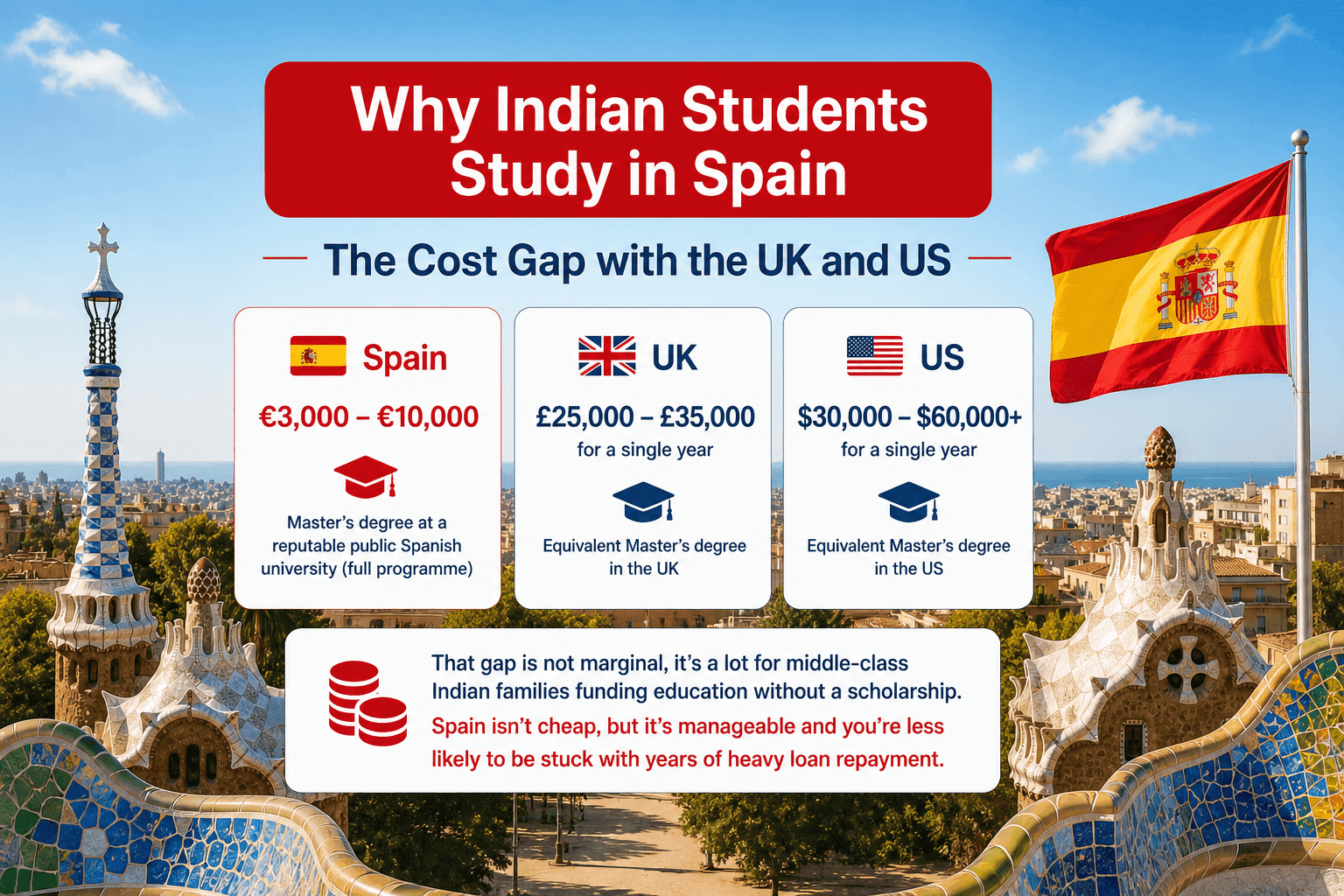
A Master's degree at a reputable public Spanish university costs an Indian student somewhere between €3,000 and €10,000 in tuition across the full programme, though some specialised programmes may be higher. The equivalent degree in the UK routinely costs £25,000 to £35,000 for a single year. That gap is not marginal, it is a lot for middle-class Indian families funding education without a scholarship.Spain isn’t cheap, but it’s manageable and you’re less likely to be stuck with years of heavy loan repayment.
English-taught programmes have expanded
This is the change that most directly opened Spain to Indian students. Universities like Universidad Carlos III de Madrid, Universitat Politècnica de Catalunya, and Universitat de Barcelona offer dozens of fully English-medium postgraduate programmes. Private business schools like ESADE, IESE, and IE University have been English-medium for decades. The language barrier at the academic level, while still real in some programmes, is no longer the wall it once was.
Quality of Life Matters More Than You Think
Spain gives students the space to actually absorb what they are learning, rather than just keeping up with constant pressure. Spain is widely regarded as one of the safer countries in Europe, with a strong emphasis on social life, community, and work-life balance. The pace of life is more measured, and rest is not treated as a failure or lack of ambition. For students coming from India’s highly competitive board and entrance exam system, this shift can make a meaningful difference - not just to mental well-being, but to how effectively they learn, engage, and perform academically.
Post-study options have improved.
Spain's 2023 Startup Law (Ley de Startups) strengthened the framework for international graduates, including a 12-month job-search permit after graduation and a clearer entrepreneur visa pathway for those starting a business. These are not a direct route to permanent residency. But for Indian students thinking about building a career in Europe rather than just getting a degree and leaving, Spain now offers more than it did even three years ago.

