

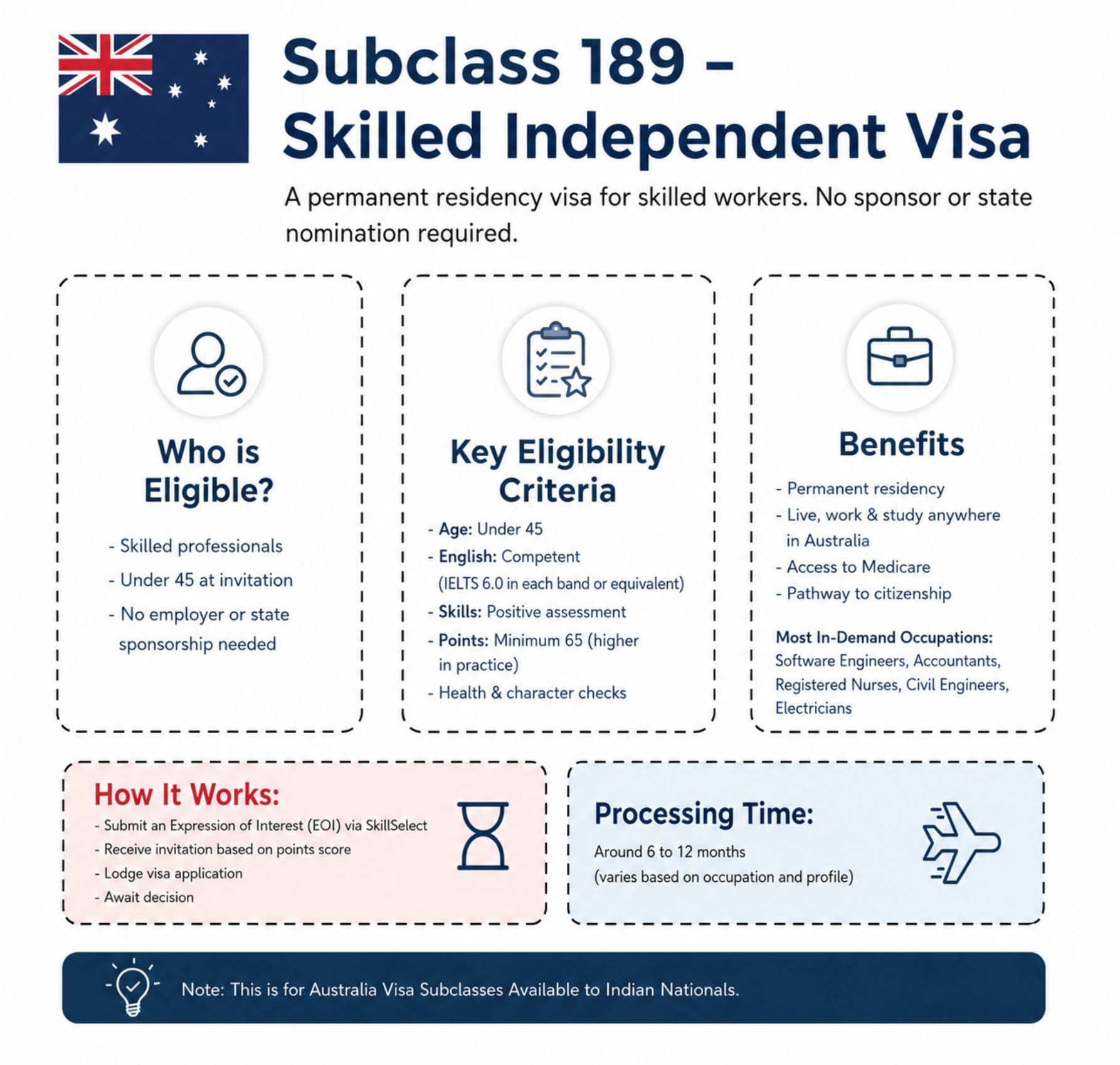
The Subclass 189 visa is the primary permanent residency visa in Australia's skilled migration program. It does not require sponsorship from an employer or nomination from a state government. Applicants need a positive skills assessment, a qualifying English test score, and a points score high enough to receive an invitation through SkillSelect.
The 189 visa grants the holder and their family members the right to live, work, and study anywhere in Australia permanently. It also provides access to Medicare and a pathway to citizenship after meeting residency requirements.The most competitive occupations under subclass 189 are those on the Medium and Long-term Strategic Skills List (MLTSSL). Examples include software engineers, accountants, registered nurses, civil engineers, and electricians.Key eligibility criteria:The Subclass 190 visa is also a permanent residency visa but requires nomination from one of Australia's states or territories. Each state nominates applicants based on their own skill shortages and migration targets.
Being nominated under the 190 program adds 5 points to a candidate's total points score. More importantly, the points cutoff for state-nominated invitations is often lower than for the 189, making it more accessible for applicants who cannot achieve the higher thresholds required for the independent stream.Recipients of a 190 visa are expected (though not legally compelled) to live and work in the nominating state for at least two years. The visa itself grants permanent residency across all of Australia.Each state publishes a list of occupations it is willing to nominate. This list changes frequently, sometimes monthly, based on labour market conditions. Applicants must match an occupation on the state's current list and meet the state's specific criteria, which vary considerably.The Subclass 491 is a temporary visa valid for five years. It is points-tested and requires nomination from a state or territory or sponsorship from a qualifying family member living in a regional area of Australia.
The 491 visa adds 15 points to the applicant's total score, making it easier to receive an invitation than the 189 or 190 for candidates with lower base scores. However, 491 holders must live and work in a regional area of Australia for at least three years and meet income thresholds before they can apply for permanent residency through the Subclass 191 visa.Regional areas under this scheme include most of Australia except Sydney, Melbourne, and Brisbane's urban cores. Cities like Adelaide, Hobart, Canberra, Darwin, Perth, Gold Coast, Sunshine Coast, and Newcastle are classified as regional for this purpose.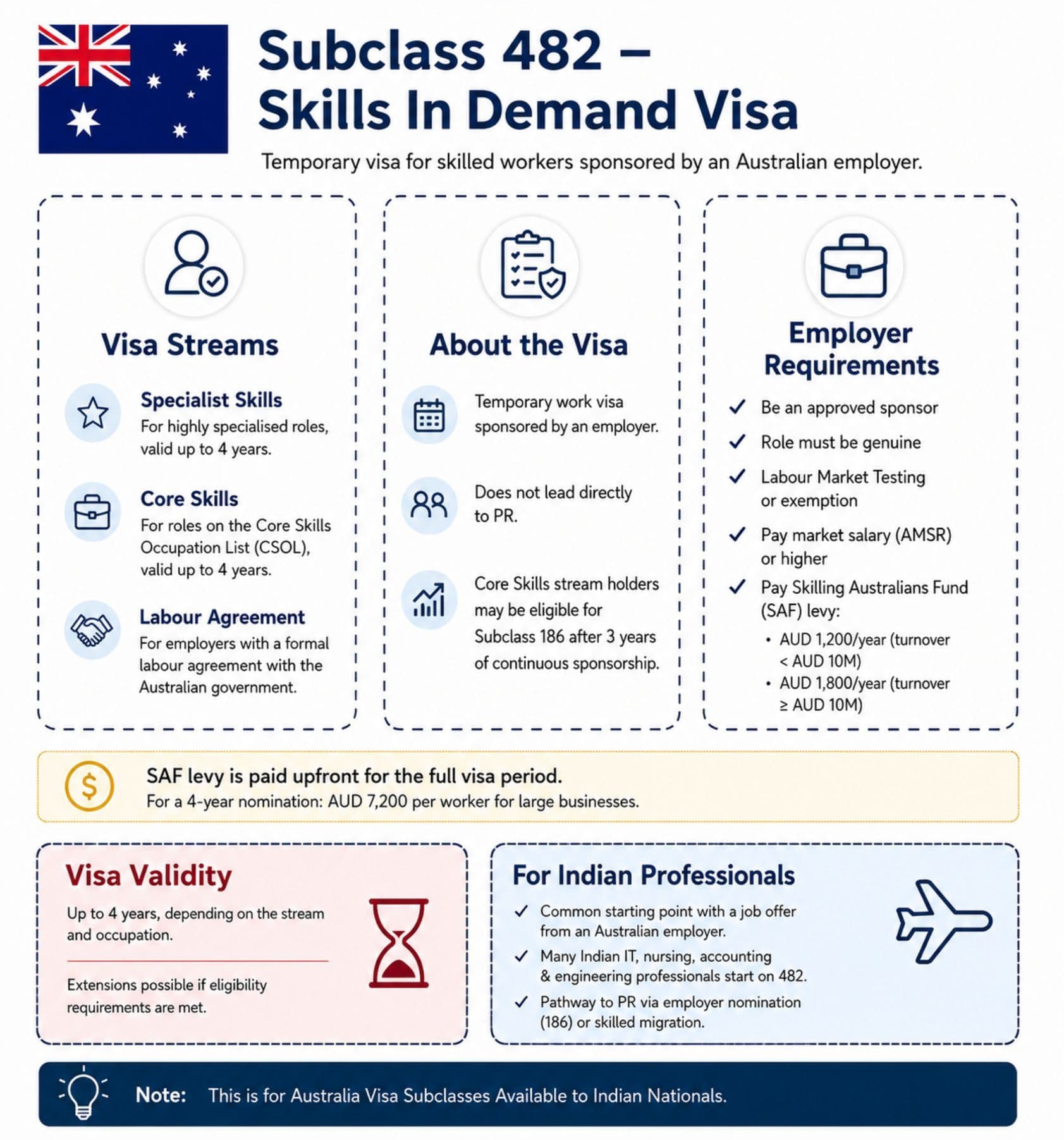
The Subclass 482 Skills in Demand visa allows Australian employers to sponsor skilled workers from overseas on a temporary basis. The visa has three streams:
The Subclass 186 is a permanent residency visa sponsored by an approved Australian employer. It has two main streams:
The Subclass 485 visa is designed for international students who have completed qualifications in Australia. It allows recent graduates to live and work in Australia temporarily while they gain experience and (if they choose) prepare for a skilled migration application.
There are two streams:Partner visas allow Australian citizens, permanent residents, or eligible New Zealand citizens to sponsor their spouse or de facto partner for residency. The process is two-stage:
The Subclass 500 visa allows Indian nationals to study full-time at a registered Australian institution (CRICOS-registered). The visa grants 40 hours of work rights per fortnight during study and unlimited hours during official vacation periods.
Australia is the fourth-largest international education destination globally. Tuition costs for international students range from AUD 20,000 to AUD 45,000 per year for undergraduate programs and AUD 22,000 to AUD 55,000 for postgraduate. Students are required to hold Overseas Student Health Cover (OSHC) for the duration of their stay.The student visa pathway is important because it frequently leads to the 485 graduate visa and subsequently to a skilled migration pathway.Parents of Australian citizens or permanent residents can apply to join their children in Australia. The most common parent visa subclasses are:

