
By now, you probably know that as an Indian travelling to Spain, a visa is non-negotiable. But not all short-stay visas and application processes are created equal. In fact, for some, it’s significantly easier, and even free. If you are a close family member of someone who is a citizen of the EU, EEA, or Switzerland, you fall into a special category of the Spain short term visa that bypasses a lot of the usual hurdles.That alone is reason enough to understand all the categories of short-term Spain visas available before you assume which one applies to you.
There is also a common misconception worth addressing upfront. Many Indians believe that once they have a Schengen visa in hand, entry into Spain is guaranteed. It is not. A visa is permission to travel to the border, not automatic permission to cross it. The border authorities in Spain can and do refuse entry if you cannot clearly demonstrate the purpose of your visit, show proof of accommodation, return tickets, or sufficient funds, or if any other entry requirement is not satisfied on the day you arrive.
So before you apply for a Spanish visa as an Indian resident, it pays to know exactly which visa category fits your situation, and exactly what you need to carry when you land.
A Schengen Visa is your entry pass to not just Spain, but the entire Schengen zone. As an Indian passport holder, you'll need this visa before you travel. It lets you stay for up to 90 days within any 180-day period, and covers a wide range of purposes, including tourism, business trips, visiting family, medical treatment, short courses, training, or volunteering.
Types of Schengen Visas for Indians
| Schengen Visa Type | Purpose |
| Tourist Visa | This is the most common one among Indians. It’s for when you’re going to Spain for a holiday, sightseeing, or just exploring the culture. |
| Business Visa | If you’re going to Spain for meetings, conferences, or to sign a contract. |
| Friends and Family Visit Visa | Specifically for when you have a legal resident or citizen in Spain inviting you to stay with them (you’ll need an official invitation letter for this). |
| Medical Treatment Visa | For Indian patients travelling to Spain to receive specific medical care or surgeries at Spanish healthcare facilities. |
| Short Study / Training / Volunteer Visa | Used for student exchanges, short courses, or unpaid internships/volunteer work that lasts less than 3 months. |
| Airport Transit Visa (TAP) | As per BLS International, from March 4, 2026 onwards, Indian passport holders no longer require an airport transit visa to transit through the international zones of Spanish airports. |
If your spouse, parent, or another close family member is a citizen of an EU country, States of EEA or Switzerland, and you're travelling with them or going to join them in Spain, you may qualify for a special family member visa. Not only is the process faster and easier than a standard Schengen visa, this visa is free of charge. It still requires you to follow the standard Schengen rule: you can stay for up to 90 days within any 180-day period.
Note: This short-stay visa is only valid if you’re visiting as a family member of an EU citizen. If you're planning to relocate permanently to Spain with a Spanish citizen, this isn't the right visa - you'd need to apply for a Residence Visa (long-stay) instead.
Who Qualifies For This Visa?

Only core family members qualify for this specific route:
A Seaman Transit Visa for Spain is another one of the short-stay visas designed specifically for seafarers or crew members working on ships who need to enter Spain temporarily through a seaport. It is one of the most commonly encountered Spanish visa types among Indian merchant navy professionals working in international cargo ships, tankers, and cruise liners. A huge number of these vessels pass through Spanish ports or have crew changes scheduled there.
When is This Visa Needed?
You may need a Seaman Transit Visa if you are an Indian seafarer who is:
It is not a general travel visa; it is strictly for maritime work-related transit through Spain.
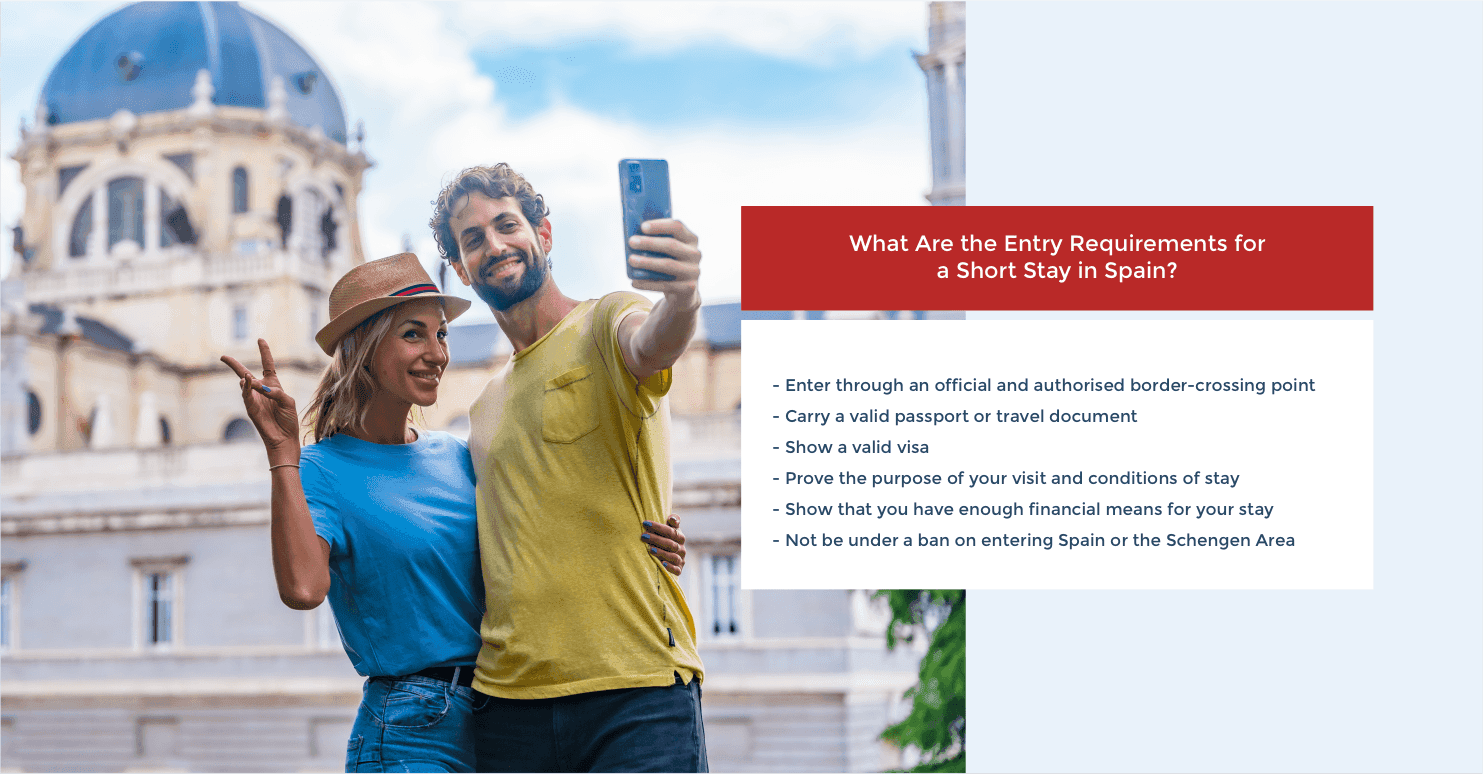
When you arrive in Spain for a short stay you need to meet a set of entry conditions at the border. These aren't just visa formalities; border officers can and do check these on arrival.
To enter Spain legally, you must:
Documents to Show at the Border
Financial Requirements
Spain has a fixed minimum for you to prove that you have enough money for your trip: €122 per person per day is required for the duration of your stay. And you should have at least €1,099 minimum, regardless of how short your trip is. So even if you're visiting for just a weekend, you need to show at least €1,099. This can be shown through bank statements, cash, traveller's cheques, or a credit card with sufficient limit.
Denial of Entry
You may be denied entry into Spain if you don’t meet the entry requirements or if there is already an entry ban against you. This can also happen if you’ve already used up your allowed stay - meaning you’ve spent 90 days in the Schengen Area within the last 180 days.
If this happens, the authorities will give you a written explanation telling you why you were refused entry. They will also inform you about how you can appeal the decision under Spanish rules. But even if you decide to appeal, the denial still applies. The appeal process won’t stop or reverse the decision immediately.
Yes, as an Indian citizen, you can technically extend a Spain Schengen visa, but the reality is quite strict. In the eyes of Spanish authorities, an extension is an exceptional situation, not a standard administrative request.
Conditions Required to Extend the 90-Day Stay
You cannot extend your visa simply because you want more time for sightseeing. An extension is only granted in these four specific scenarios:
If you meet the exceptional criteria, you must visit the Oficina de Extranjería (Foreigners' Office) or a designated National Police Station in the province where you are staying, along with the required documents.
When Should I Apply for Extension?
If you think you might need an extension, do not wait until your final days to act. The Oficina de Extranjería does not offer same-day approvals, and there is no emergency fast-track for tourists. Processing can take anywhere from a few days to several weeks depending on the province and how busy the office is. By the time you realise you need more time, it may already be too late to apply legally.
The practical rule to follow is: if any of the four exceptional circumstances apply to you, apply for extension as soon as the situation arises, ideally with at least 2 weeks remaining on your permitted stay.

