

The rollout of EES didn’t change whether Indian travellers need a visa anymore or not. The country is still a big member of visa-required countries when it comes to Spain. Even if you’re going for the first time, or have visited before, for Indians planning to visit Spain, a visa is mandatory - there are no exceptions. The type of visa depends entirely on the purpose and length of your stay:
To properly understand the Spain visa from India journey, it helps to understand who is travelling. Indian passport holders are an extraordinarily diverse group of travellers - students applying to European universities, IT professionals attending conferences, newly-wed couples on honeymoons, families visiting relatives who have settled abroad, and retirees ticking off a lifetime of travel dreams.
What binds them all together is the navy blue passport, issued by the Republic of India. As of today, the Indian passport grants visa-free or visa-on-arrival access to approximately 56-62 countries. Spain is not among those. Not even close.
India does not currently have a visa-waiver agreement with the European Union, meaning every visit requires prior approval from the Spanish Consulate or Embassy.
Countries like the USA, UK, EU Member States, Australia, Japan, South Korea, and Canada enjoy visa-free entry to Spain. However, from late 2026 onwards, many visa-exempt travellers will also need an ETIAS (European Travel Information and Authorisation System) approval before travelling to Spain and other Schengen countries.
Even with ETIAS, the travel process for visa-free nationals remains much simpler than the standard Schengen visa process followed by Indian passport holders.
| Feature | India | Visa-Free Countries |
| Advance Planning | Must apply weeks or months in advance via an embassy/center. | No embassy visit. Just book a ticket and go. |
| Documentation | Extensive, including Bank statements, ITRs, NOCs, and invites. | Minimal; just a valid passport is required. |
| Interview | Possible in-person interview at the consulate. | None. |
| Risk of Denial | Can be rejected based on financial or intent doubts. | Almost guaranteed entry unless there's a security alert. |
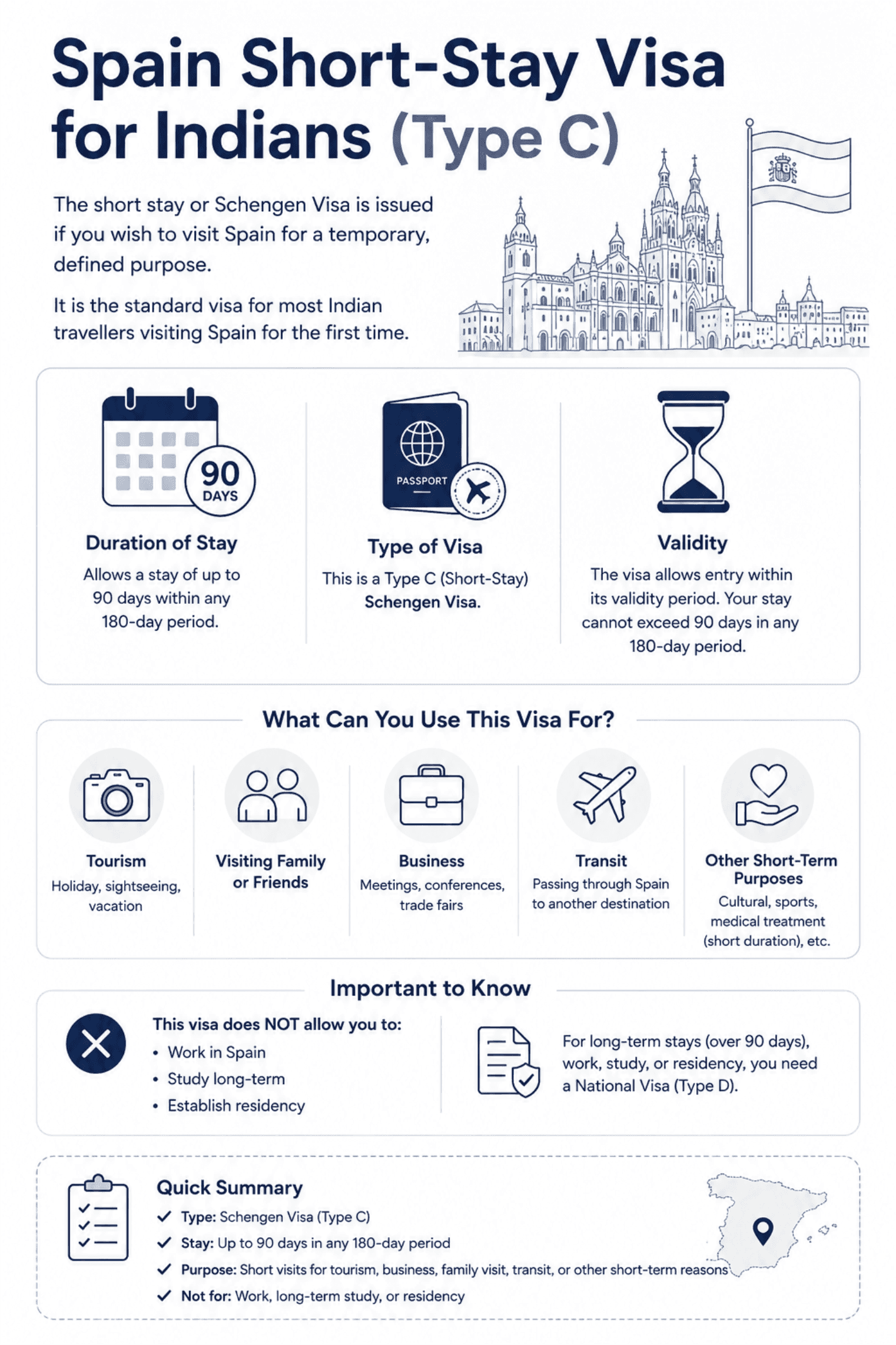
The short stay or Schengen Visa is issued if you wish to visit Spain for a temporary, defined purpose. It allows a stay of up to 90 days within any 180-day period. It is the standard visa for most Indian travellers visiting Spain for the first time. This visa does not allow you to work, study long-term, or establish residency in Spain.
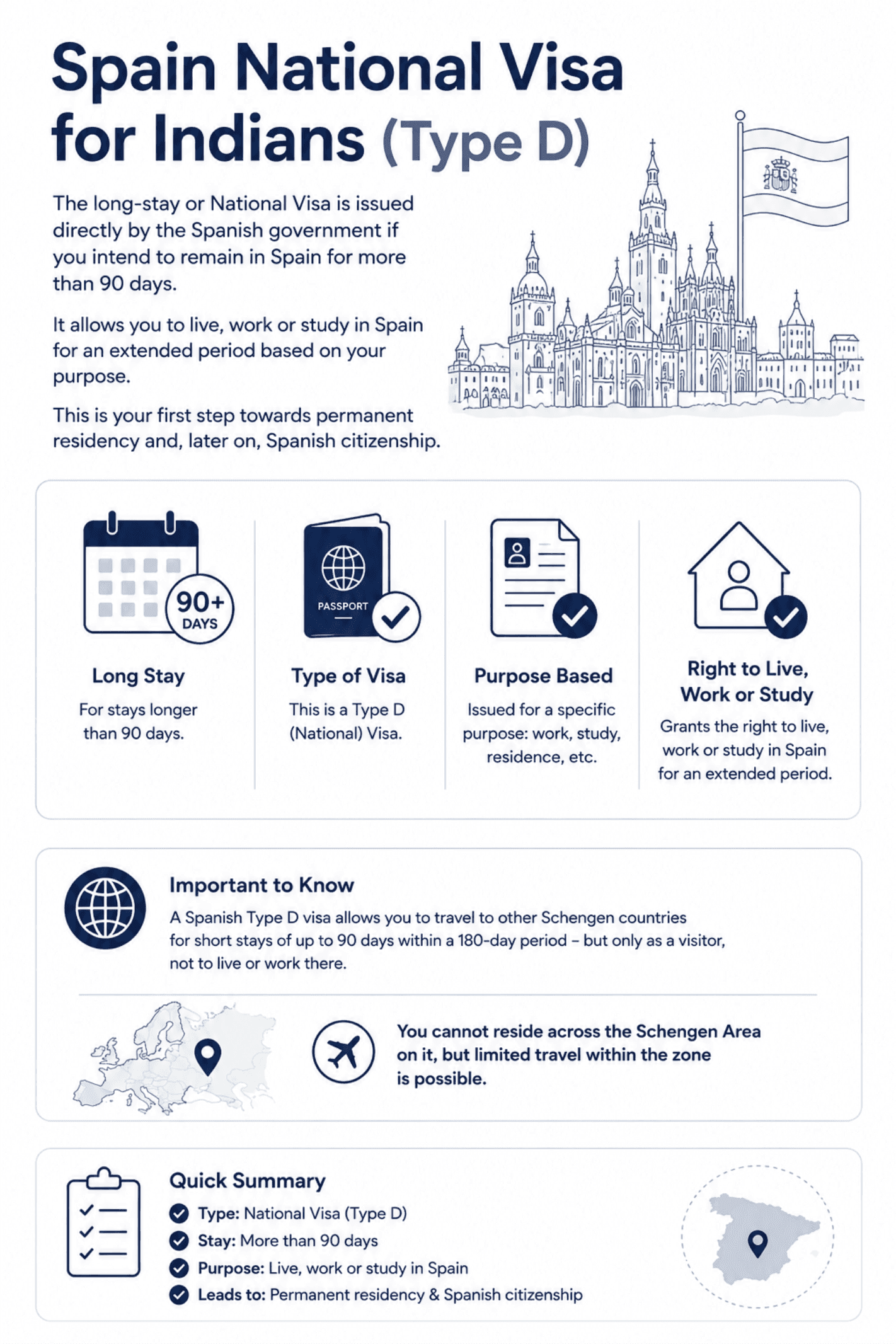
The long-stay or National Visa is issued directly by the Spanish government if you intend to remain in Spain for more than 90 days. It is tailored to a specific life purpose and grants the holder the right to live, work or study in Spain for an extended period, depending on your requirements. This long-stay visa is your first step towards getting permanent residency and, later on, Spanish citizenship.
Important: A Spanish Type D visa allows you to travel to other Schengen countries for short stays of up to 90 days within a 180-day period - but only as a visitor, not to live or work there. So while you cannot reside across the Schengen Area on it, limited travel within the zone is possible.
Before beginning your Spain visa application from India, it is worth pausing and asking yourself a clear set of questions. Your honest answers will point you directly to the right category.
If your stay is under 90 days and your purpose is tourism, business, or a short visit, the Schengen Visa is your route. If you are planning to stay beyond 90 days for any reason, you will need a National Visa, and the specific sub-category will ultimately depend on your purpose and financial circumstances. In 2026, the Spanish consulate is following a strict but fair rule: as long as your "Proof of Intent" matches your visa category, the door to Spain remains wide open.

