

The short-stay visa gets most of the attention, but the more interesting story for Indians in 2026 is the long-stay side. Spain has built one of the more accessible long-term residency paths in Europe with a lot of visa options available, each designed for a specific purpose of their move. Thousands of Indians in Spain are already building businesses, raising families, retiring, and working remotely - all legally, all through Spain's long-stay visa system.
A Spain National Visa allows you to stay in the country for up to one year at first, with the option to renew it if you continue to meet the requirements. This visa is issued by the Spanish Consulate in India and is completely different from the short-stay Schengen visa. If you hold an Indian passport, you must apply for this visa from India before you travel. There is no visa-on-arrival option.
But the hard truth is that the Spanish bureaucratic system is thorough, slow, and entirely in Spanish. That's not said to discourage you, it's said because people who go in unprepared end up with rejected applications, delays that cost them months, and frustration that could have been avoided. The system is designed to be thorough. And the only way to navigate a system this demanding and rigorous is to choose the right visa.
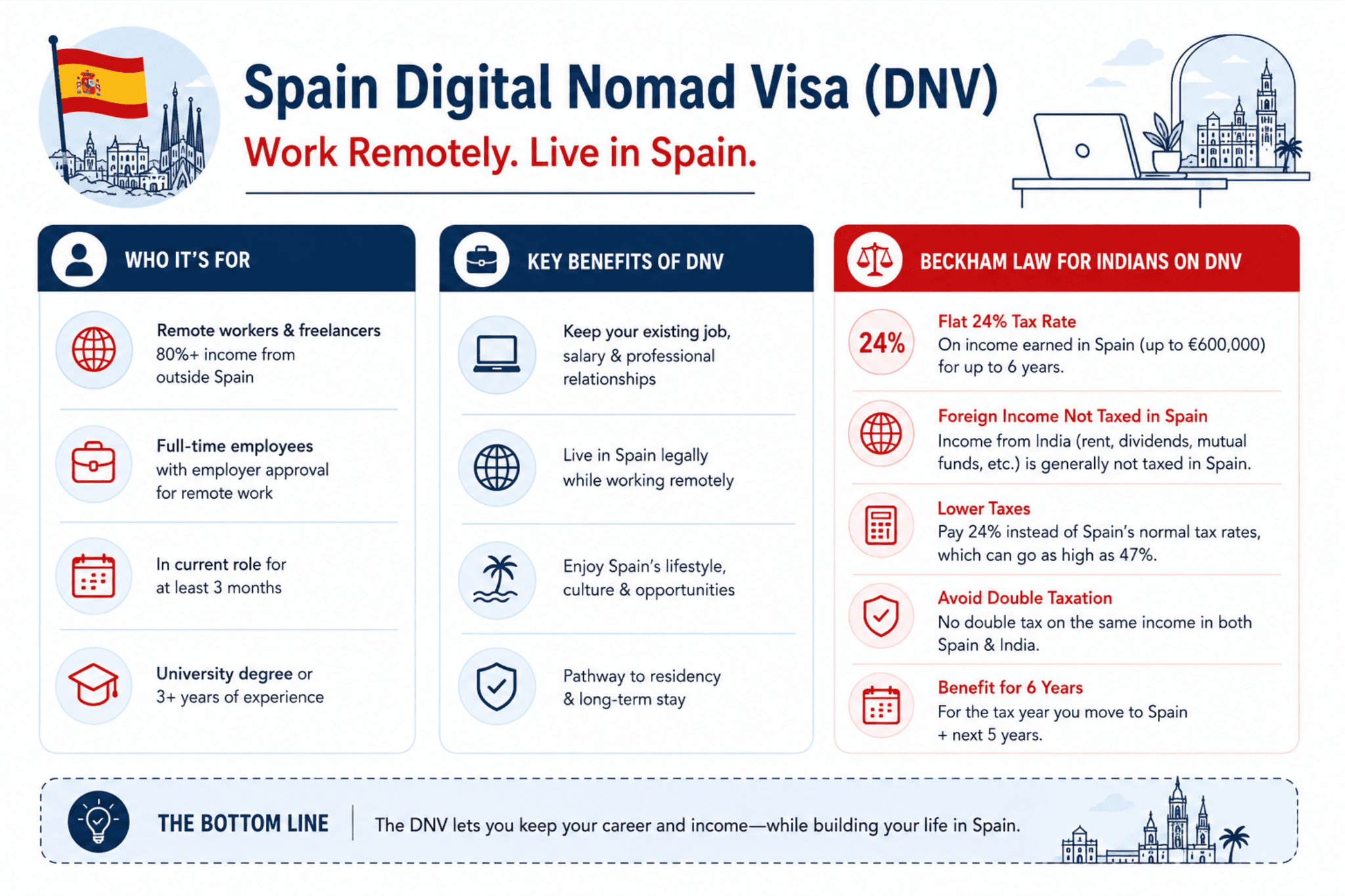
Launched in 2023 under Spain's Startup Act, the DNV is designed for those who earn their income remotely i.e. working for employers or clients based outside Spain. If you’re an Indian working in IT, consulting, finance, or any sector where remote work is the norm, and your employer has no objection to you working from another country, the DNV is probably the visa that was made for you. You keep your existing job, your existing salary, and your existing professional relationships - you simply move your laptop, and your life, to Spain.
Who it's actually for:
Beckham Law for Indians on DNV
The Beckham Law is a special tax benefit in Spain for foreigners who move there for work. If you qualify, you can pay a flat 24% tax rate on income earned in Spain (up to €600,000) for up to six years, instead of Spain’s normal tax rates, which can go as high as 47%.
Normally, once you become a tax resident in Spain, the Spanish government taxes your worldwide income. That means income from India, the US, or anywhere else could also be taxed in Spain. But the Beckham Law changes that.
Even though you live in Spain, you’re treated almost like a non-resident for tax purposes. In simple terms, Spain mainly taxes the income you earn from Spanish sources. Income from India, like rent from a property, dividends, or profits from mutual funds, is generally not taxed in Spain.This is especially useful for digital nomads and remote workers. Spain now allows people on the DNV to apply for Beckham Law benefits too. So if you’re an Indian professional working remotely from Spain for an Indian or international company, you could just pay 24% tax on your work income instead of the much higher normal Spanish tax rates.
You would still pay taxes in India on your Indian income if Indian law requires it, but you avoid being taxed twice on the same income by both countries.The benefit lasts for the tax year you move to Spain plus the next five years - six years in total. After that, you move into Spain’s regular tax system, where worldwide income is taxed.
If you want to live in Spain without working there, the Non-Lucrative Visa, or NLV, is the long-stay visa category for you. It has existed far longer than the Digital Nomad Visa and for decades, it has been the quiet favourite of retirees, wealthy individuals, and families wanting to live in Europe.
You can live in Spain indefinitely, as long as you can prove you don't need to earn money there. You are not allowed to work in Spain on this visa, not for a Spanish employer, not for a Spanish client. Your income has to come entirely from outside the country.
The basic requirement is that you can prove you have enough to support yourself (and any dependents) for the duration of your stay without relying on the Spanish economy for income.
The NLV suits you if:
One important note: if you land a job after your first year in Spain on this visa, you're legally required to switch to a work visa.
Spain’s student visa is for Indians who have gotten admission to a Spanish educational institution and want to pursue full-time studies there: university degree, vocational training course, certified professional program, master's, or doctoral program. The rule is, if your studies extend the threshold of 90 days, you will have to apply for the student visa. This visa is tied directly to your enrollment, and it lasts as long as you remain an active, registered student in good standing.
As a student on this visa, you are also permitted to work up to 30 hours per week during the academic term (as long as it doesn’t interfere with your studies). This can help you cover everyday expenses, especially since part-time jobs in areas like hospitality or tutoring are fairly easy to find. Upon completing your studies, you can get a post-study extension and stay in Spain for up to one year to look for a job before needing to transition to a work visa.
Most people assume you find a job in Spain and then apply for a work visa. That's not how this works.
A Spanish company that wants to hire an Indian national has to go through a process called the labour market test, proving that no suitable candidate exists within Spain or the EU before they can bring someone in from outside. The company applies for authorisation with Spain's immigration authorities. If that's approved, you're then notified to submit your visa application at the Spanish consulate in India.
This makes it one of the more demanding visa routes, because the process involves two parties, two sets of bureaucracy, and timelines that are mostly outside your control.
You can apply for the Spain Employee visa from India only if you:
This visa is for the immediate family members of foreigners who are already living in Spain as legal residents and EU/EEA nationals - to join them and build a shared life. It is not an independent visa. Everything about it flows from the person already in Spain: their residency status, their income, their housing, their legal standing. The family member in India is not applying to move to Spain on their own merit. They are applying to join someone who has already established a legitimate, documented life there.
The sponsor in Spain must have lived there legally for at least one year, with at least one more year of valid residency remaining at the time of your application.
It is one of the most emotionally significant visas, the one that reunites spouses separated by continents, brings parents to be near their children, and allows families to stop living across time zones. But it is also one that involves the most documentation, because the burden of proof rests almost entirely on the sponsor already in Spain rather than the applicant.
Who can be sponsored: spouses and registered partners of Spanish residents; unmarried children under 18 (under 21 if the sponsor holds Spanish citizenship); adult children who are financially dependent due to a disability; and parents over 65 who are financially dependent on the sponsor and can show that the sponsor is their primary means of financial support.
This visa is meant for highly skilled professionals that Spanish companies and research institutions cannot easily find within Europe. It is part of Spain’s work visa system, but it follows a much faster and simpler process. Unlike the regular Employee Work Visa, which can take months and requires proof that no EU candidate is available, this route assumes from the start that the person being hired has unique skills. Because of that, approvals are usually quicker and involve less paperwork.
For Indians, this visa is especially relevant. India is known for producing top talent in fields like technology, data science, artificial intelligence, cybersecurity, cloud infrastructure, financial services, and senior management. Many Spanish companies regularly look to India for this kind of talent. If you have been headhunted by a Spanish employer, transferred from an Indian office to Spain, or offered a specialised role that provides a salary well above average, this is most likely the visa your employer will apply for on your behalf.
Requirements for this visa:
As the name suggests, this visa is for Indians who already have a job in a company, and their employer is sending them to a registered entity or subsidiary operating in Spain. It is the visa that governs the movement of employees within a single corporate structure: from an Indian office to a Spanish headquarters. The company is constant. Spain is the new location. This visa allows the transfer to happen without the employee having to apply for jobs in Spain or their employer having to prove that no European candidate could fill the role.
There's just one requirement, that to qualify for this visa, you need to have been with the company for at least three months before the transfer.
The intra-company transfer visa is particularly common in India, as some of the country’s largest IT and consulting firms like Tata Consultancy Services, Infosys, Wipro, HCL, Tech Mahindra have operations across Europe, including Spain. And professionals like senior project managers, solution architects, delivery leads, and client engagement specialists are routinely moved between Indian delivery centres and European client locations.
This visa is known in Spain as the Autónomo Visa, and it is for Indians who do not want to work for anyone else in Spain. They want to build something of their own, like a consultancy, design studio, restaurant, technology product, or a freelance practice serving local clients. So, the self-employed work visa is basically for people who are not employees and are not passive income earners - they are workers, but they work for themselves, on their own terms, within Spain's economy.
The Autónomo Visa is also one of the most demanding visas. Spain does not simply take your word for it that your business will work. You need to prove it with the right qualifications or experience for your field, a clear and realistic business plan, evidence of capital, professional credentials, and in many cases a demonstrated understanding of the Spanish market you intend to enter. You should also have enough savings or funds to start your business and cover your living costs in the beginning.
How is it different from Digital Nomad Visa?
The main difference is where your income comes from. The DNV is for people working remotely for foreign companies or clients. The Autónomo Visa, on the other hand, is for those who want to earn from within Spain, by working with Spanish clients or running a business based there.
The Golden Visa was a route that allowed non-EU nationals, including Indians, to obtain Spanish residency in exchange for a significant financial investment in the country. Most people chose to buy real estate in Spain worth at least €500,000. Other options included investing in government bonds, company shares, or bank deposits in Spain. It was especially popular among high-net-worth Indians because it offered residency in Europe with very low stay requirements, allowed family members to be included, and could eventually lead to citizenship.
Why was it abolished?
In April 2025, Spain officially ended the Golden Visa program. The main reason was rising housing prices. The government believed that heavy property investment by foreign buyers was making homes less affordable for locals, especially in cities like Madrid, Barcelona, Valencia, and Málaga. The real estate investment route had already been under pressure for some time before it was finally removed.
What does it mean for Indians?
If you already had a valid Golden Visa before it was abolished, you’re not affected. Your permit remains valid and can still be renewed under the same rules. However, new applicants can no longer apply for this visa.
If you were planning to use this route, you’ll now need to look at other options based on your goals, such as the Non-Lucrative Visa, Digital Nomad Visa, or Entrepreneur Visa if you plan to invest in starting a business instead of buying property.
| Visa Type | Purpose |
| Entrepreneur Visa | For Indians who want to start or move an innovative business to Spain. This includes startups, scalable tech companies, or high-impact projects that Spain considers valuable for the economy. |
| Researcher Visa | For Indian scientists, academics, and researchers who have been officially accepted by a Spanish university, research centre, or institution to carry out an approved research project. |
| Internship Visa | For Indian students or recent graduates who have secured a formal internship or training position with a Spanish company or organisation. It allows them to gain practical work experience in Spain for a fixed period. |
| Relatives of Spanish Citizens Visa | For immediate family members such as spouses, children, and dependent relatives of Indian nationals who have Spanish citizenship. This visa grants residency rights based on EU family reunification rules rather than standard immigration pathways. |
| Work Permit Exemption Visa | For specific groups who are allowed to work in Spain without a standard work permit. This includes visiting professors/researchers, religious workers, crew members, performing artists at single events, and other narrowly defined roles that fall outside normal work authorisation rules. |
| Long-Term Recovery Visa | For people who previously held Spanish permanent residency but lost it after staying outside the EU for too long. This visa allows them to regain their residency status without restarting the full immigration process. |
No, not all Spanish national visas allow you to bring family members from India immediately or under the same conditions. While many of them are solely designed for families, others might have strict waiting periods or restricted definitions of who counts as a dependent.
Visas that allow immediate family accompaniment
These visas allow you to bring your family (spouse/partner, children, and parents) at the same time you apply.
Visas with Restrictions
Most of the standard work visas (for those employed by a Spanish company) follow a much stricter approach. You cannot bring your family immediately. You must usually live in Spain for one year and have renewed your residency permit at least once before you can apply for family reunification.
None of these visas are permanent from the start. The initial national visa is valid for up to one year. Once you're inside Spain, it converts into a residence permit (TIE card). From there, renewals are typically granted in two-year or three-year increments, as long as you continue to meet the conditions of your visa category.
If you legally live in Spain continuously for five years, you become eligible for long-term residency. After ten years of legal residence, you can finally apply for Spanish citizenship, subject to meeting the language and other legal requirements.
Spain has a strict legal window for renewals. You can submit your application starting 60 days before your TIE card expires, or up to 90 days after it expires. Outside that window, you're in more complicated territory.
Renewals happen entirely inside Spain. You don't need to return to India or visit a consulate again. Applications for Spain visa renewals can be made using two acceptable ways:
Many residents, particularly those who don't speak Spanish well, hire a gestor, a local administrative professional who handles paperwork submissions on your behalf. It's common, perfectly legal, and for non-Spanish speakers, it's usually the most practical option.

