

You must have heard that Spain is a Schengen Area member state. What does it mean? The Schengen Agreement was signed in 1985 and includes 29 European countries. Spain is part of those countries that have removed internal border checks between them. Once you enter one Schengen country, you can usually travel freely to the others without needing separate visas or border controls. The Schengen system works like a single travel zone for short stays, usually allowing up to 90 days within a 180-day period.
It simply means that you can travel around all 29 member countries with one Schengen Visa.
However, even though travel is free within the zone, you still enter through the country that issued your visa (for example, Spain if your visa is Spanish-issued). Once you are inside the Schengen Area, you can travel to other member countries like France, Italy, Germany, Portugal, Netherlands, Greece, Switzerland, and many others without needing separate visas or going through immigration checks at every border.
This creates a “border-free” travel experience across most of Europe, which is why the Schengen visa is so popular among Indians for tourism, short business trips, and visits. But there are still rules you need to follow:
One of the most positive developments for Indian travellers is the extension of the Schengen Cascade visa system to Indian nationals in April 2024.
It is a visa progression system that rewards trusted travellers by offering multiple-entry Schengen visas over time. It means: the more responsibly you travel to the Schengen Area, the better your chances of getting long-term visas in the future.
When you apply for your first Schengen visa, you will get a short visa for three months. This is mainly to see how you travel and whether you follow all the visa rules properly. If you use that visa correctly, meaning you travel as planned, do not overstay, and return on time, your next visa can be longer. Many people then start getting multiple-entry visas.
This is not automatic for everyone, but it is a common pattern for frequent and trusted travellers from India. The Schengen countries tend to encourage people who have a consistent and trustworthy travel history. So instead of applying fresh every time, you are gradually trusted with longer validity visas.
This is the eligibility criteria prescribed by the European Commission for Indian nationals to gain multiple-entry visas:
| Type of Visa | Eligibility Requirement |
| 2-Year Multiple Entry | If you have obtained and lawfully used two Schengen visas within the last three years. |
| 5-Year Multiple Entry | If you have previously held and used a 2-year multiple-entry visa and your passport validity allows it. |
The 90/180-day rule is a limit on how long you can stay in countries within the Schengen Area on a short-stay visa, including Spain. It simply means that you can stay up to 90 days (about 3 months), within any 180-day (6-month) period. All countries in the Schengen Area are treated as one single region under this rule. So, if you spend one week in France, one week in Germany, and one week in Italy, it is counted as three weeks in total, not separate time limits for each country.
If you need to stay longer than 90 days in Spain, you must apply for a national long-stay visa, called a D-visa. This visa is issued based on your reasons to stay, be it for residency, employment, or studying at a Spanish university.
How the rule works?
The period of 180 days is not fixed to a calendar year. It is a "moving window". This means that on any given day of your stay, authorities look back at the previous 180 days and count how many days you have already spent in the Schengen Area. If you have been there for 90 days or more, you must leave. You don't have to stay 90 days all at once. You can enter and exit multiple times, as long as the cumulative total in the 180-day window doesn't exceed 90.
What happens if you break the 90/180-Day rule in Spain?
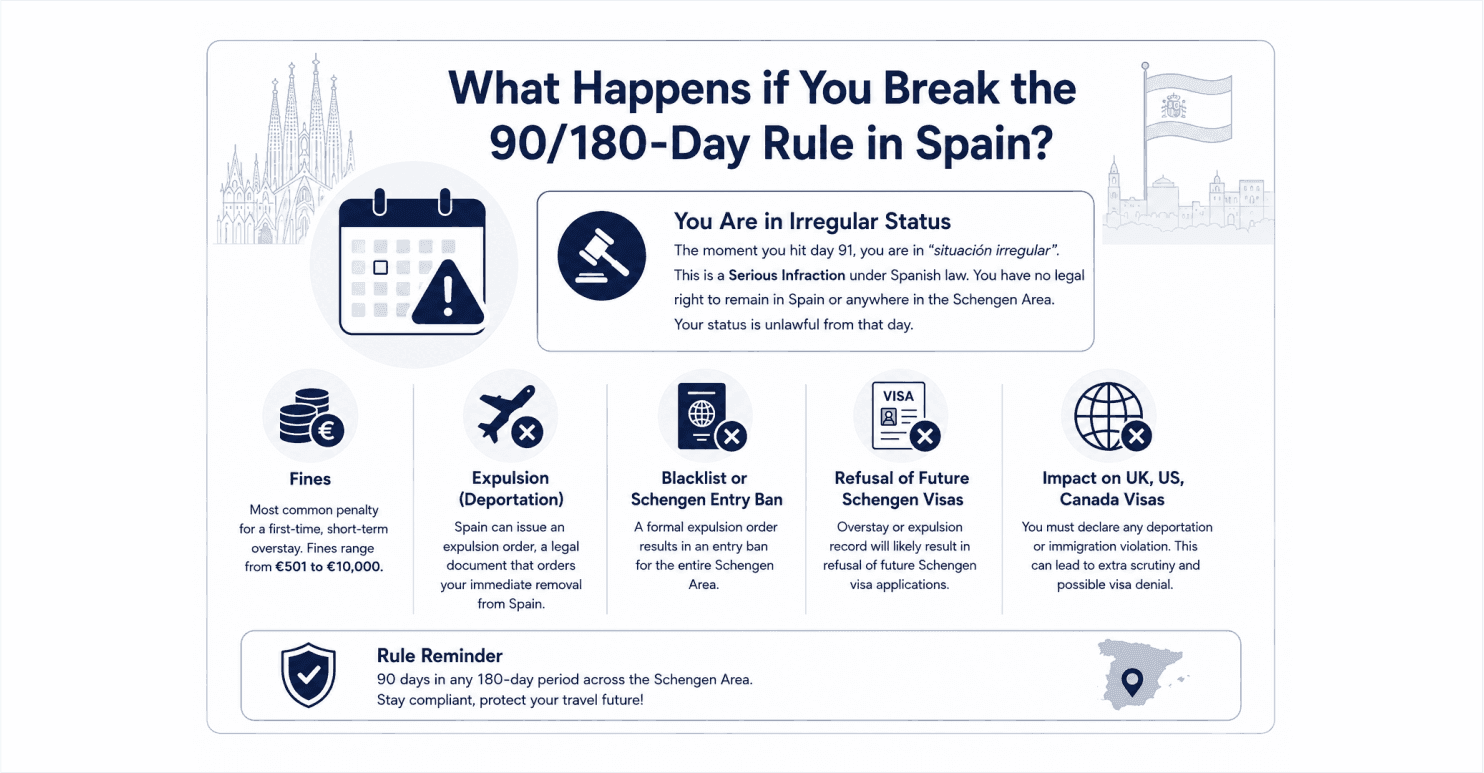
The moment you hit day 91, you are in "situación irregular" (irregular status). This is classified as a Serious Infraction under Spanish law. You have no legal right to remain in Spain or anywhere in the Schengen Area. You might not be arrested immediately, but your status is unlawful from that exact day.
In some cases, if the overstay is short and it's your first time, officers might use discretion and let you leave with a warning. But this is not guaranteed and is becoming less common since EES (Entry/Exit System) has rolled out. It tracks you digitally now, and overstaying by even one day is automatically flagged.
For Indian passport holders, the Schengen application process is already very rigorous. It is best not to break any rules while you’re there! If you are not able to manually track your travel days, do not rely on guesswork. Try a reliable Schengen Calculator to accurately monitor the number of days you have spent in Spain.
The EES has been made fully operational across all Schengen countries, including Spain, from April 10, 2026 onwards. It is a new digital border registration system that replaces the old manual passport stamping process. Every time a non-EU national, including Indian passport holders, enters or exits a Schengen Area country, their details will be digitally recorded. For Indian travellers, this marks the beginning of a highly monitored digital era.
No More Stamps
The most visible change is that your passport will no longer be stamped. Instead of a physical ink mark, you will need to provide your personal data and the EES creates a digital file the moment you cross the border.
Mandatory Biometrics
When you enter Spain for the first time under the new system, you will be asked to provide your fingerprints and have your photo taken at the border. This is a one-time registration - your biometric data is stored in the system and linked to your travel document, so subsequent entries should be quicker.
Real-Time Overstay Detection
This system was specifically designed to identify overstayers. It will calculate your permitted stay and alert border authorities if you overstay. If you try to return to Spain, or anywhere in Europe, after a previous overstay, the system will automatically alert the border officer of your history, leading to an immediate refusal of entry (even if you have a valid visa). There is no room for ambiguity anymore, so make sure you track your travel days carefully before every trip.
What You Should Do
You do not need to register for EES online or fill out extra forms before you fly. The entire process happens digitally at the Spanish border when you land. However, the airlines have warned that this first-time registration can add 5 to 10 minutes per passenger. Thus, we advise travellers to arrive at the airport at least three hours before departure during this initial rollout period.

