
Spain Visa from India 2026: Types, Requirements, Process & Documents
Guide

Spain Visa from India 2026: Types, Requirements, Process & Documents

Chapters
Spain as a Schengen Country and What It Means for IndiansWhich Spain Visa Do You Need as an Indian? Type C vs Type D ExplainedAll Short-Stay Spain Visa for Indians Spain National Visa for IndiansSpain Visa Documents Required from India: Full Checklist for All Visa TypesFinancial Requirements to Apply for Spain Visa from India How to apply for Spain Visa from India in 2026 Top Reasons Spain Visa Applications Get Rejected from IndiaArriving in Spain from India: Everything You Need to Do at the Airport and Beyond
HomeGuidesSpain Visa from India 2026: Types, Requirements, Process & DocumentsSpain Visa Documents Required from India: Full Checklist for All Visa Types
Chapters

Spain Visa Documents Required from India: Full Checklist for All Visa Types

The documents list for a Spain visa is long enough that most Indian applicants, even careful ones, submit something wrong or missing on their first attempt. The frustrating part is that consular officers won't tell you what's missing before your appointment, they'll only tell you at the desk. Not only this, the documentation does not stay the same across visa categories. What you need as a student is different from what an employee, researcher, or entrepreneur is expected to submit.

The consequences are more disruptive than they might seem. Rescheduling a Spain visa appointment from India is not as simple as picking the next available slot. At peak travel seasons, finding an open appointment at a Spanish consulate can take anywhere from three to five weeks. That kind of delay can push back job start dates, academic enrollments, and travel plans by over a month! All because of a document that you never knew was required.
Documents Common to ALL Spain Visas

chapter image

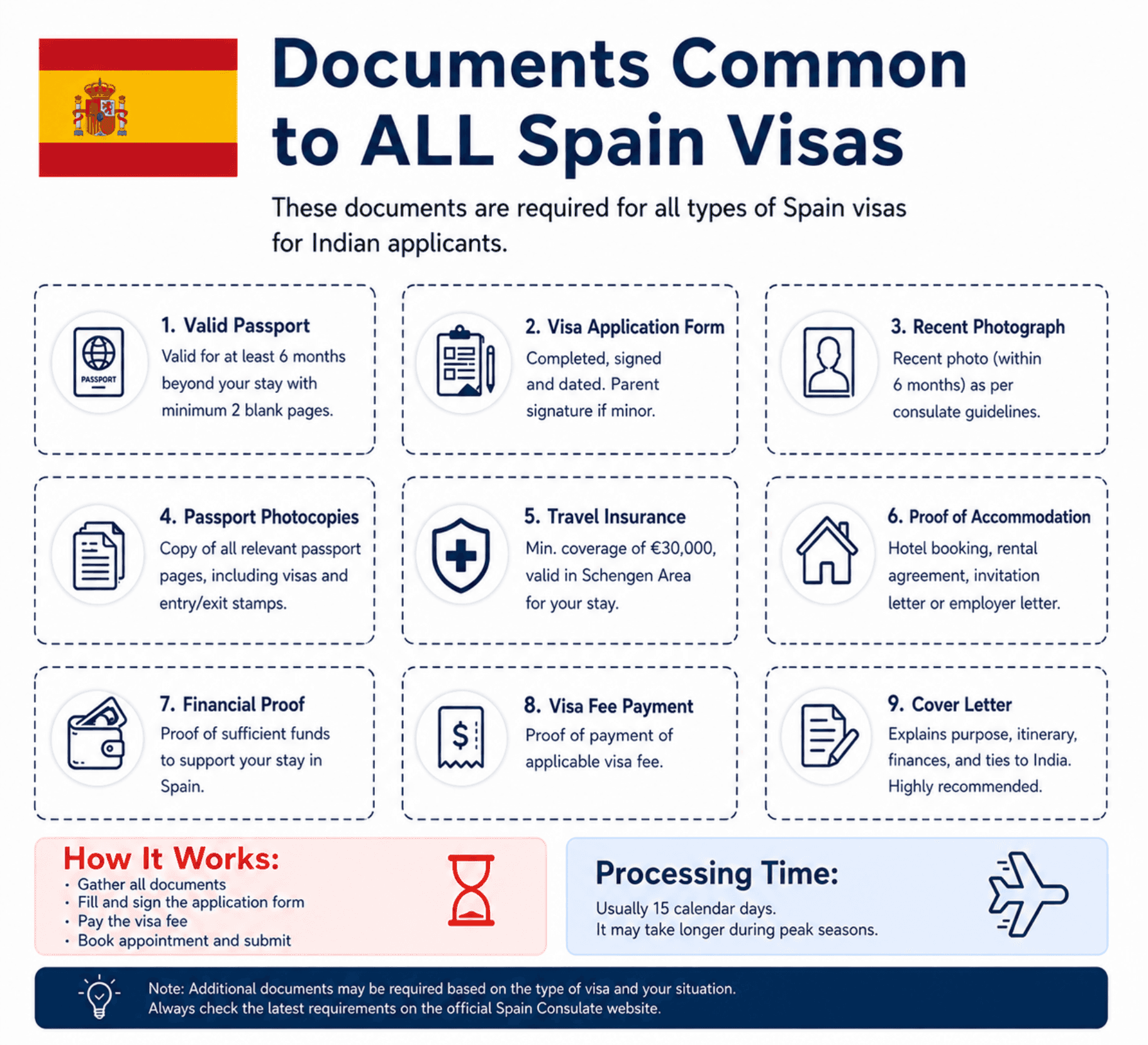
There are some documents that are required to apply for all kinds of Spain visas available for Indians. You have to keep them with you, regardless of the type of visa appointment you have. These include:

  • Your passport, which must be valid for at least six months beyond your intended stay in Spain and have a minimum of two blank pages for visa stamps.
  • Completed official Spain national visa application form, filled out in full, signed, and dated. If you are a minor, one of the parents needs to sign the form.
  • A recent photograph taken within the last six months, meeting the consulate's specified dimensions and background requirements.
  • Photocopies of all relevant pages of your passport, including the biometric data page, any previously issued visas from other countries, and pages containing entry and exit stamps from your travel history.
  • Front page of your travel health insurance policy taken from only the approved insurance companies in India. It should have a minimum coverage of €30,000, valid across the Schengen Area for the duration of your intended stay.
  • Proof of your accommodation in Spain, which includes evidence of where you will be staying, such as a rental agreement, utility bills, property ownership documents, an invitation letter from a host, or a letter from your employer or institution confirming dorm/housing arrangements.
  • Proof that you have sufficient financial means to support yourself during your stay without becoming a burden on the Spanish state.
  • Proof that you have paid the applicable visa fee at the time of application.
  • A well-written cover letter explaining your travel purpose, itinerary, accommodation, ties to India, finances, and any other important things related to your trip. It is not listed as a hard requirement, but consulate officers almost universally expect one. Without it, your application looks incomplete.

Photo Specifications

Along with your application form, you are required to submit one recent passport-sized photograph. The Spanish consulate is very strict about photo requirements. Any applications that include non-compliant photographs will be treated as incomplete and will not be processed until the issue is corrected. 

The photograph needs to be in color and:

  • Taken against a plain white or off-white background, ensuring that your facial features are clearly visible and contrast well against it.
  • Must be sharp and clear, with your face in full focus.
  • Must be printed on standard photographic paper, such as a camera print.
  • Full face must be visible, with a neutral, non-smiling expression. Sunglasses, hats, caps, and other head coverings are not permitted, unless you're wearing them for religious or cultural reasons.

Spain Short-Stay Visa Documents for Indians

On top of the standard documents, you will need to show paperwork that explains why you are going, where you will be staying, and that you plan to come back. Spanish consular officers want to see clear evidence that you intend to leave before your visa expires. The documents that usually cover this are a return flight booking, hotel reservations for your entire stay, or an invitation letter from someone residing in Spain if you are visiting family or friends.

Beyond that, your specific documents required for Spain visa from India will depend on the type of short-stay visa you are applying for.

Schengen Visa

Type of Spain Short-Stay VisaDocuments Required
Business PurposeInvitation letter written in Spanish from the Spanish company, including the purpose of your visit, the nature of the existing business relationship between the company and yourself, your full name, passport number, and your expected travel dates. 
Studying PurposeOriginal and a photocopy of the certified letter from the Spanish institution where you will be studying mentioning the name and the exact start and end dates of the study program.
Other Purposes (tourism, leisure, medical treatment, etc)Purpose specific proofs, such as hotel bookings, invitation letter, travel itinerary, doctor's appointment, medical reports, etc.

Visa for Seaman

If you are an Indian seafarer travelling to join a vessel docked in Spain, you will need:

Your Seaman's Passbook

A Letter of Employment from your employer

An invitation letter from the Spanish maritime agency, which must include all details: your full name, date of birth, job position on board, the port where you will be boarding, and the expected duration of your assignment

Visa for Relatives of EU/EEA Citizens

If you are travelling to Spain because a family member is an EU, EEA, or Swiss citizen, you will need to prove two things: first, that you are actually related to that citizen, and second, that you are either travelling together or joining them in Spain.

For proof of the family relationship, you will need civil registry documents such as a birth certificate or marriage certificate, depending on your relationship. If you are in a registered partnership, a certificate of registration or any other document that establishes the partnership as equivalent to marriage will work.

Some document requirements get a little specific depending on where your EU family member currently is:

  • If your EU/EEA family member is already in Spain, you must bring an Acta de Manifestaciones (a formal declaration made before a notary or consular official) along with a notarised copy of the Spanish citizen's DNI or Spanish passport.
  • If your EU/EEA family member is in India, Sri Lanka, Nepal, Maldives, or Bhutan, you do not need the Acta de Manifestaciones in this case. Instead, your family member must accompany you in person to the Spanish consulate on the day of your appointment, bringing their original DNI or passport along with a photocopy of the same.

Spain National Visa Documents for Indians

Spain issues long-stay national visas to Indians for many reasons, each of which require separate documents and proofs from your end. It’s very important to stay updated, because the application process for these visas from India is already very rigorous. You don’t need additional pressure of wrong/missing documents.

There are some common documents that you will need for all national visas of Spain:

DocumentSpecifics
Medical certificateIf you're staying for more than 180 days, you'll need to submit the original plus a copy of a medical certificate, issued by a licensed medical practitioner, confirming that you don't have any condition that could pose a risk to public health.
Criminal record check certificateAny adult applicant staying beyond 180 days also needs to provide a criminal record certificate covering the past 5 years - from every country they've lived in during that period. For Indian applicants specifically, this means getting your Police Clearance Certificate or PCC from your Regional Passport Office.

The visa-specific document checklist for Indian applicants is given below:

Digital Nomad Visa

For the DNV, your entire employment setup needs to be provable on paper, not just your bank balance. Here's what you'll need specifically for the Digital Nomad Visa:

  1. NIE Number Certificate Before you even start your visa application, you’ll need to get a NIE number. This is a unique identification number for foreigners in Spain. You’ll need it for things like work, banking, renting a home, paying taxes, and other official transactions in Spain.
  2. Proof of Remote Work You'll need a certificate from your employer or client confirming that you've been working remotely for at least 3 months before applying. 
    1. If you're an employee: it should mention the length of your contract, your salary, and explicit consent from the company for you to work remotely from Spain.
    2. If you're self-employed/freelance: it should cover the length of the contract and the terms under which you'll be working remotely from Spain.
  3. Company Registration Certificate A certificate from the Registrar of Companies confirming the date the company was established and the nature of business it does.
  4. Spanish Social Security Registration Proof
    1. Employees: proof that your company is registered with the Spanish Social Security system, along with evidence of your own affiliation.
    2. Freelancers: proof of affiliation with RETA (the self-employed workers' Social Security regime).
  5. Responsible Declaration A signed declaration from the company if you're an employee, or from you personally if you're self-employed, committing to fulfil all Spanish Social Security obligations before beginning any work activity in Spain.
  6. Proof of Academic Qualifications or Professional Experience You'll need to demonstrate either:
    1. A degree or postgraduate qualification from a recognised university, vocational training institution, or reputable business school (original + copy), or
    2. At least 3 years of professional experience in a role similar to the one you'll be doing as a remote worker in Spain.

Non-Lucrative Residence Visa

An NLV-specific document requirement is the submission of your own copy of the EX-01 form. It is the official Spanish application form used to request residence authorization. Since you are applying for both a visa to enter the country and a temporary resident permit, the EX-01 is required for the residency authorization portion of the process. It includes legal declarations that you possess adequate financial means and private health insurance, and that you will not engage in any work or lucrative activity while in Spain.

Student Visa

Beyond the universal paperwork, here's what's additionally required for Spain Student Visa:

  1. Proof of Acceptance A letter or document from your institution confirming your acceptance into the study program, mobility scheme, volunteer service, or educational activity. It must clearly state the start date, end date, and total cost of the programme.
  2. Proof of Fee Payment Evidence that you've actually paid your enrollment or tuition fees.
  3. Proof of Representative's Identity (minors only) If the applicant is under 18, you'll need to include copies of one parent's identity document or passport, along with proof of the family relationship. Bring the originals when you submit the application.
  4. Parental/Guardian Authorization (minors only) Both parents or legal guardians will need to provide a notarised authorisation permitting the minor to temporarily relocate to Spain for the purpose of their studies. This document must also clearly name the specific individual who will be looking after the minor in Spain during their stay.  

Employee Work Visa

For this visa, the paperwork and heavy lifting of all the additional documents is done by your employer:

  1. Initial Residence and Employee Work Permit Before you can apply for the visa at the consulate, your employer in Spain must have already obtained this permit on your behalf through the relevant Spanish authorities. You'll need to submit both the original and a copy of this permit, which should carry your employer's signature. 
  2. Work Contract A copy of your work contract, stamped by the Foreign Nationals' Office.

Family Reunification Visa

There are two types of Family Reunification Visas: the one for the family members of non-EU citizens who hold a valid Spanish residence permit. The other one is for family members of Spanish citizens or EU/EEA/Swiss citizens who are living in Spain.  

If your sponsor (the family member already residing in Spain) belongs to the first category, this is what you’ll need:

  1. Initial Family Reunification Permit This permit is the foundation of your application. The sponsor is responsible for applying for this permit first, and once it's granted, you can proceed with the visa application. Submit both the original and a copy.
  2. Sponsor's Foreigner Identification Card (TIE) A certified photocopy of your sponsor's Tarjeta de Identidad de Extranjero is required. And it must still be valid at the time of your application.

If your Sponsor is an EU/EEA National, the requirements are a bit different:

  1. Visa Application Forms and Photographs You'll need two fully completed and signed Schengen visa application forms. Attach two recent passport-sized photographs to each form.
  2. Passport Your passport must be valid for at least one year from the date of application. You'll also need to include photocopies of every page.
  3. Proof of Family Relationship You'll need official documents that establish the family connection between you and the EU/EEA sponsor. These should be registered in a Civil Registry of an EU Member State or formally certified by Spanish authorities.
  4. Sponsor's Nationality Document The original or a certified copy of the sponsor's passport or other nationality document, along with a regular photocopy to submit with the application.
  5. Declaration Letter for Spouses or Registered Partners A personally signed letter from the applicant explaining the reason for travel and clarifying whether they'll be travelling to Spain together with the EU/EEA citizen or joining them separately at a later date.
  6. Notarised Declaration for Direct Ascendants or Descendants For parents, grandparents, children, or grandchildren of the sponsor, a formal declaration made in front of a Spanish Notary Public is required. In this declaration, the sponsor must explicitly state their consent to the family reunification and confirm their intention for the applicant to reside with them in Spain. 
  7. Proof of Financial Dependence for Ascendants or Descendants Over 21 If the family member being reunified is over 21, they’ll need to demonstrate that they are financially dependent on the sponsor. This means providing documents such as bank transfer records, showing that the sponsor has been regularly sending money to support the applicant for at least the past year, and that this support is substantial enough to confirm real economic dependence.
  8. No-Objection Affidavit for Minors Travelling Without One Parent If a minor is relocating to Spain and one parent won't be accompanying them, the non-accompanying parent must provide an apostilled affidavit clearly stating that they have no objection to the child's family reunification and residence in Spain.

Highly Qualified & Intra-Company Transfer Visa

For both these visas, you’ll need the original and a copy of the residence permit issued by the Large Companies and Strategic Groups Unit. Your employer in Spain must first obtain this residence permit through the UGE before you apply for the visa.

Self-Employment and Freelance Visa

Along with the common documents, here's what you'll additionally need:
  1. Form EX-07 This is the official Spanish application form for combined Residence and Work Authorisation for self-employed individuals.
  2. Modelo 790 (Code 052) Proof that you've paid the applicable fee for the work and residence authorisation process.
  3. Modelo 990 - Initial Residence Application Fee There’s a separate fee for the initial work authorization for self-employed workers, and you'll need to show proof of this payment as well.
  4. Proof of Professional Qualifications or Capacity You'll need to demonstrate that you are qualified and capable of carrying out the professional activity you're planning to undertake in Spain.
  5. Business Project Report This is essentially a detailed business plan for your proposed activity or venture in Spain. It should cover your estimated investment, projected profitability, and (if relevant) how many jobs you expect to create. You'll also need to back this up with evidence that you actually have the funds to get the project off the ground.
  6. List of Required Licences and Authorisations Depending on the nature of your business, you may need various permits or licences to legally operate in Spain. You'll need to provide a list of all the authorisations your activity will require, along with the current status of each - whether you've already applied, received approval, or are still pending. If any applications have already been submitted, include proof of that too. 

How to Apostille Indian Documents for Spain

chapter image

All the documents discussed above to apply for a Spain visa from India require an additional step - apostille. It is very important to get all your documents apostilled before submitting them for the visa application.

What is an apostille? An apostille is an international certification under the Hague Convention that authenticates your documents for use in member countries. Both India and Spain are members of the Hague Apostille Convention, so this process is significant and shouldn’t be skipped. In India, the Ministry of External Affairs (MEA) is the only authority for apostille/attestation services.

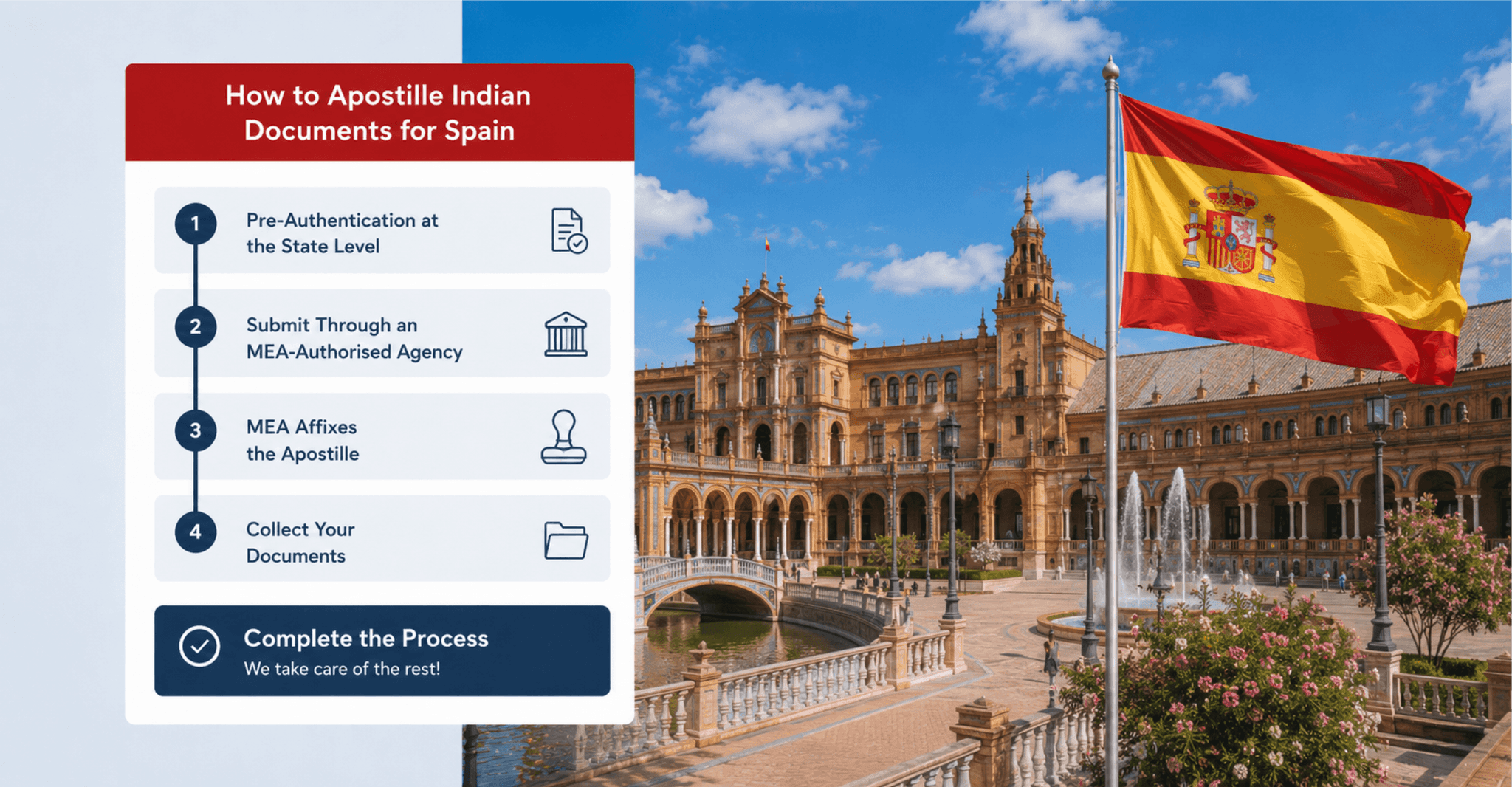
Step 1: Pre-Authentication at the State Level

Before your documents can be apostilled by the MEA, they first need to be authenticated at the state level. They confirm that the document is genuine before it moves up to the central government for the apostille.

The MEA has decentralised its apostille services across 16 cities through Branch Secretariats and Regional Passport Offices (RPOs). These are located in:

Ahmedabad · Bengaluru · Bhopal · Chennai · Chandigarh · Cochin · New Delhi · Guwahati · Hyderabad · Kolkata · Lucknow · Mumbai · Panaji · Jaipur · Patna · Thiruvananthapuram

Go to the RPO closest to you to get this done first.

Step 2: Submit Through an MEA-Authorised Agency

The MEA does not accept documents directly from individuals. You have to submit your documents through one of the outsourced agencies that are officially authorised by the MEA to handle this process on your behalf.

When you go, make sure you carry:

  • Your original document (or a certified true copy)
  • A photocopy of the document
  • A photocopy of your passport

The agency will take it from there and forward everything to the MEA for processing.

Step 3: MEA Affixes the Apostille

Once the MEA receives your documents from the agency, they verify the state-level authentication that was done in Step 1. If everything checks out, they affix an official Apostille sticker on the back of your document. Each sticker carries a unique identification number, which you can cross-verify on the MEA's official website. This is a useful way to confirm your apostille is legitimate before submitting it with your visa application.

Step 4: Collect Your Documents

Once the apostille has been affixed, your documents are returned to the same outsourced agency you submitted them through. You'll collect them directly from there. Make sure you keep the apostilled documents safe as these are what you'll be submitting to the Spanish consulate, and they can't be replaced easily.

How to Get Indian Documents Translated for Spain

After getting your Indian documents apostilled, they need to be translated to Spanish. Spain requires a Traducción Jurada (sworn translation), which is a legally certified translation done by an official translator approved by Spain’s Ministry of Foreign Affairs (MAEC). Without this, your documents simply won't be considered valid by Spanish authorities.

Option A: Use a Registered Agency in India (Easiest)

There are several translation agencies in India that contract directly with MAEC-authorized Traductor Jurados. They handle the digital scanning, coordination, and can deliver both digital copies and physical prints to your doorstep.

Option B: Hire a Translator Directly via the Spanish Government Website

If you want to cut out the middleman, you can find freelance sworn translators directly through Spain's Ministry of Foreign Affairs database. You can reach out to them via email to ask for a quote and turnaround time. 

In This Chapter
Share This Guide
Share This Guide
Share This Guide