

Getting fingerprinted in India and receiving your documents is only one part of the process, especially when those documents need to be used abroad or submitted to foreign embassies and consulates in India. In this case, three major steps come into play: Apostille, Embassy Legalization, and Translations. Without these, many Indian documents are legally worthless and may not be accepted by foreign authorities.
Normally, an international government agency wouldn't know if an Indian birth certificate or police clearance card is real or fake. An apostille and legalization/attestation solves this problem. This authentication is attached to the document in the form of a certificate, stamp, or sticker issued by the appropriate authorities.
After the document has been authenticated, translation may also be required in some cases. This is common when documents must be submitted in countries where English is not an official or accepted language for immigration, employment, education, or legal purposes.
Many Indians tend to be confused between these two requirements. Both apostille and embassy legalization are requirements of different countries, based on the being part of a specific treaty.
| Parameter | Apostille | Attestation / Legalization |
| When is it required? | Used only when both the country issuing the document and the destination country are members of the Hague Convention. | Used when one or both countries are not members of the Hague Convention. |
| Steps Involved |
|
|
| Final Authority | Ministry of External Affairs (MEA) | The Embassy or Consulate of the destination country gives the final stamp of approval. |
| Cost and Time | Generally faster and cheaper because it involves a single domestic agency. | Slower and more expensive because you must pay separate fees to multiple domestic ministries and the foreign embassy. |
You never get to choose between an apostille and legalization. The legal relationship between the country you are leaving and the country you are entering dictates exactly which route you must follow.
But there's one sequence you cannot reverse: apostille/attestation comes before translation, always. The translator is required to translate the apostille sticker text itself, which means the sticker must physically exist on the document before translation begins.
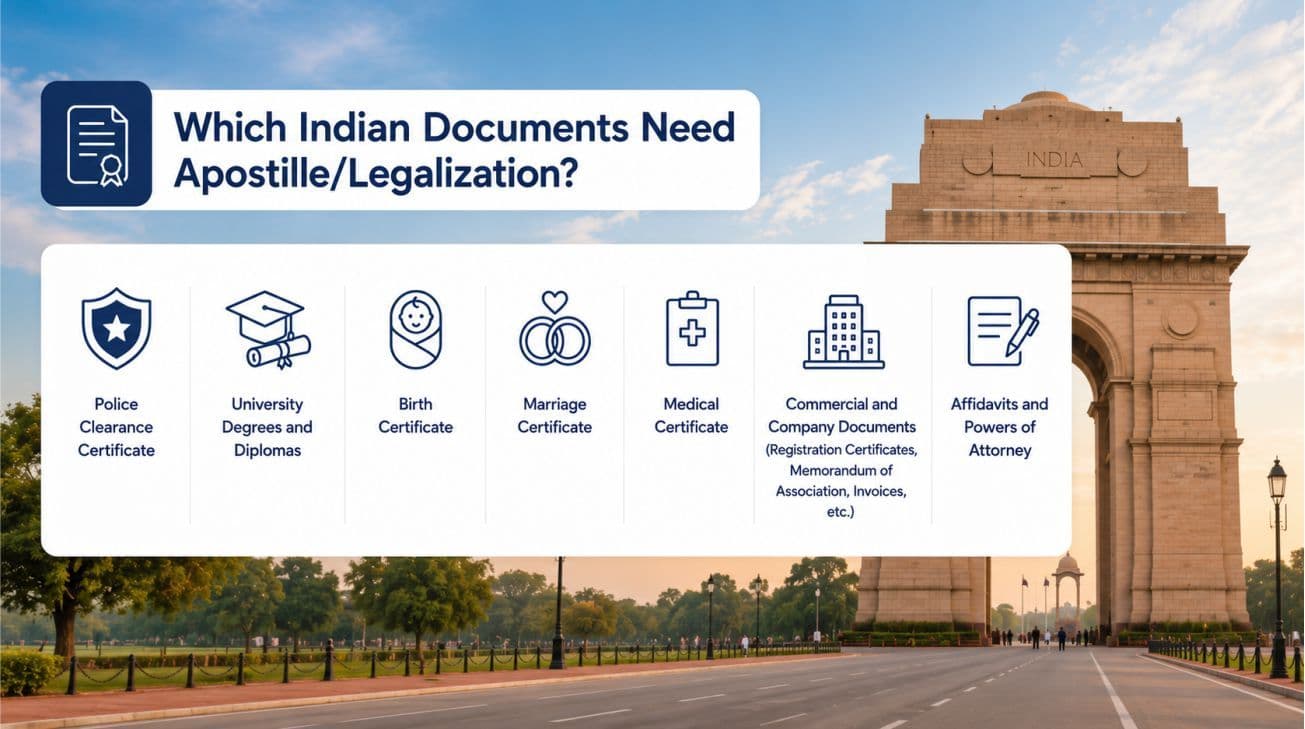
If your document was issued by an official government body, educational institution, or registered corporate entity in India, it needs an Apostille or both Apostille and Legalization if you are using it to prove your legal status, identity, qualifications, or a clean record to an international authority. Some common ones are:
Documents like your bank statements, income tax returns, salary slips, and passport etc do not require any apostille or legalization step.
The processes explained below are for apostille and normal attestation of documents in India. But before proceeding, you need to get your documents notarized by a public notary in India. This is a mandatory step, especially for private documents, such as power of attorney, affidavits, single status certificates, company documents, etc. MEA attestation or an Apostille sticker will not be processed unless a licensed Notary Public has already stamped, signed, and registered the documents.
You can find dozens of licensed notaries sitting at desks or small booths around:
Or you can just search "Notary near me" or "Notary Public in (your area name)]" on Google Maps that will bring up verified offices, user reviews, and contact numbers.
For the next steps of Apostille and Normal Attestation in India, you have two routes:
Route 1: e-Sanad (The Digital Route)
What is e-Sanad? e-Sanad is the Ministry of External Affairs' online portal that lets you get documents apostilled without physically visiting any office. Instead of you submitting original documents, the portal connects directly to the digital repositories of Document Issuing Authorities (DIAs) and the verification and apostille happen digitally.
All types of documents, like personal, educational, and commercial can be apostilled using e-Sanad, but only if they're available in the digital repository. Currently, e-Sanad is helping with the apostille of CBSE and National Academic Depository (NAD) issued documents, as only they have a digital depository of their documents. This service will expand to other issuing authorities over time, as soon as they set up their own digital repositories.
One of the best things about the e-Sanad portal is that it lets Spanish visa officers or foreign authorities cross-verify your digital attestation or apostille online.
Using e-Sanad to Get Apostille for Spain Visa from India
Route 2: The Traditional Route
This is the usual route to apostille personal documents like birth and marriage certificates, police clearance certificates, older educational documents, and anything not covered by e-Sanad. Until e-Sanad finishes expanding its services, most applicants will still need to follow this route.
Step 1: State-Level Pre-Authentication at the RAC
The MEA will only apostille a document after it has been authenticated by a competent state-level authority. This is because MEA doesn't verify the content of your document, it only certifies that the signature/stamp of the authenticating authority on that document is genuine. So the state authority goes first. You have to submit the documents to the designated RAC in your state.
Various types of documents are authenticated by different departments within the Regional Authentication Centre (RAC):
| Document Type | Examples | Authenticating Authority |
| Personal Documents | Birth certificates, death certificates, marriage certificates, domicile certificates, etc. | State Home/General Department |
| Educational Documents | Degree certificates, mark sheets, diplomas, school leaving certificates, except those covered by e-Sanad | State Education Department |
| Commercial Documents | Power of attorney, memoranda, articles of association, commercial contracts, etc. | Chamber of Commerce |
Step 2: Submission to Branch Secretariats/RPOs via MEA-Authorized Service Providers
MEA has officially decentralized its apostille services in India to Branch Secretariats/RPOs in 16 cities. This means the apostille stamp is legally affixed at these RPO locations, not at the MEA headquarters in New Delhi.
The 16 cities with active Branch Secretariats/RPOs for apostille are: Ahmedabad, Bengaluru, Bhopal, Chandigarh, Chennai, Guwahati, Hyderabad, Jaipur, Kochi, Kolkata, Lucknow, Mumbai, New Delhi, Patna, Pune, and Thiruvananthapuram.
But you cannot walk into these RPOs on your own to submit documents. Applications can be made only through the Authorized Service Providers (ASPs), that act as the mandatory intermediary between applicants and the RPO. Always verify that the agency you approach is on MEA's official list of ASPs before handing over any documents, do not use an unlisted agent.
You can find the official list of authorized agencies, along with the physical addresses of their collection centers in every city where RPOs are located, directly on the MEA government website.
You have to visit your nearest outsource agency and bring your pre-authenticated original documents along with photocopies of each document and your passport. The ASP physically carries these to the nearest Branch Secretariat/RPO and submits them in bulk. MEA officials there verify the state-level authentication already on each document and, if valid, affix the apostille/attestation sticker on the back of each document. The completed documents are then returned to the ASP, from where you collect them.
Apostille Processing Time in India
The usual processing time for attestation or apostille by the MEA is 2-3 working days. However, e-Sanad is integrated with DigiLocker, allowing supported documents to be verified in real time. Once verified, these documents are transmitted directly to the MEA for processing, which can reduce the overall turnaround time to as little as 1-3 working days.
Fees for Apostille and Normal Attestation of Documents in India
Since it is mandatory to use authorized service providers for the apostille, there are additional fees charged by the outsourcing agencies, alongside the MEA charges:
| Types of Service | MEA Fee | Outsource Agency Fee | |
| Service Charge | Scanning Charge | ||
| Apostille | ₹50 per apostille sticker | ₹84 per document | ₹3 per page |
| Attestation | Free of Cost | ₹84 per document | ₹3 per page |
International Documents Apostille Process from India
Just as the MEA is responsible for the apostille process in India, many countries have their own designated authorities responsible for apostilling international documents. A criminal record check is one of the few fingerprint-based international documents that can be obtained while living in India. If this document is intended for use in another Hague Convention country, it needs to be apostilled in its country of origin. This is the usual procedure:
Since the international criminal record check is a federal document, it has to be apostilled by a federal agency only.
Some common countries and their apostille authorities are listed below:
| Country Name | Apostille Authority |
| Australia | Department of Foreign Affairs and Trade (DFAT) |
| Canada | Global Affairs Canada (GAC) |
| Germany | Federal Office for Foreign Affairs (Bundesamt für Auswärtige Angelegenheiten - BfAA) |
| Ireland | Department of Foreign Affairs (DFA) |
| New Zealand | Department of Internal Affairs (DIA), Legalisation Office |
| South Africa | Department of International Relations and Cooperation (DIRCO) |
| UK | Foreign, Commonwealth & Development Office (FCDO) |
| USA | US Department of State, Office of Authentications, in Washington, D.C. |
The MEA will give it a normal attestation, but you have to take your documents a step further and have the destination country's specific Embassy or Consulate in India stamp it. For non-Hague countries, the outsourced agency will take your MEA-attested document directly to the embassy or consulate of your destination country to receive its final stamp. It is a multi-layered process, with a sequential chain of certifications required.
Translation from Regional Language to English
Many Indian applicants have birth/marriage certificates in regional languages, like Punjabi, Kashmiri, Bengali, Odia, Assamese, Marathi, etc. You might be required to first get it translated into English by a certified translator for use in international embassies within India, or for financial and legal contracts.
For this, you can hire any reputable ISO 9001 certified company in India. Usually, you’ll be required to send the agency high-resolution scans of the front and back of the document. The exact process will be mentioned on their official website.
Translation from English to Country-Specific Language
Most countries where English isn’t the official language, such as Germany, Spain, Italy, etc, require a Sworn or Legalized Translation. This means translation of a document via a linguist who has been officially registered with their high court or embassy. India does not have a central, government-run body that licenses sworn or officially authorized translators.
You can visit the official website of the target country’s embassy in India. Because some of them explicitly publish a directory of authorized translators they trust. If they have a list, you must pick a professional from it. If they don't, any reputable ISO 17100 certified agency in India will do.
Do not have your document translated in another foreign language until it has already received its state stamps or MEA Apostille. The final translation has to include a translated version of the stamps and seals on the back of your original document. If you translate too early, you'll have to pay to do it again.

