

Most of us are familiar with the fingerprinting scene common in Indian cinema, where a person presses their thumb or fingers onto an ink pad and then marks the impressions on a document. It is, in fact, one of the oldest methods of fingerprinting, and it is still used in certain situations. In practice, fingerprinting in India extends well beyond this image.
Many procedures such as Aadhaar enrollment, passport issuance, visa applications, and immigration screening each rely on different fingerprinting methods tailored to their specific requirements. With one of the world's largest and most diverse populations to serve, fingerprinting methods in India have also evolved to meet the different needs.
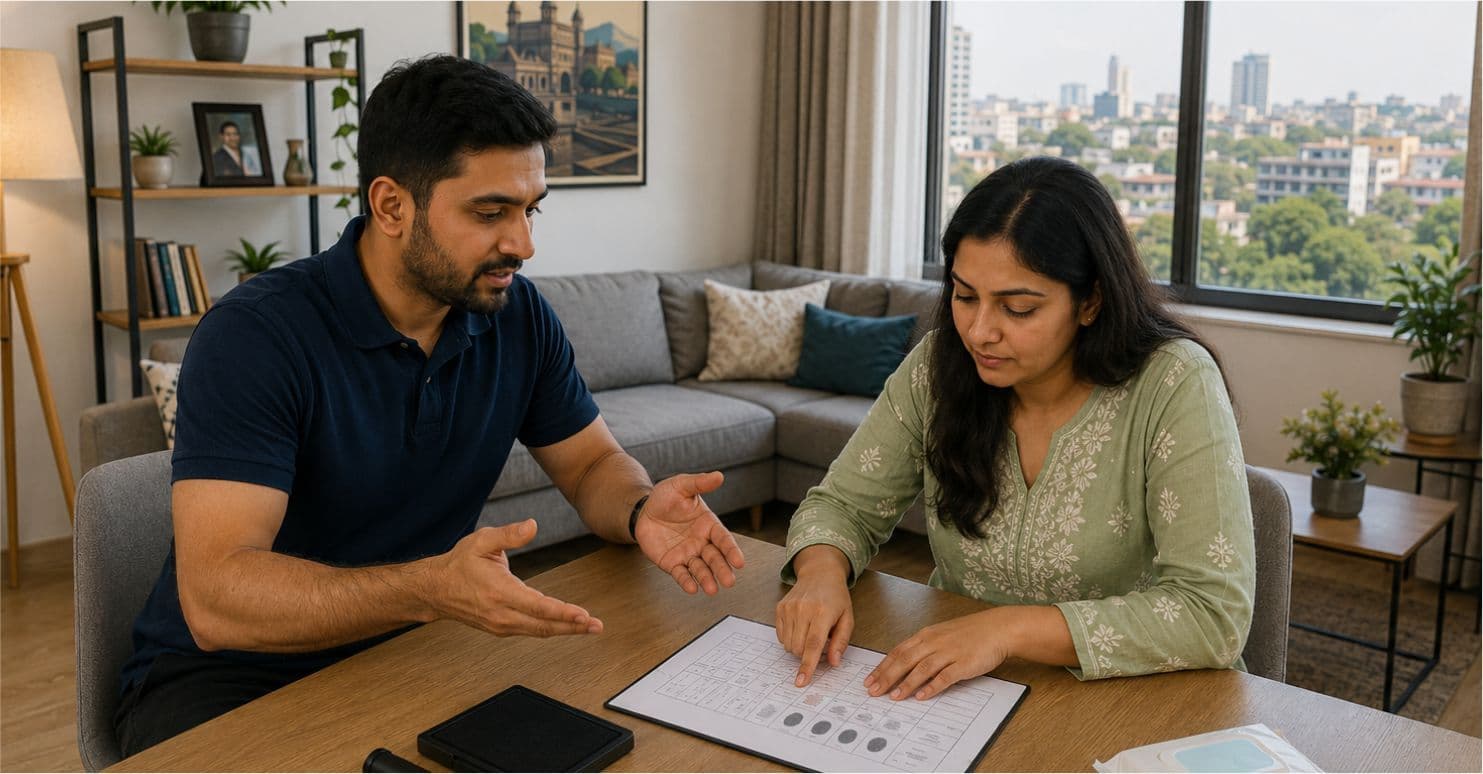
Fingerprinting using a black ink is one of the oldest and most reliable ways to identify a person in India. Even with the rise of digital scanners, the traditional ink-based fingerprinting method is a standard practice for many legal and official procedures. The ink used is a thick, oil-based black ink, similar in consistency to a printer's ink. It is designed to transfer cleanly onto paper without smudging or spreading too much.
The traditional ink-based fingerprinting in India is still used for many important purposes:
At a standard ink-based fingerprinting appointment, you will see some tools like a small roller or ink pad to apply ink evenly onto the finger, a hard, flat surface for rolling the ink out, and a ten-print fingerprint card, with clearly marked boxes for each finger, labeled in order. It also has spaces for personal details such as the person's name, date of birth, signature, and physical characteristics like height, weight, and eye colour.
There are two types of impressions taken under ink-based fingerprints, and both are recorded on the same card.
For rolled impressions, a thin layer of black forensic ink is spread. Your finger is then rolled over the ink from one side of the nail to the other. The inked finger is placed on the designated square of the fingerprint card. The technician rolls your finger firmly but gently to capture the full pattern of the ridges. This nail-to-nail rolling motion captures the full surface of the fingertip, including the sides, giving the most complete picture of the ridge pattern.
Rolled impressions are taken for all ten fingers, starting with the right thumb, followed by the right index, middle, ring, and little finger, and then the same sequence for the left hand.
After rolled impressions are taken, plain impressions are also recorded. For these, your finger will be pressed straight down onto the card and lifted, without any rolling. You will notice the impressions are narrower since they only capture the central contact area of the fingertip.
The four fingers of the right hand are pressed together, then the four fingers of the left hand, and then at last both thumbs side by side. These group impressions appear at the bottom of the fingerprint card and serve as a check to confirm that the rolled prints above them are in the correct order.
The impressions of all your ten fingers will occupy the upper portion of the card, arranged in two rows of five. The plain impressions will occupy the lower portion. This allows the expert reviewing your card to compare both sets of fingerprints and check that the sequence and print quality are correct.
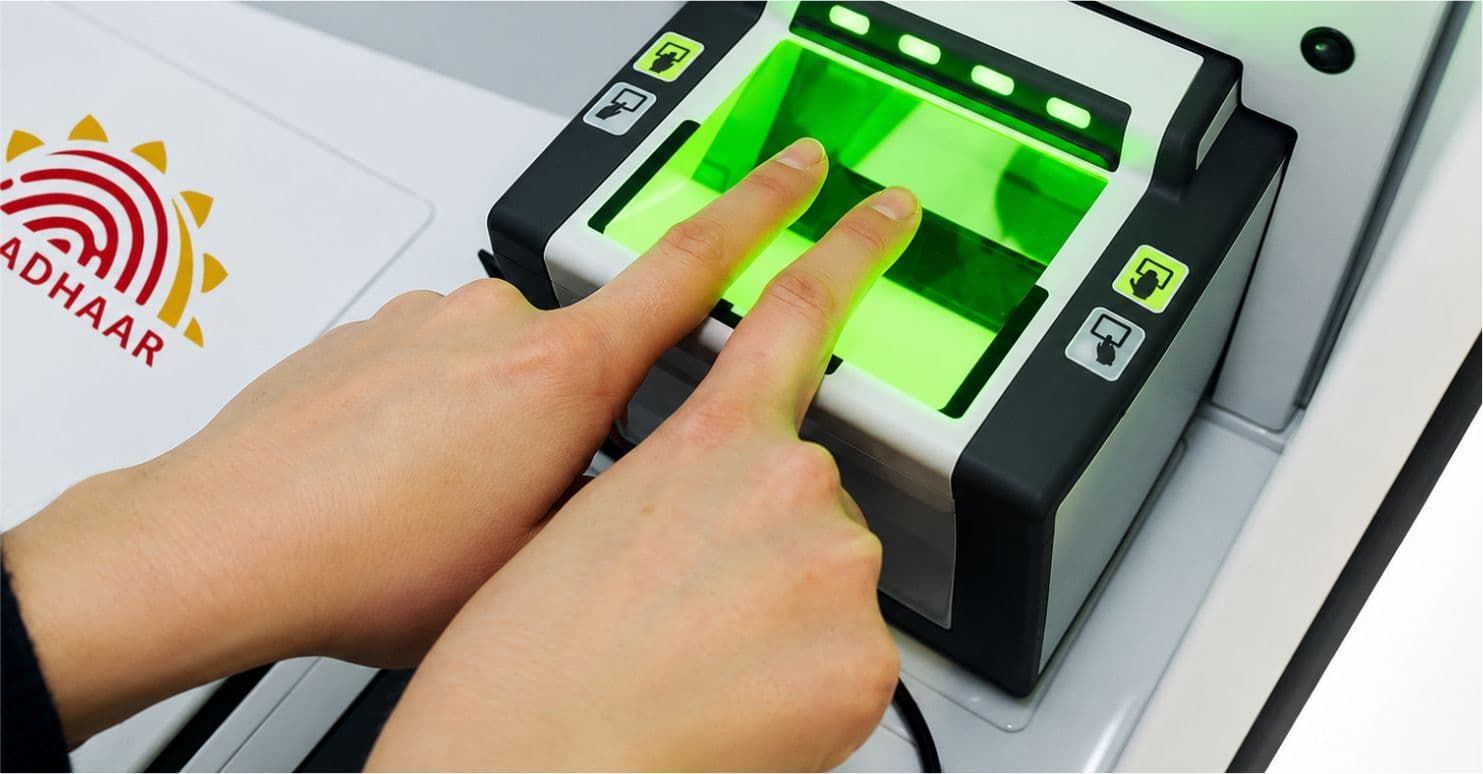
The live scan or digital method of collection is a much modern type of fingerprinting in India; fingerprints are captured electronically without using ink or paper. As opposed to the ink-based method, where fingers are rolled in ink and pressed onto a card, in this method, the finger is placed on a glass or sensor surface. The device reads the ridge pattern and converts it into a digital image. That image is then stored, transmitted, or processed depending on the purpose for which it was taken.
A live scan fingerprinting device uses either an optical sensor or a capacitive sensor to read the surface of the fingertip:
| Type of Sensor | Description |
| Optical Sensor | Works like a camera; light is projected onto the finger, and the sensor captures the reflected image. The ridges and valleys of the fingerprint reflect light differently, which is how the pattern is recorded. |
| Capacitive Sensor | Works through electrical charge; ridges of the fingerprint make contact with the sensor surface and conduct a small electrical signal, while the valleys do not. The sensor reads this difference across thousands of tiny points and constructs the fingerprint image from it. |
In both cases, the result is a high-resolution digital image of your fingerprint. Many modern devices used in government programs in India capture at 500 dots per inch as the standard, though some use higher resolutions for more detailed records.
When you enter the room for getting your digital fingerprinting done, you will notice a fingerprint scanner, which is the hardware device with the sensing surface. The size of those scanners can vary and range from small, single-finger USB scanners to larger ones that can capture all four fingers of one hand simultaneously, known as four-finger slap scanners. There are also some scanners that can capture all ten fingerprints in one session. A computer or processing unit is also connected to the scanner, which runs the capture software and handles image quality checks.
You have to place each finger on the scanner surface as instructed by the operator. The device will capture the image, while the software immediately checks whether the quality is sufficient. If the impression is too faint, blurred, or incomplete, the software will prompt a retake before moving on.
Once all impressions are accepted by the software, the complete set will be transmitted to the relevant database or authority.
Aadhaar Enrollment
The largest application of live scan fingerprinting in India is the Aadhaar program, administered by the Unique Identification Authority of India (UIDAI). The fingerprint images captured during enrollment are stored in the central UIDAI database and linked to each individual's Aadhaar number.
Since almost all major administrative and government services in India are tied to Aadhaar, your enrolled fingerprints can be used to verify your identity wherever Aadhaar-based authentication is required. This includes, but is not limited to:
NAFIS Criminal Database
This form of fingerprinting is also being adopted for submission to the NAFIS. Many state police departments are now using live scan devices for recording fingerprints of arrested individuals. Compared to scanning ink-based paper cards, which requires an additional digitization step, live scan submission to NAFIS helps with faster searching and matching against existing records.
Voter ID Verification
Did you know that the Election Commission of India is working on getting live scan devices at polling stations? As per The Hindu, the Supreme Court of India proposed a notice to the government for integrating biometric data into the electoral roll process in April 2026. If this is successfully implemented, you would no longer need to rely solely on your voter ID card; instead, fingerprints or iris scans would be used to verify your identity. Using unique physical markers like fingerprints ensures that only the real person is allowed to vote. And this could drastically reduce the problem of duplicate or fraudulent voting.
Other Applications
Beyond these major uses, live scan fingerprinting is also widely employed across several other processes in India, including:
The Live Scan technology is being adopted more and more in India, mainly due to its accuracy. Since the software provides on the spot feedback, there is almost no risk of sending bad prints that might be rejected later. It is also much faster than the ink method because there is no paper to mail and no ink to dry. And, digital prints are easier to store and search. This way, authorities can verify a person's identity in seconds.
Biometrics refers to the measurement and recording of physical or behavioural characteristics that are unique to a person and can be used to identify them. Common biometric identifiers include fingerprints, iris patterns, facial features, voice, and even the way a person walks.
Fingerprinting is just a small part of a much bigger system designed for identity verification, access control, or authentication. It is not just about recording your biometrics and filing them away. It involves capturing, processing into a digital format, storing them in a database, and then using them repeatedly over time to confirm a person's identity.
How is it different from general fingerprinting?
Any kind of fingerprinting, whether ink-based or live scan, focuses on just recording a fingerprint at a given point in time. The record is then stored and may be referred to later when needed.
Biometric fingerprinting is a broader concept. The fingerprint is not just recorded but enrolled into a system where it will be used repeatedly. Every time you scan your fingerprint or interact with that system, it confirms your identity. You can think of it as an ongoing credential, much like a password, except that it cannot be shared, stolen, or lost.
This is the usual process of biometric fingerprinting in India:
First, during enrollment, a live scan device captures your fingerprints and creates a high-quality digital template that the system will use for all future comparisons.
Once enrolled, your fingerprints can be used in two ways: verification and identification.In verification, you provide an ID, such as your Aadhaar number, and touch the sensor for a fresh scan. The system checks your scan only against the template linked to that ID, confirming you are who you claim to be.
In identification, no ID is needed; it is done based just on your fingerprint. The system searches its entire database to find a match. This is how fingerprint evidence works in criminal investigations, where a print from a crime scene is run against all records on file.
Both types of matching are used in India, depending on the context.
Common Uses of Biometric Fingerprinting in India
Again, Aadhaar is the most significant example of biometric identity at scale in India. Every resident who enrolls provides fingerprints from all ten fingers, iris scans from both eyes, and a photograph, all stored in the Central Identities Data Repository and used to authenticate identity when accessing government services.
Biometric fingerprinting is also used across a wide range of other contexts, including submission to NAFIS for criminal database searches, disbursement of welfare benefits like pensions and scholarships, tracking the entry, exit, and visa compliance of foreign nationals, verifying suspects during investigations, recording attendance across government offices, schools, and private organisations, authorising UPI transactions in place of a PIN, and even unlocking personal devices and apps.
Why It Has Grown So Rapidly
The reason biometric fingerprinting has grown so much is, since your fingerprint is always with you, there is nothing to remember (like a password) and nothing to lose (like an ID card). In a big country like India, it provides a very efficient way to serve millions of people quickly. It also adds a high level of security because, while a password can be shared or stolen, a biometric signature is unique to the individual.
A latent fingerprint is an invisible or barely visible mark. Your fingertips have tiny pores that constantly release sweat and oils. When you touch any object, like a glass, a doorknob, or a piece of paper, you leave behind a unique chemical trail in the shape of your finger ridges.
So, latent fingerprinting is the forensic science of finding and collecting those hidden fingerprints left behind at a scene. Unlike the ink or digital methods where you intentionally give your prints, a latent print is not meant to be left behind, and it is usually not visible to the naked eye under ordinary conditions. It has to be found, developed, and recorded through specific techniques before it can be examined or used.
In India, this is a critical tool for the police and forensic experts to solve crimes and identify people who were present at a specific location.
Why Latent Fingerprints Matter in Investigations
When a crime takes place, people usually do not leave behind any intentional proof of their identity. However, simply touching surfaces, holding objects, or moving around a location can leave trace evidence. While a person can easily deny being at a location or touching an object, their latent fingerprints provide physical, scientific proof of their presence.
After a latent fingerprint is found and developed, investigators compare it with reference fingerprints. These may belong to a suspect, a person who legally had access to the location, or records stored in databases such as NAFIS. These prints are also admissible in courts
Latent fingerprints are not just limited to crime scenes; they can be helpful in multiple situations:
Latent fingerprint examinations in India are carried out by state fingerprint bureaus, the Central Fingerprint Bureau under the NCRB, and government-run Forensic Science Laboratories. These agencies use trained experts, specialised comparison infrastructure, and digital fingerprint databases to help law enforcement investigate and resolve both criminal and civil cases.

