

NAFIS (National Automated Fingerprint Identification System) is a digital system used in India to store, manage, and match fingerprint records of criminals in a central database. It helps law enforcement agencies identify people using fingerprint data. Although it is operated by the National Crime Records Bureau (NCRB) in New Delhi, it also has a Disaster Recovery Centre set up at NDC, Bhubaneswar, to prevent any data loss.
Around 1,381 fingerprint workstations and related equipment of NAFIS have been installed at every district, police commissionerate, and fingerprint bureau across all 36 States and Union Territories. Three central law enforcement agencies, the CBI, NIA, and NCB, are also part of the network. Each of them have their own dedicated space in the NAFIS database. So, they have full rights to edit their own data, while other stakeholders can only read it for search purposes.
Before NAFIS came into the picture, managing fingerprint data in India was a very slow and manual process. When a person was arrested, states and union territories would create duplicate fingerprint slips. One copy would be kept in the state or UT's own database, and the other would be sent to the Central Fingerprint Bureau at NCRB to maintain a national repository of physical slips. Whenever a criminal identification or antecedent search was needed, these physical slips had to be physically sent to NCRB for a manual search through an enormous collection of records.
This process had several obvious problems. It was slow, paper-heavy, and the success rate of matching fingerprints, known as the trace percentage, was very low. The system also created large amounts of paperwork because duplicate slips had to be maintained at multiple levels. Over time, many physical slips were damaged due to wear and tear, which sometimes led to the loss of important fingerprint details.
India did try to digitize this process earlier using a system called FACTS (Fingerprint and Criminal Tracking System), which was an Automated Fingerprint Identification System. However, FACTS could not fully eliminate manual intervention, as states and UTs still needed to send physical slips. On top of that, there was no standardization in how fingerprints were collected across different states, and FACTS operated as a standalone system without any national connectivity.
It became clear that the country needed a fully digital, standardized, and nationally connected fingerprint system. This is what led to the creation of NAFIS.
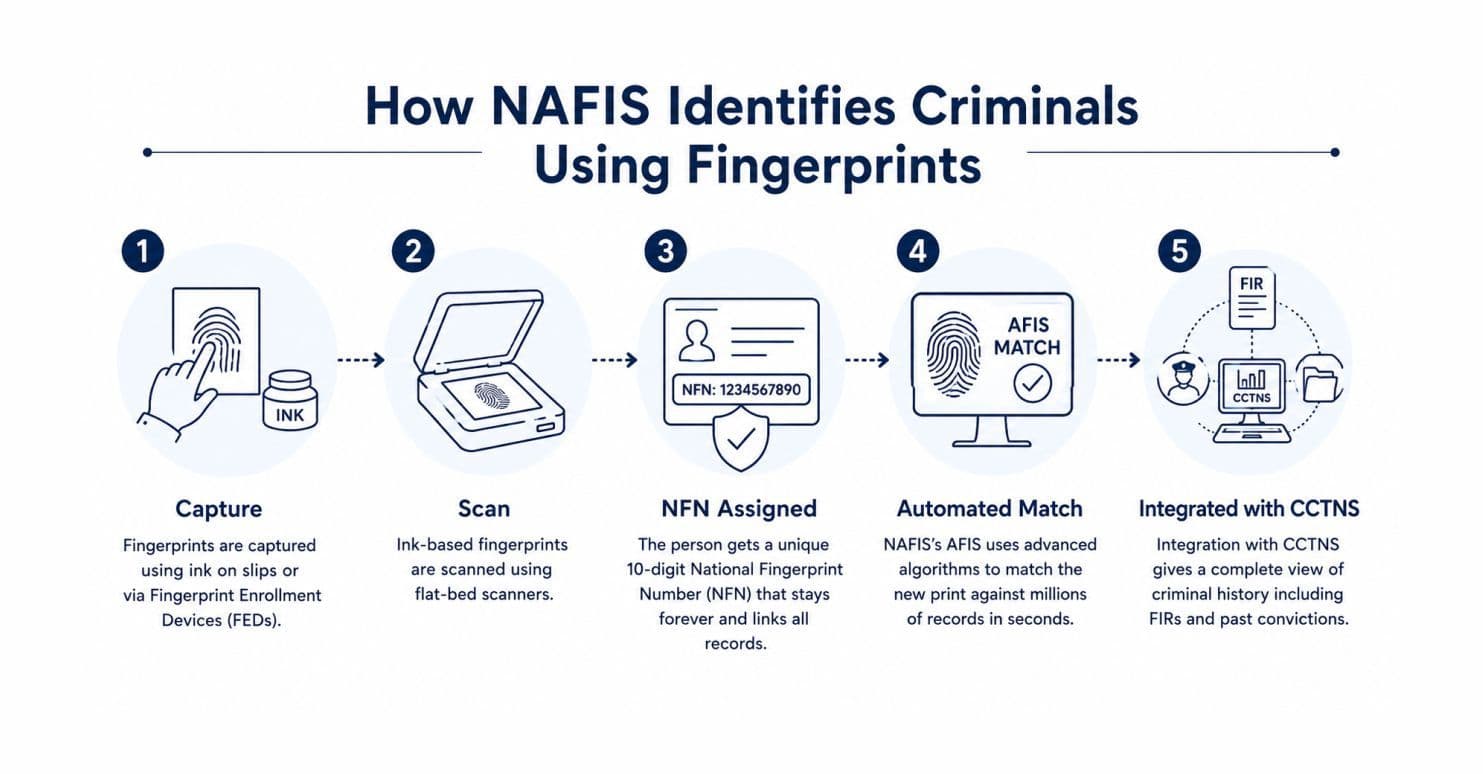
NAFIS was introduced by the NCRB with the aim of building a centralized, searchable criminal fingerprint database that law enforcement agencies across the country could access through workstations in real time for investigation purposes. The system automated important parts of the fingerprint management process, including fingerprint capture, enrollment, storage, retrieval and matching. This significantly improved the speed and efficiency of criminal identification/investigation while also improving the trace percentage of fingerprint records.
NAFIS has had a meaningful and lasting impact on how criminal cases are investigated and resolved across the country.
As a centralized repository of criminal fingerprint data, the system allows states, union territories, and central law enforcement agencies to quickly identify suspects from chance prints found at crime scenes. What would have earlier taken days or weeks through manual searches can now be done in a fraction of the time, directly improving the chances of solving cases.
Some more major improvements seen under the NAFIS system are:
Faster identification through chance fingerprints. Since criminal fingerprint records are available in a single national database, investigators can now search fingerprints in real time, helping them identify suspects more quickly from chance prints found at crime scenes.
Addressing interstate crimes. Criminal networks usually operate across state borders, which made tracking them difficult when each state maintained its own isolated records. NAFIS’s single and nationally connected database helps identify individuals with criminal records across different states much more easily. For example, a police officer in Kerala can instantly check if a suspect has a criminal record in Punjab.
Reopening of closed cases. Those unresolved cases with preserved fingerprint evidence can now be matched against the national database, giving investigators a renewed opportunity to find leads that were not available earlier.
Better support for court proceedings. Since fingerprint matching has become quicker and more reliable under NAFIS, investigators can present stronger forensic evidence in court. This helps speed up trials and improves the chances of successful convictions in criminal cases.Fingerprint analysis is no longer limited to simple identification. It now is a tool for deeper forensic examination, improving both the accuracy and the methods used in criminal investigations over time.
There is another small yet powerful improvement to note - the deterrence effect. When people are aware that their fingerprints can be easily matched to past crimes, it naturally discourages unlawful activity.
The ability to identify criminals and security threats accurately and without delay has directly contributed to a broader sense of public safety. NAFIS, in this sense, is a system that supports the well-being of communities at large
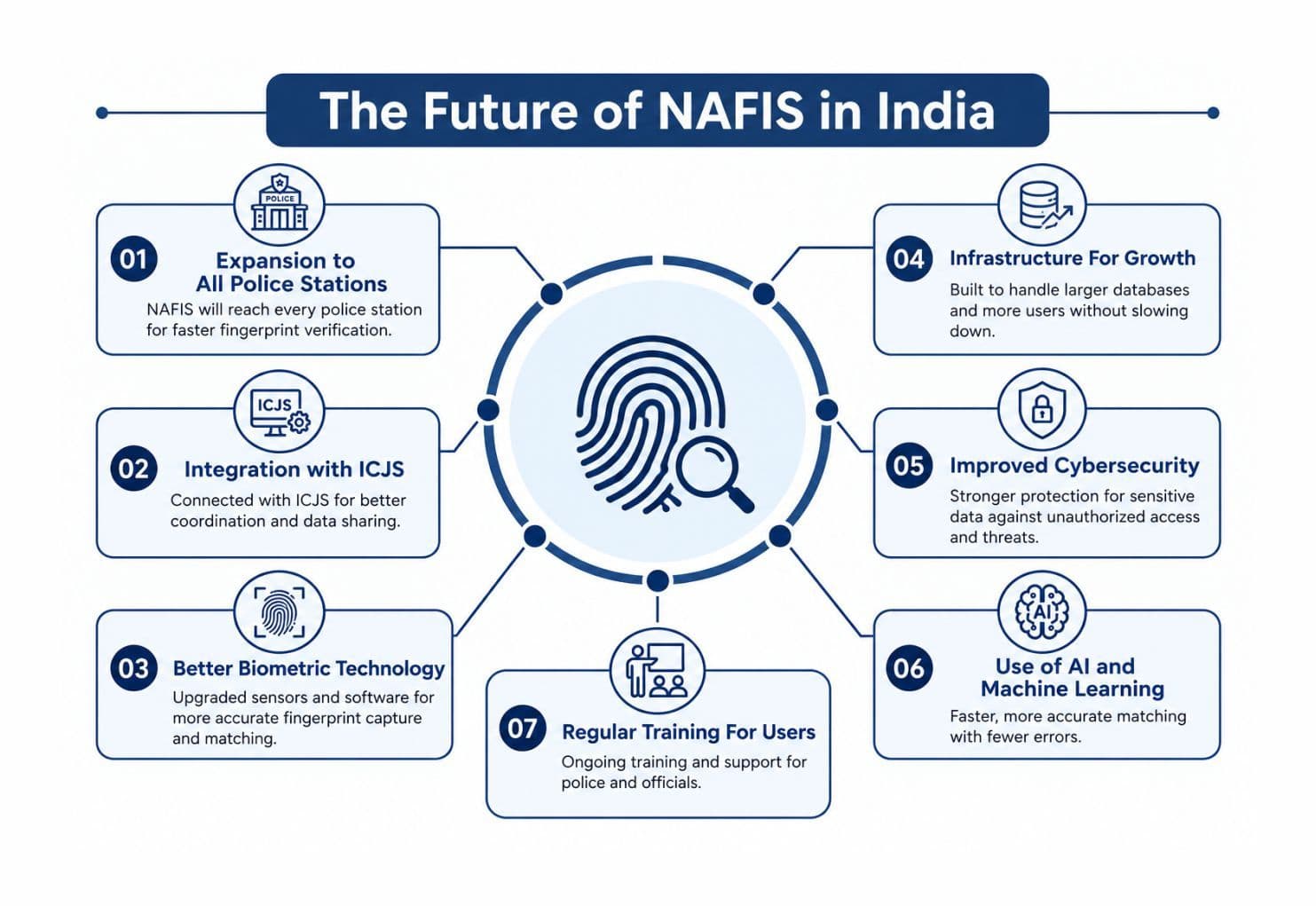
NAFIS is still growing, and several developments are planned to make the system more capable and wide-reaching in the years ahead.

