
A fingerprint card, as the name suggests, is a physical document onto which a person's fingerprints are captured. It is printed on heavy cardstock to prevent ink smudging. Any basic or standard fingerprint card provides fields for ten rolled impressions, flat impressions, and personal data like name, DOB, citizenship, signature, etc. Once completed, the card is signed and quality-checked by the technician, then submitted to the respective fingerprint repositories, depending on the document or process for which the prints were taken.
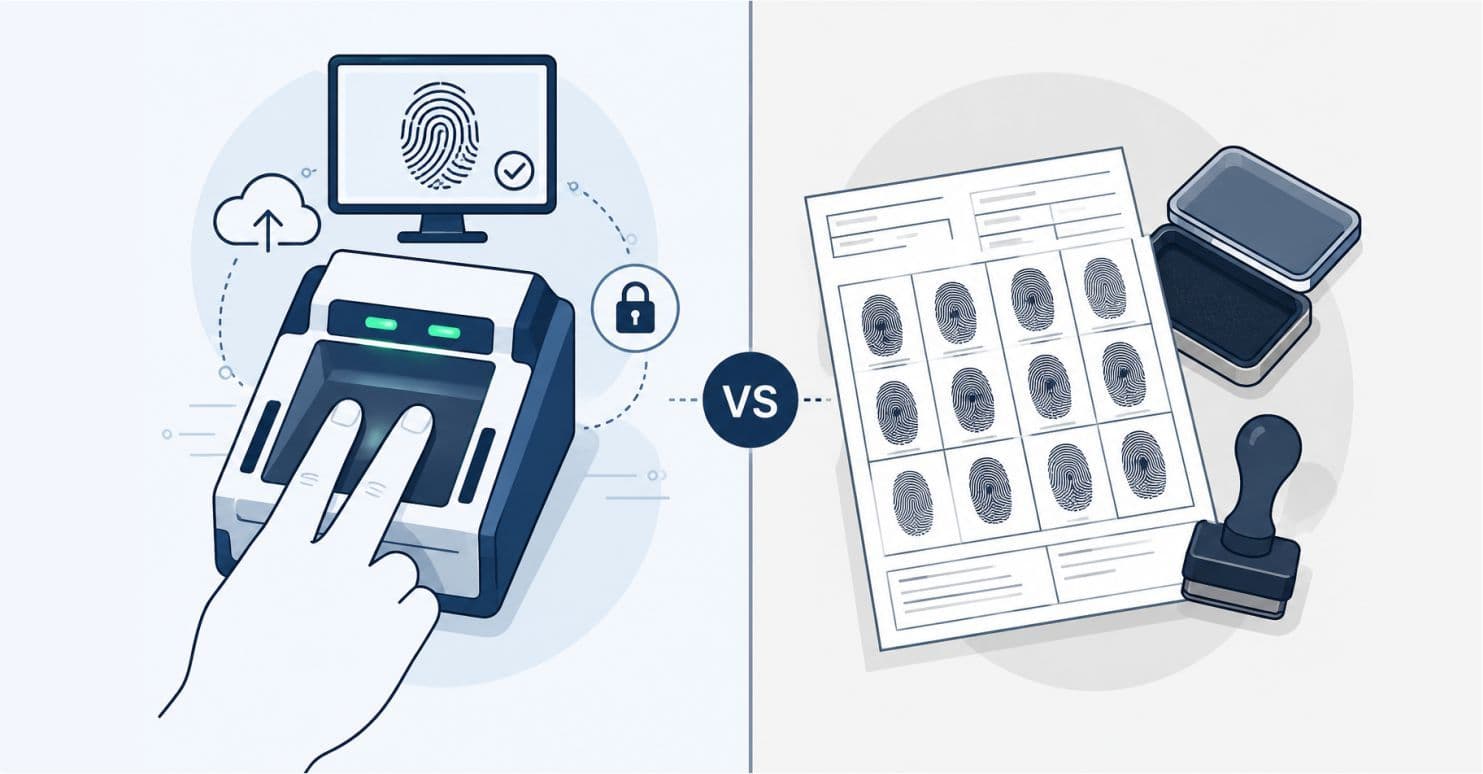
Fingerprints in India are captured using two main methods: ink-and-roll and digital live scan. The process and involvement of fingerprint cards in both is a bit different:
In India, fingerprinting cards are mainly used for three major purposes: maintaining criminal records, police verification, and international background checks. For local Police Clearance Certificates (PCCs), fingerprints are usually captured digitally using a live scan device, and applicants are not given any physical fingerprint card. This process is similar for other processes where fingerprints are required, such as Aadhaar enrollment, passport, buyer/rental agreements, adoptions, etc.
At police stations, fingerprints may also be collected using the NCRB Fingerprint Form for criminal identification and enrollment into the NAFIS database. However, if you need a background check for another country for purposes such as immigration, employment, licensing, or PR, standardized international fingerprint cards have to be used.
| Fingerprint Card | Purpose |
| FD-258 or FD-1164 | FBI background checks, FINRA licensing |
| C-216C | RCMP criminal record checks, Canada PR and citizenship applications |
Since local police stations in India often do not provide international fingerprinting services on foreign cards, you can get them from third-party vendors or international fingerprint service providers in India.
While fingerprint cards handle the collection side, there is a bigger question worth understanding: how are millions of fingerprint records actually organised and searched? Without a classification system, finding a single match among billions of records would be impossible.
India's fingerprint classification is built on the Henry Classification System, which remains the foundation of how fingerprint records are organized in this country.
The starting point of the Henry system is the observation that all fingerprint patterns fall into one of three broad categories: loops, whorls, and arches. These shapes are determined by the way the ridges on your skin flow. Every finger, when examined, will show one of these three pattern types, and the combination across all ten fingers determines how the record is classified.
Loops
This is the most common pattern, found in about 60-70% of Indians. In a loop pattern, the ridges enter from one side of the finger, curve around, and exit from the same side they started. The pattern has a single recurving structure and a core at its centre.
Whorls
This pattern can be found in around 25-35% of fingerprints. You must’ve seen circles, spirals, or tiny whirlpools on the fingertip. They’re whorls. And unlike loops, they do not have ridges that enter and exit from the same side.
Arches
Arches are the rarest type, appearing in only about 6-7% of the population. In an arch pattern, the ridges enter from one side and flow out the other side, rising slightly in the middle like a small hill or a wave. There is no recurve, no delta, and no core in the way those features appear in loops and whorls.
Now, any person, even a trained technician, would find it very hard to manually identify and classify fingerprints based on the prints alone. To simplify this, the Henry Classification System was developed.
Under this system, each finger is assigned a number based on its pattern (1 through 10, starting from the right thumb) and a potential point value, producing a fraction like 17/1 that narrows down a search before individual ridge comparisons begin. Before digital scanners, this system allowed a technician to narrow down a search from thousands of records to just a handful in minutes. Today, while NAFIS handles matching digitally, the Henry system's logic still underlies how fingerprint records are structured and retrieved across India.

