
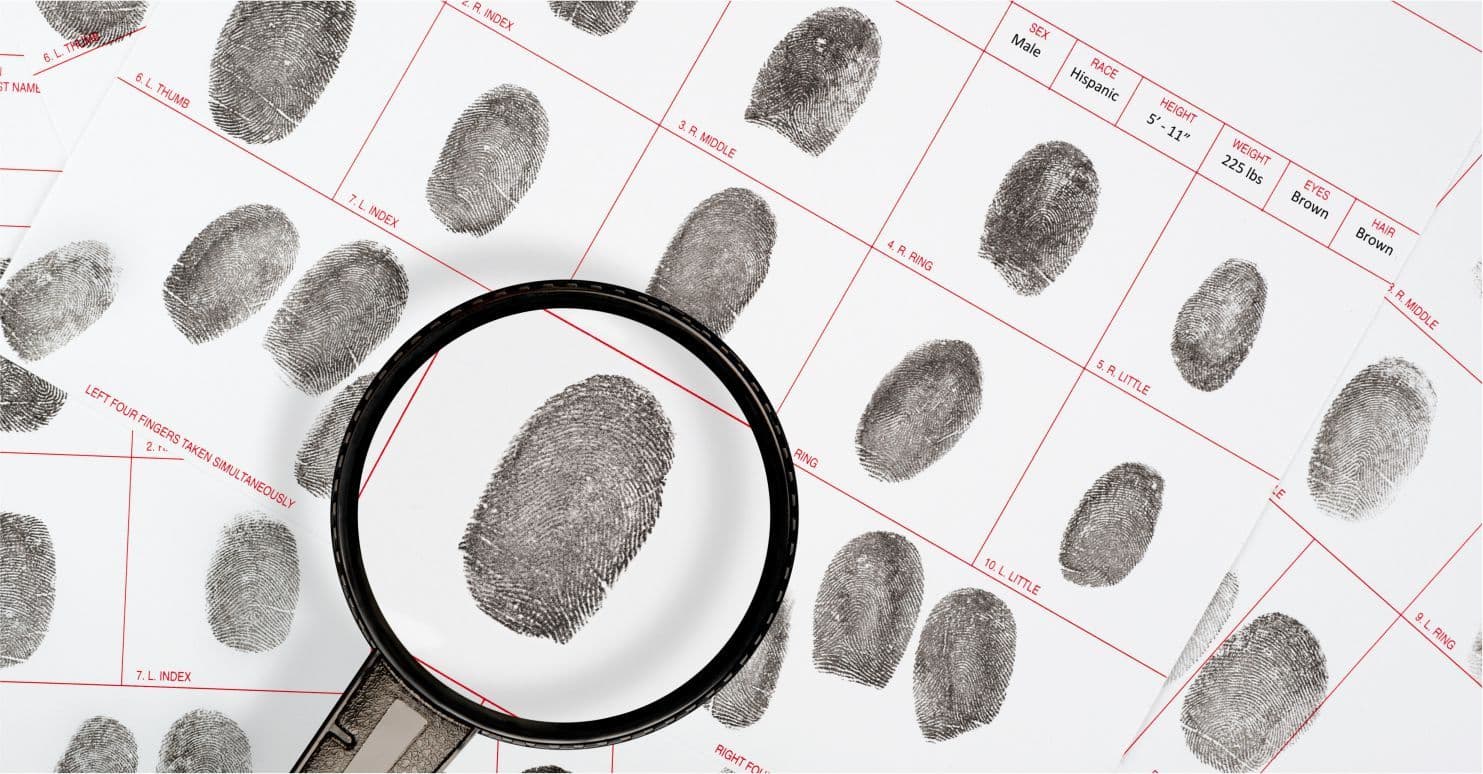
Long before fingerprints became a tool for catching criminals or verifying identities for Aadhaar and Passport, the idea that every individual has unique fingerprint patterns already existed in ancient Indian thought and traditions. Whether in ancient scripture, on royal treaties, or in the records of colonial administrators, India's relationship with fingerprinting dates back to centuries. We usually think of fingerprinting as a modern police tool, but India was actually the birthplace of the world’s first official fingerprint bureau. Today, fingerprint identification in India has become fully digital and touches nearly every aspect of civil life, making it one of the most widely used tools for establishing who a person is.
Below is the timeline that traces the entire journey of Fingerprinting in India, from its earliest philosophical roots all the way to the digital databases:
The story begins with the Samudra Shastra, an ancient Indian scripture authored by Samudra Rishi. Although the text was primarily concerned with astrology and the reading of a person's character, it contained very detailed observations about fingerprint patterns. The scripture identified three types of patterns on the fingertip: "sankhas," "chakras," and "seeps," which are similar almost exactly to what modern science calls loops, whorls, and arches.
The text went even further, noting finer details within these patterns, like "apuran java," "puran java," "padam," and "aax," terms that align with what forensic scientists today call forks, lakes, hooks, and islands. His work reflects a clear and early understanding that every individual's fingerprints are unique.
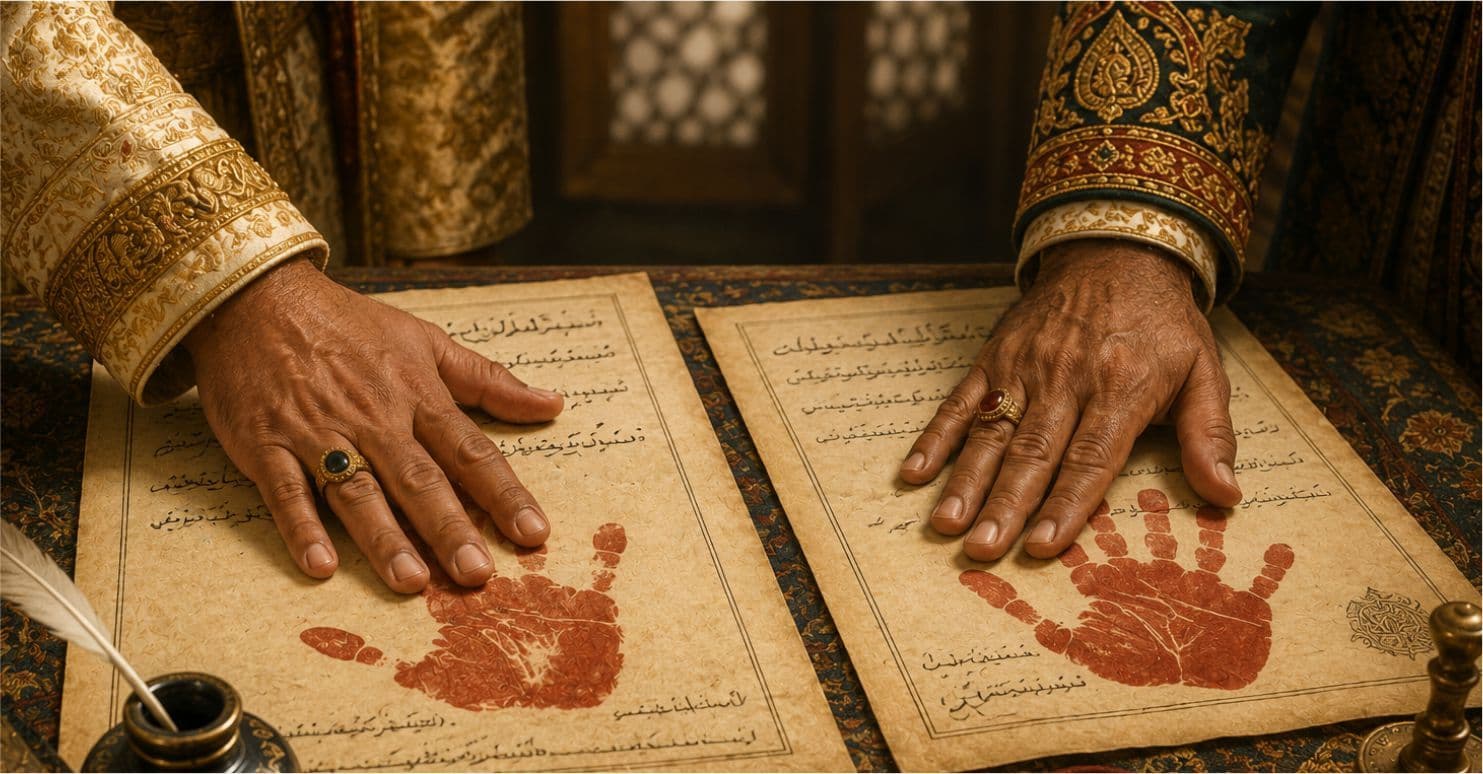
During the medieval period, handprints were used as a powerful symbol of authority and personal commitment. Ordinary documents were signed in the usual manner with a pen, but when something very important was being decided, such as a royal edict or a peace treaty, a handprint was used instead.
Mughal Emperor Shah Jahan used his handprints to show royal favor. Defeated rulers such as Shahuji Bhosle and Amar Singh Sisodia were required to provide handprints onto treaties as a formal sign of submission to the Mughal throne. This tradition carried forward into the 19th century as well, with Maharaja Ranjit Singh leaving his handprint on an important treaty. At that time, the handprint was not yet a forensic tool but it was already serving as a meaningful form of personal identification.
The practical use of fingerprints began in 1858 with Sir William Herschel, a British administrator working in the Hooghly district of Bengal, India. When dealing with a local contractor named Rajyadhar Konai, Herschel asked him to press his handprint onto their contract as a form of authentication. Curious about what he'd stumbled on, he kept going.
Herschel began exploring fingerprints as a way to prevent fraud in government dealings. He introduced a system where government employees and pensioners had their thumb impressions recorded, ensuring that pensions and payments reached the right people. He also made it a requirement for individuals to include their fingerprints on legal documents.
By 1877, the practice had expanded. In Hoogly, near Calcutta, fingerprints were being used on contracts, legal documents, and pension records as a matter of standard procedure. This helped ensure that government pensions were only collected by the rightful recipients, even after the original pensioner had passed away.
In 1897, the Bengal Fingerprint Bureau was established in Calcutta's Writer's Building, becoming the first fingerprint bureau anywhere on the globe. Its purpose was to bring consistency and scientific rigour to the entire process of fingerprint work, covering the recording, detection, classification, development, and preservation of fingerprint evidence.
Two Indian police sub-inspectors, Khan Bahadur Azizul Haque and Rai Bahadur Hem Chandra Bose, played an important role in advancing fingerprint science during this period.
Hem Chandra Bose created a more detailed way of organizing fingerprint patterns, along with a system for sending fingerprint information through telegraph messages and a method for classifying fingerprints using single digits.
Azizul Haque developed a mathematical formula that helped Sir Edward Henry create a practical system for sorting fingerprint records based on their patterns. This eventually became known as the Henry Classification System, which went on to be adopted by police forces around the world.
The development of fingerprint records continued rapidly even after India gained independence.
In 1955, the Central Fingerprint Bureau was established in Calcutta. Initially, the bureau operated under the Intelligence Bureau. It was later transferred to the Central Bureau of Investigation (CBI). In 1986, the bureau came under the control of the National Crime Records Bureau (NCRB) and was moved to New Delhi.
The bureau became the central authority for fingerprint data collection, criminal identification, and forensic support across India.
As the years went by, India moved away from paper-based fingerprint records to advanced digital databases. Today, fingerprint identification in India is managed through the National Automated Fingerprint Identification System (NAFIS), operated by the Ministry of Home Affairs under the NCRB. This is a massive, country-wide database that allows police from different states to share and search fingerprint records instantly. India didn't adopt fingerprint science. It invented the modern version of it.

